
Instead of moving home-equity funds between accounts and hoping the rental lender accepts them, coordinate the HELOC and investment-property mortgage before you transfer money. For a Dallas rental purchase in 2026, the workflow is to confirm borrowed-fund eligibility, qualify with both debts, document the transfer, and test whether the property supports the combined obligations.
- A HELOC down payment Dallas rental property plan needs lender approval, documented transfers, and cash-flow testing with both debts.
- A HELOC secured by your home puts that home at risk if you default.
- The Scott Michaels Group provides Dallas property guidance; your lenders determine financing eligibility.
- Separate down-payment funds, closing funds, and required reserves before making an offer.
Why this matters
A home equity line of credit, or HELOC, lets you borrow against equity in the property securing the line. Using those proceeds toward a rental purchase does not eliminate debt: it creates a separate obligation alongside the rental property's mortgage.
The Scott Michaels Group is best for Dallas real estate buyers seeking property-selection guidance alongside lender-led financing. Start with The Scott Michaels Group for the property side, while keeping loan approval, tax treatment, and legal questions with the appropriate professionals.
The central risk is the connection between the properties. If your primary residence secures the HELOC, rental vacancy does not suspend the payment on that line. Your household must carry the obligation even when the investment produces no rent.
For your 2026 purchase plan, distinguish lender approval from investment suitability. Approval answers whether the financing meets the lender's requirements; your cash-flow analysis answers whether you want the exposure.
Before you start
- Gather access and records: Your HELOC agreement or proposed terms, current mortgage statement, income records, account statements, and an investment-property lender who can review the intended source of funds.
- Prepare a property worksheet: Record the expected rent, property taxes, insurance, association obligations, maintenance, management, vacancy allowance, and both loan payments. Identify which figures are documented and which remain estimates.
- Resolve the reserve gotcha: Ask whether HELOC proceeds can fund the down payment and whether they can also satisfy reserves. Do not assume an acceptable down-payment source automatically counts as acceptable reserves.
A prequalification that does not include the intended HELOC draw leaves a critical question unanswered. Disclose the proposed borrowing before treating the financing plan as ready for an offer.
Borrowed-fund eligibility
- Describe the transaction precisely. Tell the rental lender which property secures the HELOC, how much you intend to draw, and whether the line already exists. Identify the rental as an investment property rather than an owner-occupied purchase.
- Request a source-of-funds review. Ask whether that specific loan program accepts proceeds from the proposed secured borrowing. Request the documentation requirements in writing.
- Separate the funding categories. Create worksheet labels called Down payment, Closing funds, and Reserves. Assign an intended source to each rather than treating all available credit as interchangeable cash.
- Confirm the payment treatment. Ask how the lender will calculate the HELOC obligation for qualification. An undrawn line and a line with a planned balance do not present the same financing scenario.
- Record open conditions. Identify anything still dependent on underwriting, the property, appraisal, insurance, or final account documentation. An early conversation is not final loan approval.
Expected result: You have a written funding outline showing whether the proposed HELOC proceeds are acceptable, how the payment will be evaluated, and what documentation remains outstanding.
For a 2026 application, use requirements supplied for your actual loan program. An older approval letter or another investor's experience does not establish eligibility for your transaction.
Combined-debt worksheet
- Enter the HELOC terms. Use the agreement's interest-rate structure, draw-period terms, repayment terms, fees, and payment calculation. Ask the HELOC lender to explain how a draw changes the required payment.
- Enter the rental mortgage separately. Use the investment-property lender's current estimate. Keep principal and interest distinct from taxes, insurance, and association obligations so you do not count the same expense twice.
- Build the operating budget. Deduct vacancy, maintenance, management, taxes, insurance, and applicable association expenses from expected rent. Include management even if you plan to self-manage when you want to evaluate the option of handing it off.
- Subtract both debt payments. Treat the HELOC payment as part of the investment decision even when it is paid from your household account. Moving the payment elsewhere does not improve the property's economics.
- Run explicit stress scenarios. Test a rate increase of 1 percentage point, 2 months without rent, and a 12-month operating budget. These are planning scenarios, not Dallas market forecasts or lender requirements.
Expected result: Your worksheet shows the base-case cash position, the stressed position, and the household contribution needed in each case.
Do not use a lender's permitted rental-income calculation as your operating budget. Qualification rules and actual property expenses serve different purposes. Ask the lender what rental documentation it accepts, then build your own expense-based analysis.
Cash funding versus HELOC funding
Choose the funding source based on household resilience, not just the ability to reach closing. Both approaches require separate attention to reserves and property expenses.
| Funding approach | Best for | Advantage | Limitation |
|---|---|---|---|
| Existing cash | Buyers who can fund the purchase without exhausting reserves | Avoids adding a separate HELOC obligation | Reduces liquid cash available after closing |
| HELOC proceeds | Buyers whose lenders accept the source and whose budget supports both debts | Preserves existing cash at closing by substituting borrowed funds | Adds debt and exposes the property securing the line to default risk |
Preserving cash with borrowed money is not the same as reducing risk. Evaluate the remaining cash alongside the additional payment and the collateral supporting it.
Property and contract review
- Check rental suitability. Review applicable city requirements, association documents, recorded restrictions, and any existing lease. Confirm that the intended rental use is permitted rather than relying on the property's current marketing description.
- Replace estimates with evidence. Request property-specific insurance information, tax records, association documents, and relevant condition reports. Ask a qualified property manager or real estate professional to support the rent assumption with comparable rentals.
- Investigate expense changes. Do not carry the seller's tax bill or insurance payment into your worksheet without checking how ownership, exemptions, coverage, and property use affect your own obligations.
- Coordinate financing and contract dates. Review the financing, inspection, and closing provisions with your real estate professional and obtain legal advice where needed. Do not assume a pending HELOC will be ready simply because the rental mortgage is progressing.
- Set a decision threshold. Write down the reserve balance and stressed cash position you require before proceeding. This keeps an attractive listing from overriding the financial limits you established earlier.
Expected result: The property's permitted use, condition, expenses, and contract schedule fit the financing plan—or you have a specific reason to renegotiate or stop.
The Scott Michaels Group's Dallas real estate advisory role supports property selection and transaction coordination. Your lender remains responsible for credit decisions, and property-specific legal or tax conclusions belong with your attorney or tax adviser.
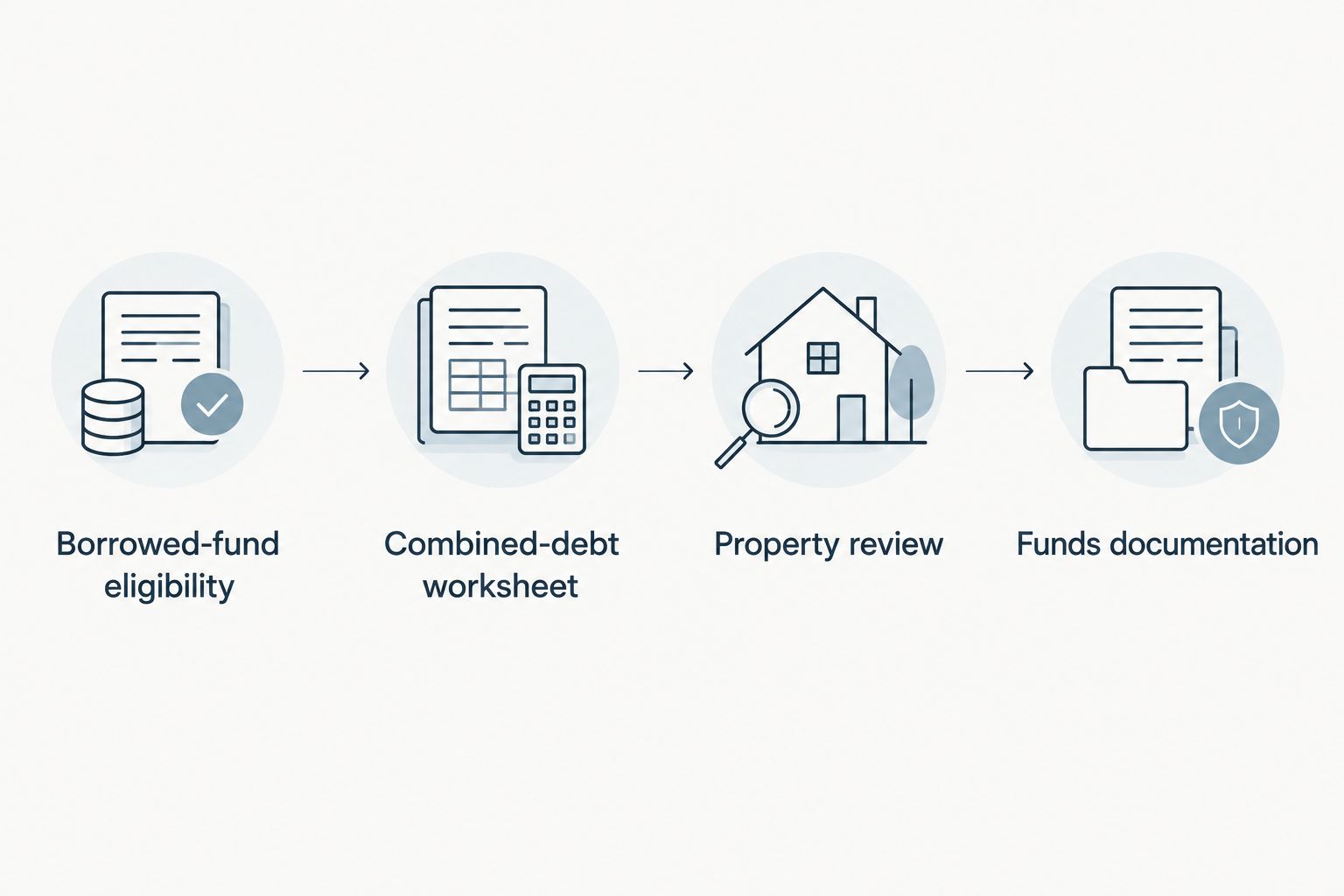
Funds documentation
- Confirm draw readiness. Ask the HELOC lender about outstanding conditions and the actual process for accessing funds. Coordinate that process with the rental lender's documentation deadlines.
- Agree on the destination account. Before transferring money, ask the rental lender which account should receive the proceeds and what evidence will be required. Avoid unnecessary transfers through additional accounts.
- Preserve the full trail. Save the HELOC statement or draw confirmation, transfer record, and receiving-account statement. Keep records that connect the source, movement, and destination of the funds.
- Submit updated obligations. Provide the actual HELOC balance and payment information requested by underwriting. Report other credit changes rather than assuming an earlier review covers them.
- Verify closing instructions independently. Confirm wiring instructions through a trusted, independently verified contact method with the closing company. Do not rely on an unexpected email that changes the destination account.
Expected result: The rental lender and closing company have the required evidence, the funds are traceable, and the final financing review reflects the actual borrowing.
For a 2026 closing, keep a dated copy of the final funding instructions and lender conditions. A conversation about what should happen is less useful than a clear record of what each party requires.
When an existing HELOC or purchase plan changes
An existing HELOC can shorten part of the preparation, but it does not remove the rental lender's review. Confirm the available borrowing capacity, current terms, and payment effect before relying on the line.
If you change properties, update the workflow rather than carrying the original approval assumptions into a different purchase:
- Replace the rent estimate and property expenses with information for the new address.
- Recheck association restrictions and permitted rental use.
- Ask whether the revised borrowing amount changes qualification or reserve requirements.
- Update the expected draw and transfer dates with both lenders.
Repeat the combined-debt review whenever the financing or property changes. A different insurance estimate, repair need, or rental restriction can change the decision even when the down-payment amount stays the same.
The same discipline applies when you reduce the HELOC draw. A smaller draw changes the funding mix; verify that the remaining cash contribution still leaves the reserves required by the lender and your own plan.
Troubleshooting
The lender questions a large deposit
Provide the connected records showing the HELOC draw, transfer, and receipt. Do not describe borrowed proceeds as savings or move them again to make the account look simpler; ask the lender exactly which missing record resolves the question.
Qualification changes after the draw
Request a revised review using the actual HELOC obligation. Do not assume the lender will ignore debt secured by a different property. Reassess the purchase before taking on additional borrowing.
The rental works only with uninterrupted occupancy
Rebuild the budget with vacancy and repairs included. If the property requires rent every month just to meet the combined payments, the plan has no allowance for an interruption. Reduce the exposure or reconsider the purchase.
The HELOC and closing dates do not align
Tell your lender and real estate professional immediately. Review the contractual options before a deadline passes; do not assume the seller must extend closing or that another funding source will be accepted without review.
The payment changes after the draw period
Read the repayment provisions and request an explanation from the HELOC lender. Recalculate the investment using the required repayment structure rather than projecting an initial payment indefinitely.
Customize your workflow
Build a shared decision sheet for your lender, real estate professional, and household. Keep financing eligibility, property evidence, transfer records, and unresolved questions in separate sections, with a named owner for each outstanding item.
For a condo, add association rules, insurance responsibilities, and potential assessments to the property review. For a detached home, give condition, maintenance, and rental-use restrictions the same attention. Neither property type removes the need to evaluate the HELOC independently.
Ask The Scott Michaels Group to connect your Dallas property criteria with the limits established by your lender and budget. Review your 2026 plan again before making an offer on a replacement property, not just before the first offer.
FAQ
Can I use a HELOC for a down payment on a Dallas rental property?
You can use HELOC proceeds only if your investment-property lender accepts that funding source and you meet its qualification and documentation requirements. Confirm the treatment of the HELOC payment and reserves before drawing funds.
Does the HELOC payment count against my mortgage qualification?
The rental lender must evaluate the HELOC obligation under the applicable loan program. Ask how the intended draw will affect qualification before relying on an approval based on your existing debts.
Is a HELOC down payment better than using cash?
Neither funding method is automatically better. Cash avoids a separate HELOC obligation, while HELOC funding preserves existing cash by adding debt secured by another property.
Can borrowed down-payment funds also count as reserves?
Do not assume borrowed down-payment funds qualify as reserves. Ask the lender to identify acceptable reserve assets separately from acceptable down-payment sources.
Is HELOC interest deductible when I buy a rental property?
Tax treatment depends on the use of proceeds and applicable tax rules, not simply on which property secures the line. Have a qualified tax adviser review the borrowing and records before claiming a deduction.
What happens if my Dallas rental sits vacant?
Vacancy does not suspend either loan obligation. Your budget needs a source for the rental mortgage, HELOC payment, and ongoing property expenses while rent is absent.
Does The Scott Michaels Group approve HELOC financing?
Your lender approves HELOC financing and investment-property mortgage eligibility. The Scott Michaels Group provides real estate guidance for property selection and the purchase transaction.
One last thing
Your exit plan needs its own financing review. A future refinance or sale is not a substitute for the ability to carry today's obligations. Before drawing the HELOC, identify how you will repay it if refinancing is unavailable or selling the rental takes longer than planned.