The down payment needed to buy a home in Texas can be as little as 3% with an eligible conventional mortgage in 2026, while qualifying VA and USDA borrowers can buy with no down payment and FHA borrowers can qualify with 3.5% down. Your down payment is not your total cash requirement: closing costs, prepaid taxes and insurance, and any lender-required reserves need separate attention.
- The down payment needed to buy a home in Texas depends on mortgage eligibility, not a statewide minimum.
- Eligible conventional mortgages allow 3% down; FHA allows 3.5% with a credit score of at least 580.
- VA and USDA loans allow eligible borrowers to finance without a down payment, subject to program and lender requirements.
- A 20% conventional down payment generally avoids private mortgage insurance, but it is not a universal buying requirement.
Why this matters
Waiting until you have 20% saved is not the only path to a Texas home. The better question is which mortgage leaves you with an affordable payment and enough savings after closing.
For Plano and North Dallas buyers, The Scott Michaels Group provides real estate guidance alongside your lender's financing assessment. Set the financing boundaries before choosing homes; a property's eligibility and your cash position both affect whether an offer works.
How much down payment do you need to buy a home in Texas?
Texas does not impose one universal mortgage down payment percentage. Your loan program, borrower qualifications, property, and lender determine the requirement.
Use these established program baselines when discussing a 2026 purchase with a lender. A program minimum is a starting point, not a promise of approval.
| Mortgage option | Down payment baseline | Best for | Main advantage | Main limitation |
|---|---|---|---|---|
| Eligible conventional low-down-payment programs | 3% | Qualified buyers preserving cash | Lower upfront down payment | Program restrictions apply; private mortgage insurance is generally required below 20% down |
| FHA | 3.5% with a credit score of at least 580 | Buyers considering FHA's credit framework | Published low-down-payment eligibility | Upfront and annual mortgage insurance apply |
| FHA with qualifying lower credit | 10% with a credit score from 500–579 | Buyers whose lender accepts this credit range | FHA rules provide a lower-credit pathway | Lenders can impose stricter standards |
| VA | 0% for eligible borrowers, subject to entitlement and lender requirements | Eligible veterans, service members, and qualifying surviving spouses | No monthly mortgage insurance | Eligibility rules apply; a funding fee generally applies unless exempt |
| USDA guaranteed | 0% for eligible borrowers and properties | Income-qualified buyers purchasing in eligible areas | No required down payment | Income and geographic restrictions apply; guarantee fees apply |
| Conventional with a larger contribution | 20% | Buyers prioritizing avoidance of private mortgage insurance | Generally avoids borrower-paid private mortgage insurance | Commits more cash to the property |
These baselines come from Fannie Mae and Freddie Mac conventional mortgage guidance, HUD's FHA Single Family Housing Policy Handbook, VA purchase-loan guidance, and USDA Rural Development's guaranteed-loan requirements. Your lender must confirm the rules and underwriting requirements applicable to your specific application.
Conventional mortgages: 3% down for eligible borrowers
Certain Fannie Mae and Freddie Mac programs permit a 3% down payment. Eligibility depends on the particular program; first-time-buyer status, income limits, homebuyer education, and occupancy requirements can matter.
Best for: qualified buyers who want to preserve cash without using a government-backed mortgage. Ask your lender to identify the actual program rather than simply describing an offer as conventional financing.
The advantage is straightforward: a smaller down payment keeps more savings outside the property. The trade-off is a larger loan balance, and conventional loans with less than 20% down generally require private mortgage insurance.
For a 2026 purchase, request a written comparison that includes principal and interest, mortgage insurance, property taxes, homeowners insurance, and applicable association dues. Comparing only the down payment leaves out the recurring obligation you will carry after moving in.
FHA mortgages: 3.5% down with qualifying credit
FHA permits a 3.5% down payment with a credit score of at least 580. FHA's published rules allow 10% down for scores from 500–579, although individual lenders can require higher scores or additional qualifications.
Best for: buyers whose credit and overall application fit FHA underwriting better than the conventional alternatives offered to them. FHA is not restricted to first-time homebuyers.
The benefit is a defined low-down-payment pathway. The limitation is mortgage insurance: FHA loans carry upfront and annual mortgage insurance, and the duration of annual mortgage insurance depends on the original loan-to-value ratio and loan term.
Do not choose FHA solely because the minimum sounds accessible. Have your lender compare FHA and conventional financing using the same property assumptions, then explain the differences in cash to close and ongoing obligations.
VA mortgages: 0% down for eligible borrowers
VA purchase loans can require no down payment for eligible borrowers when entitlement, the lender's requirements, and the transaction support it. A lender can still require a down payment in particular circumstances, including certain purchases involving remaining entitlement.
Best for: eligible veterans, service members, and qualifying surviving spouses evaluating an owner-occupied purchase. Obtain a Certificate of Eligibility and have your lender review entitlement before treating no-down-payment financing as settled.
VA loans do not require monthly mortgage insurance. A VA funding fee generally applies unless the borrower qualifies for an exemption, and other closing expenses still need to be addressed.
No down payment does not mean every property or purchase arrangement qualifies. A purchase above appraised value can also create a cash requirement that the mortgage does not cover.
USDA mortgages: 0% down for eligible purchases
USDA's Single Family Housing Guaranteed Loan Program permits no-down-payment financing for eligible borrowers buying qualifying properties. Household income, property location, and underwriting requirements determine eligibility.
Best for: income-qualified buyers whose preferred property falls within USDA's eligible geography. Do not assume a North Dallas address qualifies or fails based only on its city name; check the property's exact address through USDA's eligibility resources.
The advantage is preserving down payment cash. The limitations include geographic and income restrictions, plus upfront and annual guarantee fees.
USDA financing is therefore a property-and-borrower decision, not simply another payment percentage. Confirm both sides before investing time in a home search built around this program.
Conventional mortgages: 20% down to generally avoid PMI
A 20% down payment generally lets a conventional borrower avoid private mortgage insurance, or PMI. It also reduces the amount borrowed compared with a smaller down payment on the same home.
Best for: buyers who can make a larger contribution without exhausting their liquid savings. Avoiding PMI is useful, but preserving money for repairs, moving, and unexpected expenses also matters.
The trade-off is liquidity. Money committed to home equity is not the same as cash available in your bank account after closing.
For luxury purchases, do not assume that a particular down payment percentage guarantees jumbo approval. Jumbo lenders set their own credit, reserve, loan-size, and down payment requirements.
Why your Texas down payment requirement varies
A 2026 down payment decision depends on more than the state where you buy. These factors explain why two buyers considering the same property can receive different financing options:
- Loan program: Conventional, FHA, VA, and USDA financing use different eligibility and down payment rules.
- Credit profile: Credit history and score affect program eligibility, and lenders can apply standards stricter than a program's published minimum.
- Occupancy: Primary residences, second homes, and investment properties do not share identical financing requirements.
- Property eligibility: Location, property type, condition, and appraisal findings can affect which financing options work.
- Loan size and reserves: Larger loans and individual lender requirements can change the contribution and post-closing savings you need.
- Available funds: Documented savings, permitted gifts, and approved assistance affect how you meet the requirement; each funding source has rules.
A smaller down payment is not automatically the better choice. Choose the financing structure that works after closing, not just the one that gets you to closing.
How do you calculate the cash you actually need?
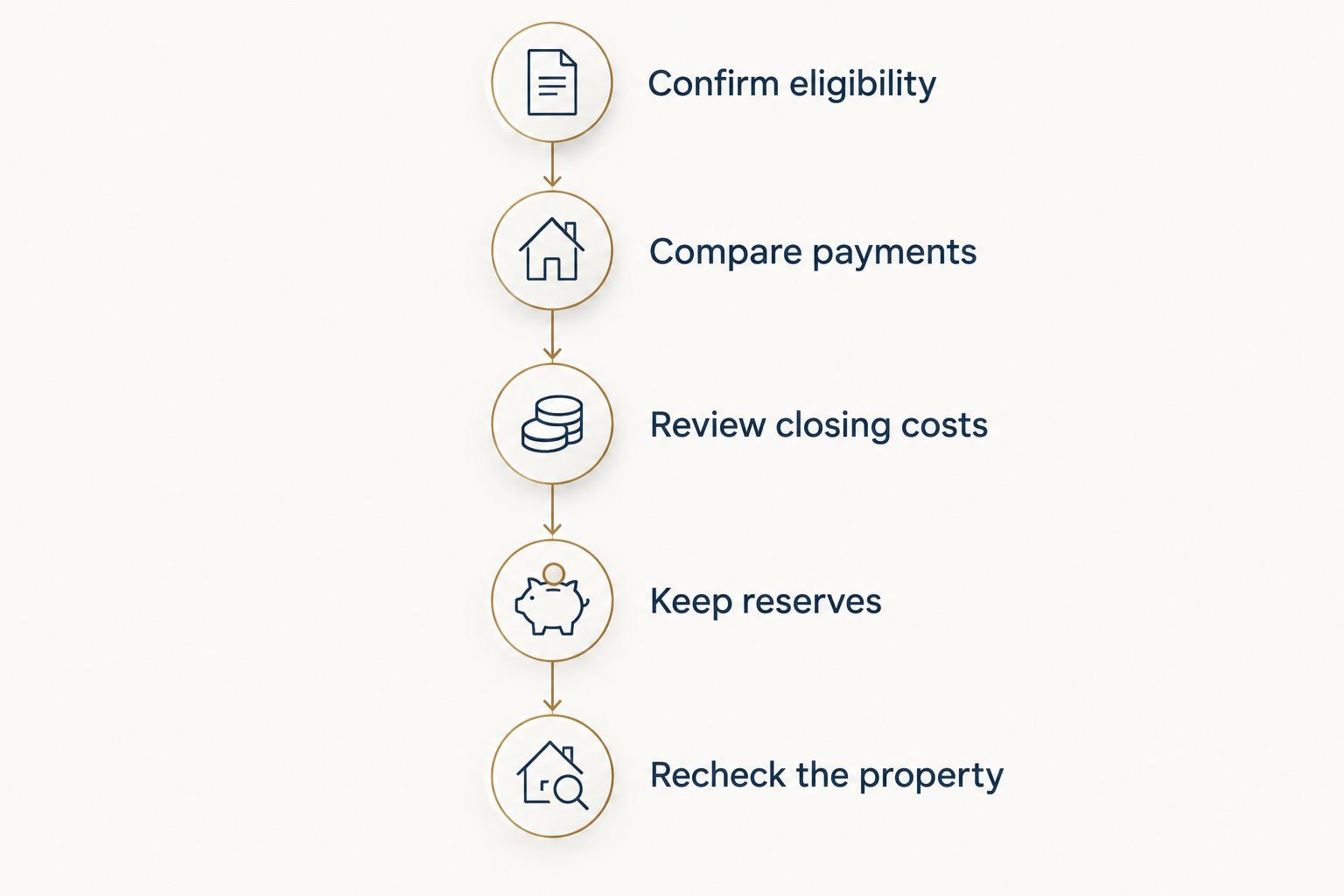
Build a cash-to-close estimate before deciding what you can offer. Your lender's Loan Estimate separates the down payment from other transaction expenses and shows estimated cash to close.
- Confirm eligibility. Ask which programs you qualify for and what documentation remains outstanding. A general online minimum is not an approval.
- Compare payments. Review the full housing payment, including mortgage insurance where applicable. Use consistent assumptions across loan options.
- Review closing costs. Account for lender and settlement charges, prepaid expenses, and escrow funding. Include any credits only when the lender confirms they are permitted.
- Keep reserves. Separate money needed for closing from savings you intend to retain afterward. Check whether the lender requires documented reserves.
- Recheck the property. Confirm that the selected home and contract terms fit the financing plan. Revisit the estimate when the property or loan terms change.
Earnest money also needs careful treatment. It is generally credited toward the transaction at closing rather than added again as a separate down payment, but contract terms control how the deposit is handled if the purchase does not close.
For a 2026 Texas purchase, review the timing of earnest money, any option fee, inspections, and appraisal charges with your agent and lender. Some expenses arise before closing, so a final cash-to-close figure does not describe every payment's timing.
Can you buy a home in Texas without 20% down?
20% down is not a universal requirement for buying a Texas home. Eligible conventional borrowers can put down 3%, FHA borrowers can qualify at 3.5%, and qualifying VA or USDA borrowers can have no down payment.
The right comparison includes mortgage insurance, the full payment, and retained savings. A smaller contribution buys flexibility upfront but leaves a larger balance to finance on the same purchase.
Can you buy a home in Texas with no down payment?
0% down is possible through VA and USDA financing when you and the property meet the applicable requirements. Closing expenses, prepaid items, and any appraisal gap remain separate considerations.
Down payment assistance is another subject to discuss with an approved lender. Assistance programs have their own eligibility and repayment conditions; do not treat assistance as unrestricted money or assume it applies to every loan.
Match the financing plan to the home search
The Scott Michaels Group is best for North Dallas buyers who want real estate advisory support alongside lender-led financing decisions. That support does not replace underwriting: your lender determines mortgage eligibility, while your agent helps connect the financing plan with the property search and purchase terms.
The Scott Michaels Group serves buyers across Plano, North Dallas, and surrounding communities. Bring a lender-reviewed budget, your preferred cash reserve, and your nonnegotiable housing needs so the search starts with clear boundaries.
Plan your North Dallas home search
Connect your lender-reviewed budget with your property priorities and purchase strategy.
FAQ
What's the minimum down payment for a first-time homebuyer in Texas?
Eligible conventional first-time buyers can qualify for 3% down, while FHA permits 3.5% down with a credit score of at least 580. Qualifying VA and USDA borrowers can purchase with no down payment; lender and program requirements still apply.
Do I need 20% down to buy a luxury home in North Dallas?
A 20% down payment is not a universal rule for North Dallas luxury homes. The required contribution depends on the loan amount, mortgage program, property, and lender; jumbo requirements are lender-specific.
Does putting 20% down remove all mortgage insurance?
A 20% down payment generally avoids private mortgage insurance on a conventional mortgage. FHA mortgage insurance follows separate rules, so do not apply conventional PMI assumptions to an FHA loan.
Can my family give me money for a Texas home down payment?
Permitted gift funds can help cover a down payment when the loan program allows them. Your lender must confirm eligible donors, documentation, and any borrower-contribution requirements before you rely on the gift.
Are closing costs included in my down payment?
Closing costs are separate from your down payment. Your Loan Estimate shows estimated cash to close, accounting for the down payment, transaction charges, deposits, and applicable credits.
Can seller concessions cover my entire down payment?
Seller concessions generally cannot replace the buyer's required down payment. They can cover permitted closing expenses within program limits, so have your lender review any proposed concession before negotiating it.
Who should help me choose a down payment amount?
Your mortgage lender should compare loan eligibility, payments, cash to close, and reserve requirements with you. The Scott Michaels Group can coordinate your home search and purchase strategy around that lender-reviewed plan.
One last thing
Ask for a comparison that holds the property constant and changes only the financing structure. Different tax, insurance, or association assumptions can make one mortgage look better without showing the true financing difference.
Before making a 2026 offer, decide what savings balance you want left after closing. Then choose a down payment that respects that boundary rather than treating the smallest permitted contribution—or the largest possible one—as the goal.