Yes—2026 is a good time to buy a home in Collin County, TX, if the full ownership budget fits your finances, the property meets your needs, and the contract protects your interests. That does not mean every listing is a good purchase: taxes, insurance, maintenance, financing terms, and property condition matter more than a countywide timing verdict.
- A good time to buy a home in Collin County TX depends on affordability, property condition, and your plans.
- Compare buying now, waiting, and renting against your actual housing needs—not predictions about mortgage rates.
- Evaluate Plano and North Dallas homes using comparable sales and property-specific expenses.
- The Scott Michaels Group offers real estate advisory for buyers seeking personalized guidance across North Dallas.
Is now a good time to buy a home in Collin County TX?
Buy when the home works under today's financing terms—not only under a hoped-for refinance. Your decision should survive an ordinary repair, an insurance renewal, and a change in your moving plans without depending on immediate appreciation.
Use these 3 tests before deciding whether to make an offer:
- Budget fit: Calculate principal and interest, property taxes, insurance, applicable association charges, maintenance, and cash needed at closing.
- Property fit: Confirm that the home's condition, location, layout, and restrictions support how you intend to use it.
- Exit fit: Consider what happens if you need to sell earlier than expected, including selling expenses and an uncertain resale value.
For personalized help applying those tests, The Scott Michaels Group provides buyer representation and real estate advisory across North Dallas. The advantage is property-specific guidance; the limit is that representation cannot eliminate ownership expenses or guarantee future value.
Why this matters
A countywide headline cannot tell you whether a particular Plano home is the right purchase. Your commute, cash reserves, financing, and the property's condition remain personal even when you and another buyer are considering the same neighborhood.
For your 2026 search, separate two questions: whether you are ready to own, and whether a specific seller offers acceptable terms. You can be ready to buy while still declining a particular home. That distinction keeps urgency from becoming an expensive substitute for judgment.
The strongest buying position is not simply having approval to borrow. It is knowing what you can comfortably carry, what you will not compromise on, and what evidence would justify your offer.
Should you buy now, wait, or keep renting?
There is no universally correct choice between buying and waiting. Each option solves a different problem and creates a different exposure.
| Option | Best for | Main advantage | Main drawback | Decision rule |
|---|---|---|---|---|
| Buy now | Buyers with a workable ownership budget and a home that fits | You can secure a suitable property without waiting for a forecast to come true | You accept ownership expenses and resale uncertainty | Proceed only when the property and contract pass your tests |
| Wait to buy | Buyers strengthening savings, credit, or financial clarity | You gain time to improve readiness | Future rates, home values, and selection remain uncertain | Name the specific condition that waiting must improve |
| Keep renting | Households prioritizing mobility or still choosing a location | You preserve flexibility before taking on ownership | You do not build equity through mortgage principal payments | Reassess when your location and ownership plans become clearer |
Waiting is useful when it fixes a defined problem. Waiting without a target simply replaces a purchase decision with an open-ended prediction.
If you choose to wait, write down your trigger: stronger reserves, a confirmed job location, a resolved credit issue, or a clearer household plan. Review that trigger rather than reacting to every mortgage-rate headline.
How do you check whether buying works for you?
Use a repeatable process before touring seriously. It lets you compare homes on the same basis instead of rebuilding your priorities around whichever listing you saw most recently.
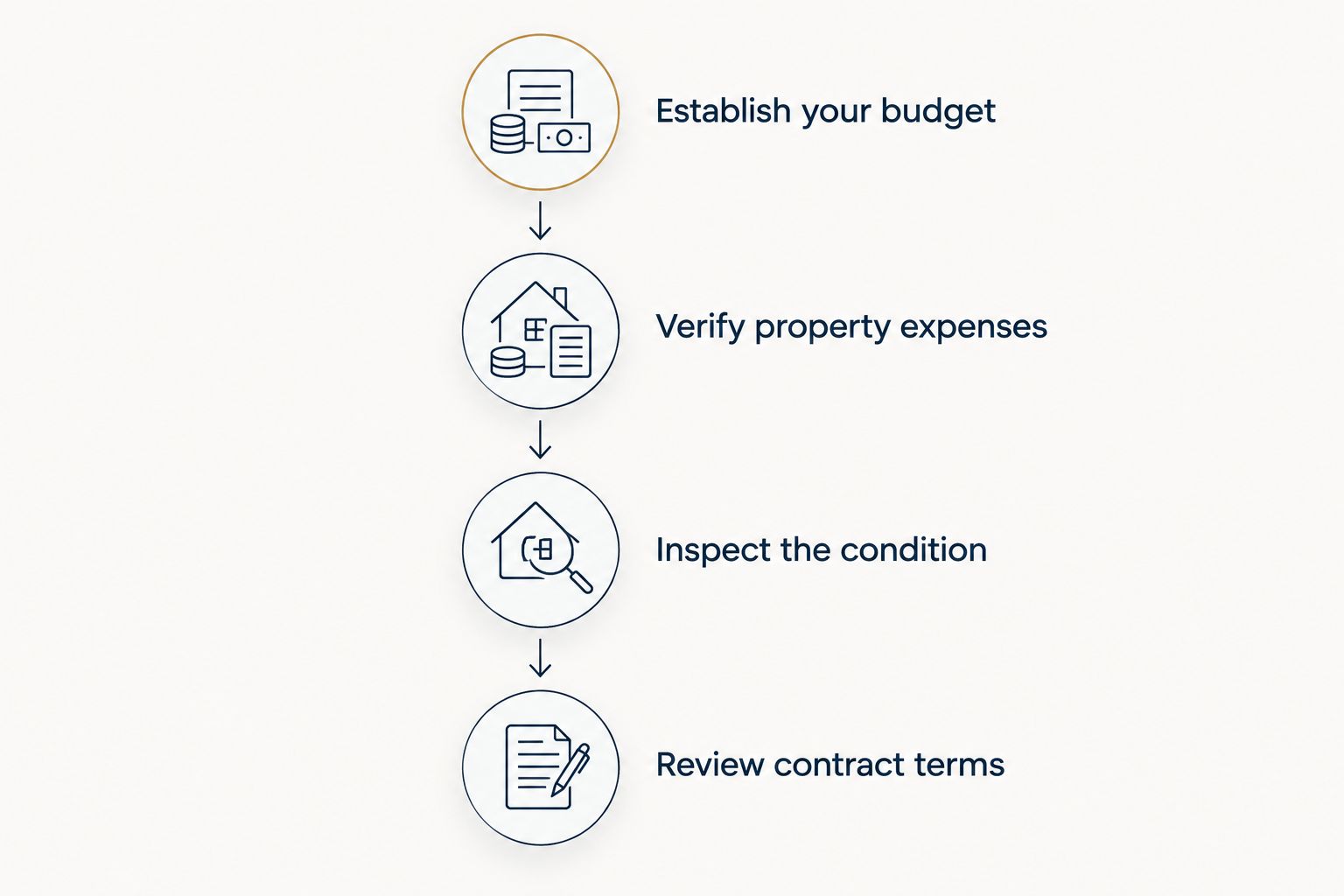
Establish your budget
Start with the monthly amount you are comfortable spending, not the largest loan a lender will approve. Then work backward using a current financing quote and property-specific expense estimates.
Separate recurring expenses from cash needed to complete the purchase. Down payment funds, closing expenses, moving costs, and money retained for repairs serve different purposes; spending one pool does not make the others disappear.
Verify property expenses
Review these 3 documents together: a lender's Loan Estimate, an address-specific insurance quote, and the property's tax record. Add association documents when the property belongs to an association.
A seller's current tax bill is not a promise of your future bill. Confirm how the property's assessed value, applicable exemptions, and taxing jurisdictions affect the estimate you use. Also ask the lender which expenses are included in the proposed payment and which you must budget separately.
Inspect the condition
Use inspections to identify defects and decide which findings require further specialist evaluation. A general inspection is not a guarantee that every hidden condition has been found.
Focus on findings that affect safety, insurability, financing, or significant repairs. Cosmetic preferences belong in your decision, but they should not distract from a roof issue, drainage concern, or unresolved repair history.
Review contract terms
Understand deadlines, deposits, financing provisions, and any inspection or termination rights before signing. Ask your agent to explain how the proposed terms apply to your purchase; direct legal questions to a qualified attorney.
The right house with unacceptable contract exposure is not automatically the right deal. Decide which protections you need before negotiations create pressure to give them up.
Why buying conditions vary across Collin County
Your buying decision depends on the address, not just the county. A useful comparison accounts for the differences that affect your daily life and the property's ownership obligations.
- Location and routine: Test the actual trip between the home and your regular destinations. A city name alone does not establish a workable commute.
- Property type: A detached home, condominium, and vacant parcel require different reviews. Compare the responsibilities attached to the property you intend to buy.
- Condition and upkeep: Recent improvements do not replace inspection evidence. Review what was completed, what documentation exists, and what remains your responsibility.
- Taxes and association obligations: Check the property's taxing jurisdictions, applicable exemptions, association charges, and governing documents rather than applying another home's assumptions.
- Financing and contract terms: Compare lender quotes on equivalent assumptions. Evaluate seller concessions, deadlines, and contingencies as part of the same transaction—not as isolated benefits.
For a 2026 purchase, use current documents attached to the home and your proposed loan. A payment estimate from an earlier search is not a reliable substitute when the property or financing assumptions change.
How can you tell whether a listing offers good value?
Judge value against comparable sales, verified condition, and your ownership budget—not the size of a price reduction. A listing can be reduced and still fail those tests.
Ask your agent to explain which closed sales support the proposed offer and why those properties are comparable. Location, condition, property type, lot characteristics, and sale timing all affect whether a comparison is useful.
Active listings show competing choices, but they do not establish what buyers have actually paid. Pending transactions also require care because their final terms are not necessarily public before closing.
Request a clear explanation of the differences rather than accepting an average without context. If a comparable property has a materially different condition or setting, the analysis should acknowledge that difference instead of treating every nearby sale as interchangeable.
Finally, separate market value from personal fit. A defensible offer does not make an unsuitable layout, location, or maintenance burden right for your household.
Should you wait for mortgage rates to fall?
Do not buy a home that requires a future refinance to become affordable. Refinancing requires a new lending decision and comes with transaction expenses; future eligibility and terms are not guaranteed.
Compare the financing available to you now with your comfortable budget. If the payment does not work, waiting or changing your search criteria is a clearer decision than assuming the problem will resolve later.
Waiting for lower rates also leaves other variables unresolved. The homes you prefer, your household circumstances, and the terms sellers will accept can change independently of borrowing costs.
For your 2026 decision, ask a narrower question: does buying with today's verified terms meet your needs without straining your reserves? That question is answerable. Predicting the best future combination of rates and home values is not.
Does buying make sense if you might move again soon?
Buying deserves extra scrutiny when your next move is uncertain. Purchasing and selling both involve expenses, so appreciation alone is not a dependable exit plan.
Compare 2 scenarios: selling when you currently expect to move and selling earlier because your circumstances change. Include estimated transaction expenses and the cash you would need if the sale proceeds were lower than expected.
Do not assume you can simply rent out the home instead. Check lending requirements, association restrictions, insurance needs, and the practical responsibilities of becoming a landlord before treating that as your backup plan.
Renting remains a valid choice when flexibility matters more than ownership. The goal is a housing decision that supports your life, not ownership on an arbitrary schedule.
What should you ask before making an offer?
A productive offer discussion ends with clear answers, not pressure to act. Bring these questions to the property review:
- Which closed sales support the proposed terms, and where do the comparisons differ?
- Which ownership expenses have been verified, and which estimates still need confirmation?
- What do the disclosures and inspections establish about condition?
- Which deadlines and contractual protections require my attention?
- What would make this purchase unsuitable even if the seller accepted the offer?
The Scott Michaels Group is best for North Dallas buyers seeking personalized real estate advisory rather than a transaction-only approach. Strategic guidance can clarify trade-offs and negotiation choices; it does not remove the need for independent inspections, lender review, or legal advice where appropriate.
Choose representation that makes the reasons to decline a property as clear as the reasons to pursue it. That is especially important when an attractive home tempts you to stretch beyond the limits you set before touring.
FAQ
Is 2026 a good time to buy a home in Collin County, TX?
2026 is a good time to buy a home in Collin County, TX, when the full ownership budget works and the property fits your needs. Base the decision on current financing, verified expenses, condition, and acceptable contract terms rather than a countywide prediction.
Should I buy a home now or wait for lower mortgage rates?
Buy only if the financing available now fits your budget without requiring a future refinance. Waiting makes sense when it improves a defined issue such as savings, credit readiness, or certainty about where you want to live.
What expenses should I check beyond the mortgage payment?
Check property taxes, insurance, association charges, maintenance, and cash needed at closing. Confirm which expenses your lender includes in the quoted payment and budget separately for the rest.
Is a price reduction proof that a Collin County home is a good deal?
A price reduction is not proof of good value. Compare the property with relevant closed sales, review its condition, and confirm that the complete ownership budget works for you.
Is renting better if I am relocating to Plano?
Renting is better when you need flexibility to confirm your location, commute, or household plans. Buying deserves consideration when those needs are clear and the property's financial and practical obligations fit.
Can The Scott Michaels Group help me decide whether to buy?
The Scott Michaels Group provides buyer representation and personalized real estate advisory across North Dallas. Use that guidance alongside lender estimates, insurance quotes, property records, and inspection findings to assess a specific purchase.
One last thing
Before touring your next home, write a brief walk-away rule. Name the payment you will not exceed, the property issue you will not accept, and the contract protection you will not surrender without understanding the consequences.
Keep that rule where you can read it before making an offer. A successful 2026 purchase is not the home you managed to win; it is the home you can own on terms you understand and accept.