
Instead of comparing Frisco listings while manually recalculating what your equity will cover, coordinate a cash-out refinance and a separate purchase plan so your offer reflects usable funds, lender approval, and realistic closing dates. A cash-out refinance can help fund a second home in Frisco, but it replaces the mortgage on your current property and puts that property behind the new debt.
- For a cash out refinance second home frisco tx plan, separate refinance approval from second-home mortgage approval.
- Texas homestead cash-out borrowing generally cannot exceed 80% of the property's fair market value.
- The Scott Michaels Group handles real estate guidance; your mortgage lender determines financing eligibility.
- Confirm occupancy, net proceeds, and funding dates before committing to a Frisco purchase.
Why this matters
A cash-out refinance and a second-home purchase are connected transactions, not a single approval. The refinance lender evaluates the property securing the new loan; the purchase lender evaluates the Frisco property and your ability to carry both obligations.
The Scott Michaels Group is best for Frisco second-home buyers seeking real estate guidance alongside lender-led financing. Coordinate your property search with The Scott Michaels Group, then have your lender establish the financing boundaries before you write an offer.
For a 2026 purchase, start with the existing property's location and legal status. A Texas homestead cash-out refinance follows different requirements from refinancing a non-homestead investment property or a home outside Texas. Buying in Frisco does not, by itself, determine which refinance rules apply.
Before you start
- Gather both financing files. Have your current mortgage statement, income documentation, asset statements, insurance information, and property-tax information ready. Identify the lender handling the refinance and the lender handling any purchase mortgage.
- Define the property's use. Tell your lender whether the Frisco home will be your principal residence, a second home for personal use, or a rental. A property you intend primarily to rent is not interchangeable with a personal second home.
- Address the timing trap. An approved refinance is not the same as accessible purchase funds. Required notices, closing conditions, and any applicable rescission period affect disbursement; obtain the actual funding sequence before setting purchase deadlines.
Establish your equity and occupancy plan
Confirm the borrowing boundary
- Identify the collateral. Tell the refinance lender which property secures the loan and whether it is your Texas homestead. Do not assume the Frisco property's address controls the rules for the existing home.
- Request a lender-supported valuation. Use the lender's accepted appraisal or valuation process rather than a listing estimate to establish the borrowing calculation.
- Confirm the maximum loan amount. For a Texas homestead cash-out loan under the state's home-equity framework, total secured borrowing generally cannot exceed 80% of fair market value. That leaves at least 20% equity under that calculation; lender requirements can be stricter.
- Separate gross borrowing from net proceeds. Have the lender account for the existing mortgage payoff, other required lien payoffs, and financed transaction expenses. The remaining proceeds—not the headline loan amount—are the funds relevant to your purchase plan.
Expected result: You have a lender-supported estimate of accessible proceeds and know which property secures the debt. You have not treated all home equity as spendable cash.
For your 2026 worksheet, keep the valuation source and date next to the proceeds estimate. If the appraisal or payoff changes, update the purchase budget before changing your offer strategy. An older estimate is not a funding commitment.
Document the intended occupancy
- Describe actual use. Explain who will occupy the Frisco property, how you intend to use it, and whether you expect rental activity.
- Request the lender's classification. Ask the purchase lender to identify the applicable occupancy category and its documentation requirements. Do not select a category simply because its financing terms look more attractive.
- Align the purchase search. Share that classification with your real estate advisor so property selection matches the intended use. For a condo, ask the lender about project review before making an offer dependent on financing.
Expected result: The financing application and your actual plans describe the same property use. You avoid building an offer around an occupancy classification the lender will not accept.
Coordinate the refinance and purchase files
Build the financing sequence
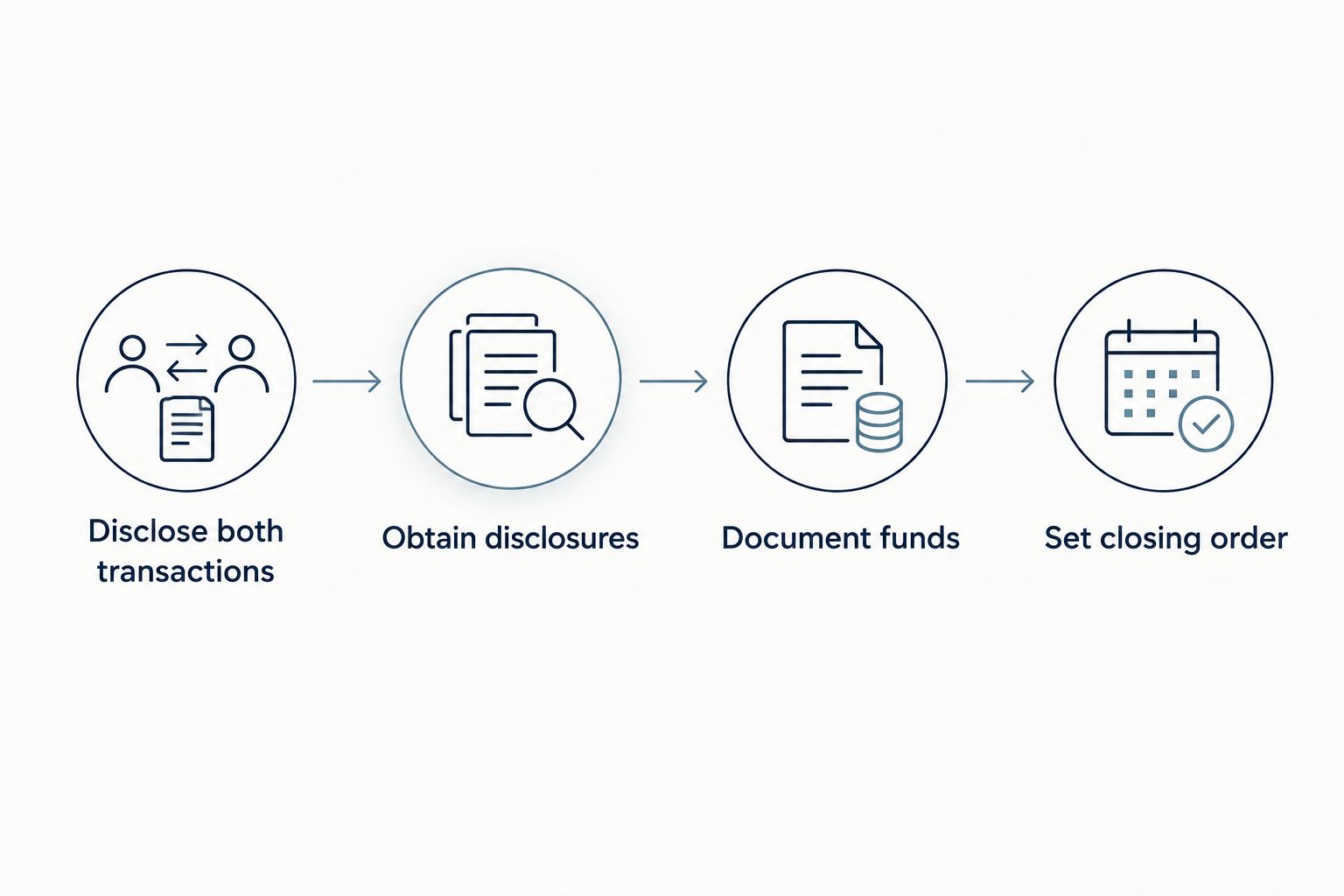
- Disclose both transactions. Tell each lender about the other loan application and the planned purchase. Include the proposed refinance payment when discussing purchase qualification.
- Obtain the Loan Estimate. Review Loan Amount, Projected Payments, and Estimated Cash to Close with the refinance lender. Have the lender explain how its proceeds calculation connects to the disclosure.
- Request purchase qualification using the new debt. A purchase preapproval based only on your existing mortgage payment does not establish affordability after the refinance.
- Document the source of funds. Ask the purchase lender which refinance closing documents, account statements, and transfer records it needs. Keep proceeds traceable rather than moving them through unnecessary accounts.
- Set the closing order. Confirm when the refinance can close, when proceeds can disburse, and when the purchase lender requires evidence of those funds.
Expected result: Both lenders are evaluating the same debts, source of funds, and transaction sequence. Your purchase budget reflects the proposed financial position rather than the one you are leaving behind.
The 2026 decision is not simply whether the refinance produces a down payment. It is whether the combined housing obligations remain acceptable after insurance, property taxes, maintenance, association obligations, and any lender-required reserves are included.
Establish the notice and funding calendar
- Ask about Texas notice requirements. A Texas homestead home-equity loan generally cannot close before the required 12-day notice period has run. The lender must calculate the applicable dates; this period is not a promise of total processing time.
- Confirm any rescission period. Ask the refinance lender whether a right of rescission applies and when it ends. Do not equate signing loan documents with receiving spendable proceeds.
- Review the Closing Disclosure. Reconcile Loan Amount, Projected Payments, and Cash to Close with the lender's final proceeds statement. Resolve differences before signing.
- Match the purchase contract to funding. Have your agent and lender coordinate financing deadlines and closing dates. Earnest money and other early obligations can arise before refinance proceeds arrive.
Expected result: You have a written sequence for signing, disbursement, and purchase funding, with the responsible contact identified at each stage.
Do not make an offer dependent on unconfirmed refinance proceeds without understanding your contractual exposure. An agent can explain transaction procedures; an attorney should address legal questions about contract obligations or remedies.
Compare the equity-access workflows
A cash-out refinance is not the only way to access equity. Compare the structure before choosing the application path, particularly when replacing the existing first mortgage would change terms you want to retain.
| Workflow | Best for | Main advantage | Main limitation |
|---|---|---|---|
| Cash-out refinance | Buyers who want to replace the existing mortgage while accessing equity | Combines the existing mortgage payoff and additional borrowing in a new loan | Replaces the existing first-mortgage terms and requires a new closing |
| Home-equity loan | Buyers who want a separate lump-sum loan without replacing the first mortgage | Keeps the existing first mortgage separate | Adds another secured payment and requires separate qualification |
| HELOC | Buyers who need a credit line rather than a single lump sum | Allows draws under the line's terms | Variable-rate and repayment provisions require careful review |
All three workflows place the collateral property at risk if you fail to meet the loan obligations. Texas homestead restrictions can apply to home-equity loans and HELOCs as well; changing the product name does not remove the state's requirements.
Choose the debt structure before choosing the Frisco property. The largest accessible amount is not automatically the right borrowing amount, and a preapproval is not an instruction to spend to its limit.
Adjust the workflow when the Frisco home becomes your residence
If you are moving to Frisco rather than buying a personal-use second home, change the occupancy discussion before submitting the purchase application. Your future residence and your existing home need separate, accurate descriptions.
- Explain the move. Tell both lenders when you expect to relocate and what will happen to the existing property.
- Disclose any rental plan. If you intend to retain and rent the existing home, ask what documentation the purchase lender requires before considering rental income. Do not assume projected rent automatically offsets its mortgage payment.
- Recheck insurance and tax treatment. Discuss the change in property use with your insurance professional and tax advisor. Address homestead-exemption questions with the relevant appraisal district.
- Refresh qualification. Have the lender reassess debts, reserves, occupancy, and available funds before your agent revises the purchase strategy.
Expected result: Your financing reflects a relocation rather than an incorrectly labeled second-home transaction.
The question of how much equity you can access starts with property value and secured debt, but the usable amount also depends on local lending rules and underwriting. An equity-release explanation written for Australia does not establish eligibility for a Texas homestead loan; apply the Texas lender's calculation to your transaction.
For a 2026 relocation, keep the occupancy explanation consistent across loan applications, insurance discussions, and purchase planning. If your plans change, notify the lender rather than letting an outdated assumption remain in the file.
Troubleshooting the transaction
The proceeds are lower than expected
Compare the lender's valuation, mortgage payoff, required lien payoffs, and transaction expenses against your worksheet. Reduce the purchase contribution or revisit the financing structure before committing additional funds. Do not bridge the gap with undisclosed borrowing.
The purchase preapproval changes after refinancing
Ask the purchase lender to recalculate qualification using the final refinance payment and updated assets. A new secured loan changes the financial picture. Adjust the property search to the revised approval rather than relying on the earlier letter.
The refinance will fund after the purchase deadline
Have the lender identify the actual disbursement date and have your agent address the contract timeline promptly. Do not assume an extension is automatic or that a signed refinance package satisfies the purchase lender's funds requirement.
The property does not fit the loan classification
Explain the intended use again and request the appropriate loan review. Rental plans, occupancy expectations, or condo-project requirements can change the financing path. Correct the application instead of reshaping the facts to fit it.
The tax deduction looks uncertain
Ask a qualified tax advisor to trace how the borrowed funds will be used and which property secures the debt. Using cash-out proceeds to buy another home does not automatically make the new interest deductible as home-acquisition interest. Keep the refinance documents and purchase settlement records together.
Customize your workflow
Create a shared transaction checklist for your lender, real estate advisor, and closing contact. Include the valuation status, refinance approval conditions, estimated proceeds, purchase approval conditions, and the date each item was last confirmed.
The Scott Michaels Group's Frisco real estate guidance belongs alongside this financing process, not in place of it. Use property-level due diligence to evaluate condition, location, association documents where applicable, and the fit between the home and your intended use.
For a 2026 purchase, define your stop conditions before touring seriously: insufficient net proceeds, an unacceptable combined payment, unresolved occupancy classification, or funding dates that do not support the contract. A clear reason to pause protects you more than an optimistic closing calendar.
FAQ
Can I use a cash-out refinance to buy a second home in Frisco?
Yes, cash-out refinance proceeds can help fund a Frisco second-home purchase, subject to lender approval. You must qualify for the refinance and any separate purchase mortgage, with the new debt disclosed.
How much equity can I take out of my Texas homestead?
Texas homestead cash-out borrowing generally cannot exceed 80% of fair market value when secured debt is included. Existing loan payoffs and transaction expenses reduce the proceeds you receive, and lenders can impose stricter limits.
Does buying in Frisco make my refinance subject to Texas rules?
No, the Frisco purchase location alone does not determine the refinance rules. The location and legal status of the property securing the refinance control that analysis.
Can I call the Frisco property a second home if I plan to rent it?
You must disclose your actual rental and occupancy plans to the lender. The lender determines whether the property qualifies under its second-home requirements or needs investment-property financing.
Will a cash-out refinance affect my purchase approval?
Yes, the refinance can affect purchase qualification because it changes your debt obligations and available assets. Have the purchase lender evaluate the proposed new payment before relying on a preapproval.
Can I close on the Frisco home as soon as I sign the refinance?
Only if the funds are disbursed and the purchase lender's requirements are satisfied. Signing, any applicable rescission period, disbursement, and purchase funding are distinct stages.
Is cash-out refinance interest deductible when I buy another home?
The interest is not automatically deductible merely because the proceeds buy another home. A tax advisor must evaluate the use of funds, the property securing the debt, and applicable deduction rules.
One last thing
Choose the source of your earnest money before choosing your closing date. Refinance proceeds scheduled for later disbursement cannot cover an earlier payment obligation. Have your lender verify the acceptable source and your agent confirm the contractual deadline before you sign.