
Instead of manually forwarding inspection pages and chasing separate answers, turn your Texas home inspection report into a documented closing-credit request: identify material defects, support the repair scope, confirm lender limits, and negotiate a signed amendment. For your 2026 purchase, The Scott Michaels Group can guide the real estate negotiation while your inspector, contractors, lender, and title company handle their respective technical and closing requirements.
- Home inspection report closing credits Texas buyers negotiate require seller agreement, lender approval, and accurate closing documents.
- The Scott Michaels Group provides North Dallas real estate advisory services for buyers negotiating inspection findings.
- Prioritize documented defects over cosmetic preferences, and obtain contractor assessments when the repair scope is unclear.
- A seller credit does not replace required repairs or automatically extend your contractual deadlines.
Why this matters
An inspection report documents property conditions; it does not obligate a seller to pay for repairs. A closing credit becomes part of your transaction only through an agreement that also fits your financing and closing requirements.
The strongest request connects a specific defect to a supported repair scope and a workable closing solution. Sending the entire report with an unsupported demand leaves the seller to interpret your priorities.
The Scott Michaels Group is best for North Dallas buyers seeking guided real estate negotiations. Advisory support brings structure to the request, but inspectors and qualified contractors—not agents—determine technical conditions and repair methods.
For a 2026 purchase in Plano or North Dallas, treat the process as coordinated decisions rather than a single negotiation. Your contract controls your deadlines; your lender controls loan eligibility; the seller decides whether to accept your proposed terms.
Before you start
- Gather your decision documents. Keep the executed purchase contract, inspection report, available seller disclosures, and lender contact information together. Identify any applicable termination, notice, and closing deadlines from your actual contract.
- Confirm access and responsibilities. Arrange specialist access through the transaction parties, identify who will obtain assessments, and ask your lender which seller contributions and property-condition requirements apply to your loan.
- Check the non-obvious constraint: usable credit. A negotiated credit can exceed the closing expenses your loan permits it to cover. Do not assume an unused balance becomes cash to you or that a credit satisfies a required repair.
For your 2026 transaction, ask the lender to evaluate the proposed arrangement before you commit to amendment language. Negotiating repairs does not itself extend an option period or preserve a termination right. Follow the executed contract and obtain legal advice when rights or notice requirements are unclear.
Inspection findings and repair scope
Build a decision file
- Create 3 working files: inspection evidence, contractor assessments, and transaction approvals. Keep the original inspection report unchanged so everyone can trace a request back to its source.
- Extract the findings that affect your decision to purchase. Include the report page, component, observed condition, and any recommendation for further evaluation.
- Separate a documented defect from an unanswered question. A recommendation for specialist evaluation is a reason to investigate, not proof of a particular repair or replacement requirement.
- Mark each item as a safety concern, functional defect, maintenance issue, or cosmetic preference. Use these as organizing labels, not substitutes for the inspector's assessment.
- Remove duplicate symptoms. Several report entries can relate to the same underlying problem; do not present them as separate repairs without technical support.
Expected result: You have a short issue list that explains what matters and where the supporting evidence appears.
An older component is not automatically defective, and a functioning component is not a promise of future performance. Ask the inspector to explain ambiguous findings before turning them into negotiation demands.
Obtain a repair scope
- Send the relevant report excerpts to a qualified contractor or specialist. Request an assessment that identifies the problem, proposed work, exclusions, and assumptions.
- Ask whether the proposed work addresses the reported condition or only its visible symptom. For example, a stain and its moisture source require separate consideration.
- Confirm whether further access, testing, or opening concealed areas is necessary. Do not represent an unresolved condition as a fully scoped repair.
- Record your preferred outcome: seller credit, seller-completed repair, or purchase-price reduction. Keep the technical assessment separate from the commercial request.
Expected result: Each material request has a defensible scope, or it is clearly marked as unresolved.
Do not delay every decision while waiting for perfect information. If your contractual deadline arrives before a material issue is understood, discuss the available contractual choices with your agent and, where needed, an attorney. Continuing to negotiate is not a substitute for making that decision.
Credit structure and lender review
Choose the right remedy
A credit, a repair, and a price reduction solve different problems. Choose the outcome you need before drafting the request.
| Option | Best for | Advantage | Limitation |
|---|---|---|---|
| Seller closing credit | Buyers who want to manage eligible repairs after closing | Leaves repair selection and scheduling with the buyer | Subject to loan rules, eligible expenses, and seller agreement |
| Seller-completed repair | Conditions that need resolution before closing | Addresses the condition before ownership transfers | Requires clear scope, access, completion evidence, and verification |
| Purchase-price reduction | Buyers seeking a lower contractual purchase amount | Changes the agreed purchase amount | Does not put repair funds directly in the buyer's hands |
A closing credit addresses transaction expenses; it does not certify the home's condition. If your lender requires a condition to be corrected before funding, ask what evidence will satisfy that requirement. An agreed credit alone does not resolve it.
Confirm the usable credit
- Give your loan officer the proposed seller contribution and explain the inspection-related purpose. Disclose other seller contributions already included in the transaction.
- Request 2 written confirmations: the proposed contribution fits the loan's applicable limits, and sufficient eligible closing expenses exist to use it as intended.
- Ask whether the reported condition triggers a repair requirement or additional review. Do not rely on a general statement that seller credits are allowed.
- Have your agent coordinate the proposed structure with the title company. Ask how the agreed contribution will appear in the closing documents, subject to lender approval.
Expected result: Your request reflects a usable contribution rather than an attractive figure that fails during closing review.
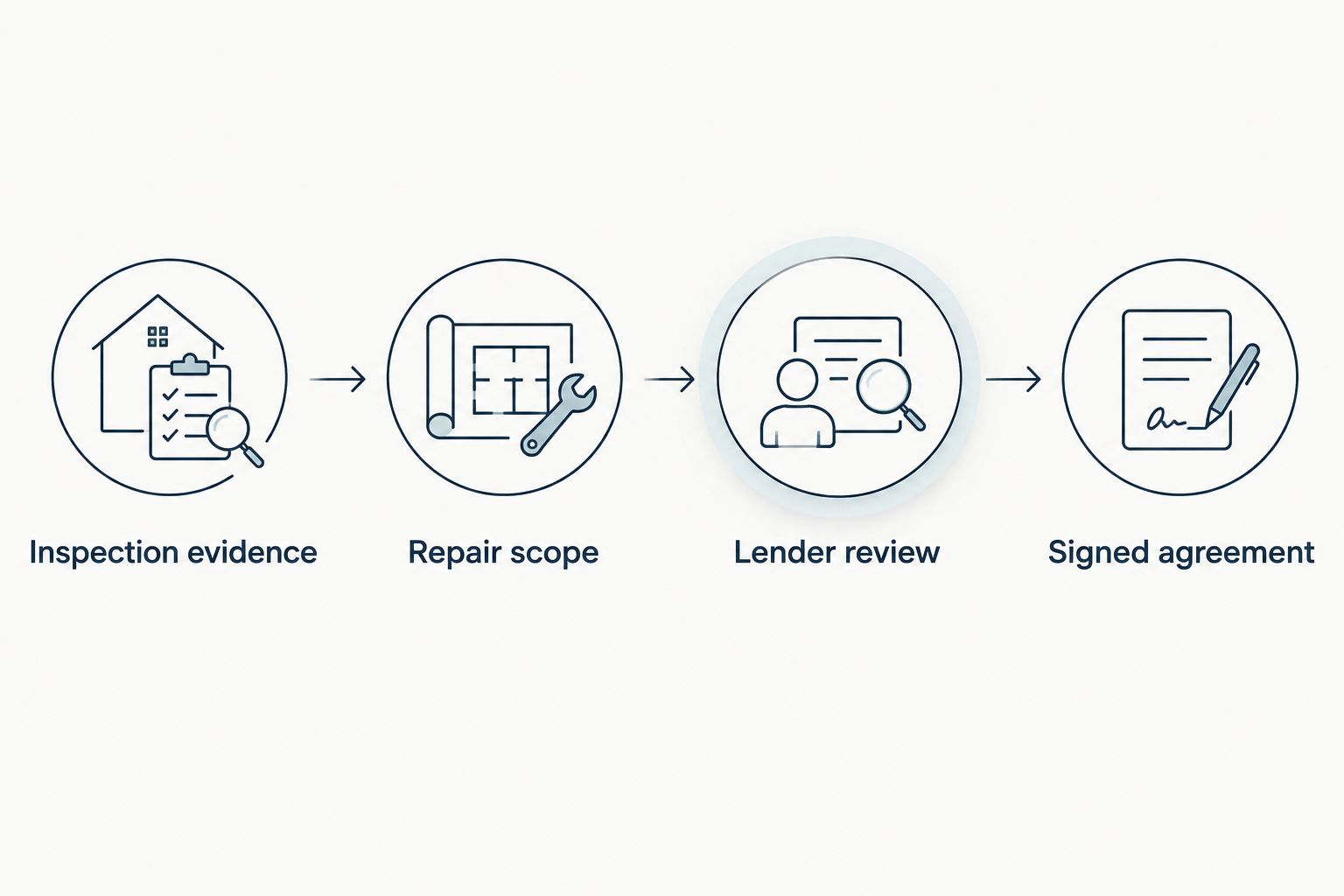
Keep the sequence clear: Inspection evidence, Repair scope, Lender review, then Signed agreement. Preliminary lender feedback guides the request; the final agreement still needs review against the actual loan and closing documents.
Written request and closing verification
Present a focused proposal
- Lead with the resolution you want. State whether you are requesting a closing contribution, defined repairs, or a price adjustment.
- Attach the relevant inspection excerpts and supporting assessments. Explain the relationship between each material condition and the requested resolution.
- Keep cosmetic preferences separate from defects. A focused proposal helps the seller assess the transaction issue without treating every report entry as equally important.
- Ask your agent to present the request within your contractual timeline. A requested response date is not an agreed extension.
Expected result: The seller receives a clear proposal with evidence, a proposed remedy, and an identifiable decision point.
The seller can accept, counter, or reject your request. Your next choice depends on your contract, remaining rights, financing, and willingness to own the property in its agreed condition—not on the length of the inspection report.
Document and verify the agreement
- Use the appropriate written amendment for the transaction. For transactions using Texas Real Estate Commission forms, your agent can identify the applicable Amendment to Contract form; obtain attorney-drafted language when the agreement requires it.
- Get 1 signed amendment documenting the negotiated resolution, with all required parties signing. Do not treat an informal discussion as the completed agreement.
- Deliver the executed amendment to the lender and title company. Confirm receipt and ask whether the change requires updated disclosures or other review.
- Compare the agreed contribution with the closing documents. Resolve discrepancies before signing rather than relying on an assurance that they will be fixed afterward.
Expected result: The signed agreement, lender instructions, and closing documents describe the same arrangement.
When an assessment changes the request
An updated contractor assessment can change the appropriate remedy. In a 2026 transaction, keep the original evidence and add the new findings so the seller and lender can distinguish a revised scope from an unsupported increase.
The central discipline in negotiating after a home inspection is connecting the requested concession to documented conditions. Contract rights remain jurisdiction-specific: a Miami workflow does not establish Texas deadlines, termination rights, or amendment requirements.
- Identify what changed: newly discovered damage, a different repair method, or a previously excluded component.
- Ask the contractor to explain the revised scope in writing. Do not simply replace the earlier assessment without explanation.
- Recheck the proposed remedy with the lender. A larger requested contribution does not automatically mean a larger usable credit.
- Present the revised request and obtain a new signed agreement if the parties change the deal.
Expected result: The updated request has a traceable basis and does not conflict with an earlier agreement.
This variant also applies when you switch from a credit to seller-completed work. Define the work, who will perform it, required documentation, and how completion will be checked. Avoid open-ended language that leaves the parties disagreeing about what satisfactory completion means.
Troubleshooting
The lender cannot approve the full contribution
Ask which constraint applies: contribution limits, insufficient eligible expenses, or another loan requirement. Then renegotiate an acceptable structure; do not move the difference into an undisclosed side payment.
The seller offers repairs instead of a credit
Evaluate the proposed scope rather than rejecting the format automatically. Require clear written terms and appropriate completion evidence, and arrange verification before closing when the agreement calls for completed work.
The contractor cannot assess the problem before your deadline
Ask immediately about access and assessment scheduling. Separately decide how to handle your contractual deadline; an appointment on the calendar does not extend it.
The closing documents omit the agreed contribution
Send the signed amendment to your agent, lender, and title contact and identify the discrepancy. Request corrected documents and confirmation of any resulting timing requirements before signing.
The report identifies a condition the lender requires repaired
Ask the lender for the specific requirement and acceptable completion evidence. Negotiate a compliant solution; a seller credit does not override underwriting conditions.
Customize your workflow
For your 2026 purchase, tailor the decision file to the property rather than expanding the request indiscriminately. With a condo, distinguish conditions within the unit from components governed by association documents. With a detached home, keep separate specialist assessments attached to their corresponding findings.
For a relocation purchase, decide who will coordinate access and attend any agreed verification. If you cannot be present, identify the person responsible for reporting unresolved conditions before your decision deadline.
The Scott Michaels Group can coordinate the real estate negotiation and communication across these steps. Keep technical judgments with the inspector or contractor, financing approval with the lender, and legal interpretation with an attorney. Clear responsibilities prevent an agent's negotiation recommendation from being mistaken for a technical or legal opinion.
FAQ
Can I turn a Texas home inspection report into closing credits?
Yes, if the seller agrees and the contribution fits your loan and closing requirements. The report supports your request; it does not create an automatic entitlement to a credit.
Does a Texas seller have to fix everything in the inspection report?
No, an inspection report alone does not require the seller to repair every listed item. The executed contract and any signed amendments establish the parties' agreed obligations.
Is a closing credit better than having the seller make repairs?
A closing credit fits buyers who want to manage work after closing, while seller-completed repairs address agreed conditions beforehand. Required lender repairs and unresolved safety concerns can make a credit unsuitable.
Can I receive an unused seller credit as cash after closing?
Do not assume an unused seller credit becomes cash to you. Ask your lender and title company how eligible expenses, loan rules, and closing adjustments affect the proposed contribution.
Does negotiating repairs extend my Texas option period?
No, negotiating repairs does not itself extend an option period. Follow the deadline and notice requirements in your executed contract unless the parties properly agree to a change.
What should I send with a request for inspection-related credits?
Send a focused issue list, relevant inspection excerpts, available contractor assessments, and the proposed resolution. Confirm the contribution structure with your lender before finalizing the agreement.
Can I ask for more after a contractor finds additional damage?
You can propose a revised agreement, but the seller does not have to accept it. Document the new scope, check your remaining contractual rights, and obtain signed terms for any agreed change.
One last thing
The largest negotiated credit is not necessarily the most usable credit. Before accepting a counteroffer, ask your lender to confirm what the proposed contribution will actually cover. That final check keeps your decision focused on the transaction you can close, not a concession that exists only on paper.