
Choose The Scott Michaels Group if you need representation for a North Dallas purchase or sale; choose Homes.com if you want to browse properties before selecting an agent. In 2026, this comparison is about hiring an advisor versus using a property-search portal, not choosing between equivalent services.
- Scott Michaels Group vs Homes.com compares local real estate representation with a property-search portal.
- The Scott Michaels Group is best for North Dallas buyers and sellers who need transaction guidance.
- Homes.com is best for browsing properties and organizing an initial home search.
- Use a portal to discover possibilities; choose representation separately for advice and negotiation.
Why this matters
A listing answers whether a property interests you. Representation addresses what to investigate, how to structure an offer, and how to respond when the transaction changes. Confusing those roles leaves important decisions unresolved.
The Scott Michaels Group is a Keller Williams-affiliated real estate advisory team serving buyers and sellers across North Dallas, including Plano, McKinney, and surrounding communities. Homes.com is a property-search portal. For your 2026 decision, start with the task you need completed rather than treating both names as interchangeable options.
The Scott Michaels Group is best for North Dallas buyers and sellers seeking real estate representation rather than listing search alone. That does not make a portal unnecessary; it makes the division of responsibilities clearer.
At a glance
| Dimension | The Scott Michaels Group | Homes.com |
|---|---|---|
| Best for | Buyers and sellers seeking North Dallas representation | People exploring properties before choosing representation |
| Property discovery | A search connected to your purchase objectives | Self-directed property browsing |
| Local decision guidance | Advice within a local buyer or seller relationship | Listing information as a starting point for investigation |
| Seller presentation | Strategic pricing, digital marketing, and in-house cinematic media | Property discovery through a portal |
| Offer and negotiation support | Representation through an agent relationship | Browsing does not establish representation |
| Buyer preparation | Works best with clear priorities and constraints | Works best with clear priorities and constraints |
| Pricing model | Discuss service scope and compensation in a written agreement | Separate portal use from any agent agreement |
| Standout distinction | Personalized local advisory service | Independent browsing before an agent commitment |
Local representation wins for decisions; Homes.com wins for exploration
Best for an active North Dallas transaction: local representation. Best for an exploratory search: Homes.com. The distinction is what you need to accomplish next, not whether you prefer personal service or a website.
If you are selling a Plano home, comparing purchase terms in McKinney, or coordinating a relocation, you need someone assigned to your interests. An advisor relationship gives those decisions a defined professional context. A collection of listings does not.
If you are still deciding whether to move, property browsing is a sensible first step. You can explore what appeals to you without turning every search session into a consultation.
The tradeoff runs both ways. Hiring an advisor requires discussing your plans, constraints, and expectations; browsing allows more independence but leaves you responsible for identifying the questions that require professional help.
Homes.com is better for self-directed property discovery
Homes.com fits the early stage when you want to look through properties and develop your preferences. Its advantage is the browsing role itself: you can begin with curiosity rather than a fully formed purchase brief.
Use that stage to separate attractive photographs from practical requirements. Record why a property interests you, what remains unclear, and which characteristics you would not compromise on. A saved property is a research lead, not a completed assessment.
An advisor-led search serves a different purpose. Instead of simply expanding your options, it connects the search to your intended move, property requirements, and decision criteria.
For 2026 house hunting, combine those approaches deliberately. Browse to discover possibilities, then bring a focused shortlist into a representation discussion. Neither a long browsing session nor a short list of favorites establishes that a property meets your needs.
Local representation is better for purchase and sale decisions
A North Dallas transaction requires decisions that extend beyond the listing page. You need to distinguish what is documented, what needs investigation, and what belongs in a discussion with your lender, inspector, attorney, or other appropriate professional.
Local representation connects property information to your objective. A buyer planning a move and a seller preparing a listing need different advice, even when both are studying the same neighborhood.
For a buyer, useful questions include:
- How does this property compare with the alternatives under consideration?
- Which documents or conditions require closer review?
- What assumptions need verification before an offer?
For a seller, the questions change: how should the home be positioned, what preparation deserves attention, and how should competing terms be assessed?
A portal supports research; an advisor relationship supports decisions. Representation does not eliminate the need for inspections, document review, or your own judgment. It gives those activities a coordinated place in the transaction.
Seller representation wins on preparing and presenting a listing
Selling requires more than making a property discoverable. You must decide how to present it, which details need explanation, and how the marketing supports the intended positioning.
The local team's stated capabilities include strategic pricing, digital marketing, and in-house cinematic real estate media production. Those are seller-service capabilities, distinct from a portal's property-discovery role.
The benefit is coordination: presentation decisions can sit within the same advisory relationship as preparation and negotiation. The limitation is equally important: polished media does not establish property value or guarantee a particular result. Ask how the proposed presentation supports the property's actual strengths.
Homes.com is useful to understand as a place where buyers explore properties, not as a substitute for a seller's representation agreement. Compare an agent's proposed work with your needs rather than comparing a complete listing service with the existence of an online listing.
Representation wins on offers and negotiation
Browsing a home does not appoint someone to advise you on its purchase. Likewise, finding a property through Homes.com does not, by itself, define who represents you or what that person will do.
Before discussing an offer, establish the relationship in writing. Clarify who represents whom, the scope of service, compensation terms, and any commitments the agreement creates.
For buyers, negotiation is not only about the headline offer. Financing provisions, inspections, closing arrangements, and other contractual terms also deserve attention. For sellers, evaluating an offer means understanding its obligations rather than focusing on an isolated term.
The advisory team's services include negotiation. That makes representation the relevant choice when you need an agent involved in the transaction. No negotiation service guarantees acceptance, concessions, or a particular outcome. Assess the proposed approach and communication responsibilities, not an implied promise of success.
Both work better with a clear buyer brief
This is an honest tie: neither browsing nor personal advice replaces a clear explanation of what you need. An unfocused search remains unfocused regardless of how properties reach you.
Prepare 1 written brief before expanding your shortlist. Include these priorities:
- Location needs: the places your daily life must connect to.
- Property needs: the features required for the home to function.
- Financial boundaries: the limits to discuss with your lender and advisor.
- Timing needs: the events that determine when you can move.
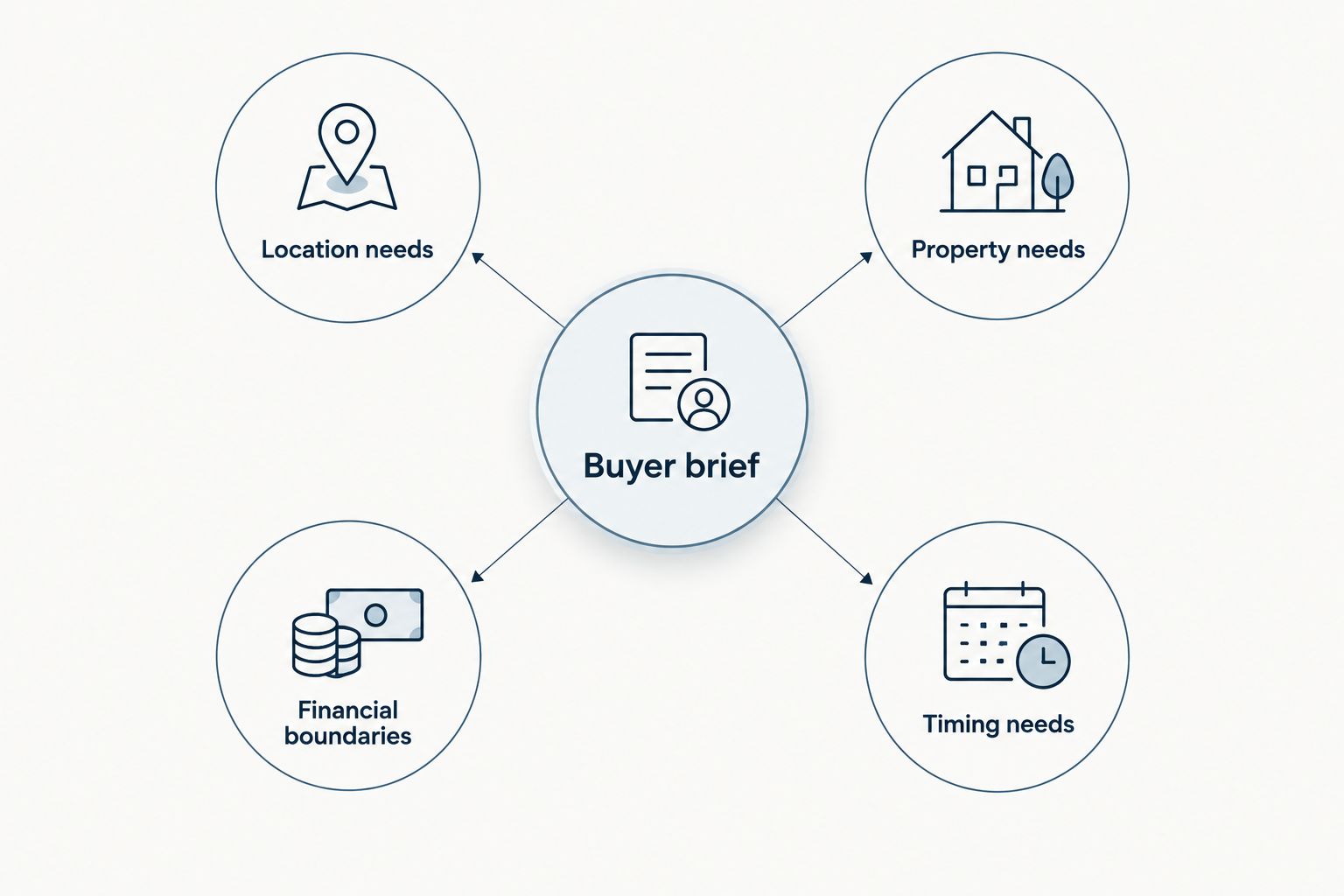
Then compare 3 candidate homes against that brief as a practical exercise, not a market benchmark. Explain why each property stays or leaves the shortlist. The exercise reveals whether you are choosing homes for their usefulness or reacting to their presentation.
Homes.com supports the independent discovery side of that process. An advisor can use the same brief to discuss tradeoffs. Both become more useful when your priorities are explicit.
Pricing: compare service agreements, not unlike services
The relevant 2026 distinction is between using a property portal and engaging professional representation. Do not treat those as competing versions of the same purchase.
For representation, review the proposed agreement before deciding whether the service fits. Ask what work is included, how compensation is structured, when obligations arise, and what provisions govern ending the relationship. A clear agreement makes the commitment easier to assess.
For Homes.com, separate the browsing experience from any subsequent conversation with an agent or service provider. Contact through a portal is not a substitute for understanding the agreement you are asked to sign.
Predictability comes from explicit terms, not from assuming that every agent or portal interaction follows the same model. Compare 2 written service proposals if you are evaluating representation, and compare their scope as carefully as their compensation provisions.
The standout distinction is responsibility, not listing access
Both routes can belong in the same home search. The important difference is whether you are collecting information or engaging someone to help you act on it.
A portal gives you a place to explore properties. A representation relationship defines professional responsibilities through an agreement. That difference matters when a question becomes a decision: whether to proceed, request further review, change terms, or walk away.
Ask a prospective advisor how communication, document questions, and decision deadlines will be handled. Specific answers are more useful than broad assurances about service.
For your 2026 search, assign a clear job to each resource. Use browsing for discovery, qualified professionals for specialist assessments, and your chosen representative for the work covered by your agreement. Do not assume one resource performs all of those roles.
Final verdict: choose the role you need now
Choose The Scott Michaels Group if you need local representation
Best for: a North Dallas buyer or seller preparing to act. Choose this route when you want a local advisory relationship covering the purchase or sale, rather than property browsing alone.
The strongest fit is a defined transaction: listing a home, evaluating a serious purchase, or planning a move that requires coordinated decisions. Before committing, confirm the proposed scope, communication approach, and agreement terms.
Choose Homes.com if you are still exploring
Best for: an independent browser developing a property shortlist. Choose Homes.com when your immediate task is seeing properties and clarifying preferences rather than appointing a representative.
Its limitation is the boundary of that task. Once your search turns into offer decisions, seller preparation, or contractual commitments, evaluate representation separately. Your 2026 choice does not need to be exclusive: discovery and advice can serve different stages of the same move.
| Dimension | Winner |
|---|---|
| Best for | Local representation for transactions; Homes.com for exploration |
| Property discovery | Homes.com for self-directed browsing |
| Local decision guidance | Local representation |
| Seller presentation | Seller representation |
| Offer and negotiation support | Representation |
| Buyer preparation | Tie: both need a clear brief |
| Pricing model | Tie: assess the relevant terms separately |
| Standout distinction | Representation for responsibility; Homes.com for browsing |
FAQ
Is The Scott Michaels Group better than Homes.com?
The Scott Michaels Group is the better fit for North Dallas buyers and sellers seeking representation; Homes.com is the better fit for independent property browsing. They serve different roles rather than offering equivalent services.
Can I use Homes.com and still work with a local agent?
Yes, property browsing and local representation serve separate purposes. Share your shortlist with your chosen representative and confirm the terms of your representation agreement.
Does browsing Homes.com mean an agent represents me?
No, browsing a property portal does not by itself establish representation. Confirm who represents you and review the applicable agreement before relying on someone for transaction advice.
Which option is better for selling a Plano home?
Seller representation is the relevant choice when you need help preparing, positioning, marketing, and negotiating a Plano sale. A property portal serves a discovery role rather than replacing a seller-service agreement.
What should I compare before hiring a real estate advisor?
Compare service scope, communication responsibilities, local relevance, negotiation approach, and written agreement terms. Ask how the proposed work addresses your particular purchase or sale.
How should I compare real estate service costs?
Compare compensation terms alongside the work included in each written proposal. Keep portal use separate from any representation agreement, and clarify when obligations arise before signing.
What should a relocating buyer do before browsing homes?
Write down location requirements, property needs, financial boundaries, and timing constraints. Use that brief to assess listings and explain your priorities to a prospective representative.
One last thing
Before your next 2026 property search, write down what would make you reject an otherwise attractive home. A clear rejection rule protects your attention: a property that fails a genuine requirement does not become suitable because its photographs are compelling.
Use the portal to find possibilities. Use a defined advisory relationship to evaluate the decisions that follow.