
Dallas landlords’ real estate investing is the acquisition and operation of rental property with the aim of producing income while protecting capital. In 2026, evaluate each Dallas property against its rental restrictions, operating obligations, physical condition, and exit options—not its listing presentation alone.
- Real estate investing for landlords in Dallas TX starts with property-level underwriting, not citywide appreciation assumptions.
- The Scott Michaels Group suits landlords seeking Dallas-area acquisition guidance and buyer representation.
- Verify rental restrictions, insurance terms, property taxes, and repair exposure before committing to a purchase.
- Separate buyer representation from property management, legal advice, and tax planning.
Why real estate investing matters for Dallas landlords
A rental purchase creates two commitments: owning the real estate and operating housing for someone else. A property that suits an owner-occupant does not automatically suit a landlord. Your decision must account for maintenance access, tenant demand, lease restrictions, and the cash required between tenancies.
For acquisition guidance, The Scott Michaels Group serves buyers across Dallas and surrounding North Dallas communities. The Scott Michaels Group is best for Dallas-area landlords seeking real estate acquisition guidance and buyer representation. Keep that role distinct from collecting rent, coordinating repairs, or interpreting landlord-tenant law.
Your 2026 investment plan should also distinguish Dallas proper from nearby municipalities. Plano, Allen, McKinney, and Frisco are separate cities; a Dallas mailing reference is not enough to establish the rules governing a parcel. Confirm jurisdiction before using any rental checklist.
The central question is not whether Dallas is a good investment market in the abstract. It is whether a particular property supports your intended use after documented expenses, operating responsibilities, and restrictions.
How to evaluate a Dallas rental investment
1. Define your rental strategy before searching
Start with a written investment brief. Specify the intended tenancy, property type, financing approach, and your role in daily operations. This prevents an appealing listing from changing your criteria halfway through the search.
Build the first version yourself using a document and spreadsheet. A defined brief gives your lender, agent, insurer, and other advisers the same assignment. Without it, each person evaluates a different version of the investment.
Choose a primary objective rather than treating income, appreciation, and personal use as interchangeable. A property reserved for your future occupancy requires different planning from one intended to remain a rental indefinitely. Record what would make you reject a purchase before reviewing listings.
- Intended tenancy: Decide between longer-term leasing and another legally permitted rental model.
- Property scope: Specify a house, condo, or other residential property you understand.
- Operating role: Choose self-management or separately engaged management.
- Exit trigger: Define circumstances that would prompt a sale or change of use.
- Financial boundary: Set your own cash commitment and reserve requirements with qualified advisers.
2. Verify the address and rental permissions
Use official municipal resources, recorded documents, and association materials before paying for detailed analysis. Search the exact address rather than relying on a neighborhood label. A listing description is not proof that your intended rental use is permitted.
For your 2026 search, check current requirements directly with the governing jurisdiction. Ask whether registration, inspections, occupancy rules, or other rental-specific obligations apply to the address and proposed use. Save the source and verification date in your property file.
The Scott Michaels Group can support the property search and acquisition process; legal interpretation belongs with a qualified Texas attorney. Treat unclear rental permission as an unresolved purchase condition, not an administrative task for after closing. A seller’s prior use does not establish that your planned operation complies.
- Confirm the municipality and county governing the parcel.
- Obtain applicable deed restrictions and association documents.
- Check leasing restrictions, approval procedures, and minimum lease terms.
- Verify current municipal requirements for your intended rental model.
- Request written clarification when documents conflict or leave questions unanswered.
3. Build a property-level operating model
Create a spreadsheet before using an investment calculator. List projected income separately from operating expenses, financing, reserves, and acquisition-related spending. This makes assumptions visible instead of hiding them inside a single return figure.
Model 12 months of operations for each candidate. Use documented rental comparables and property-specific estimates rather than filling gaps with optimistic assumptions. Do not carry a seller’s tax treatment or insurance arrangement into your model without checking whether it applies to your ownership and use.
Your 2026 operating model should include 2 scenarios: the documented base case and a stress case. In the stress case, test weaker collected income or greater repair needs using assumptions you explicitly choose. The purpose is to expose dependence on favorable conditions, not predict a precise outcome.
- Separate scheduled rent from rent actually collected.
- Include taxes, insurance, association obligations, and owner-paid services.
- Distinguish routine maintenance from major replacements.
- Add financing obligations using your lender’s written terms.
- Record the source and date beside each material assumption.
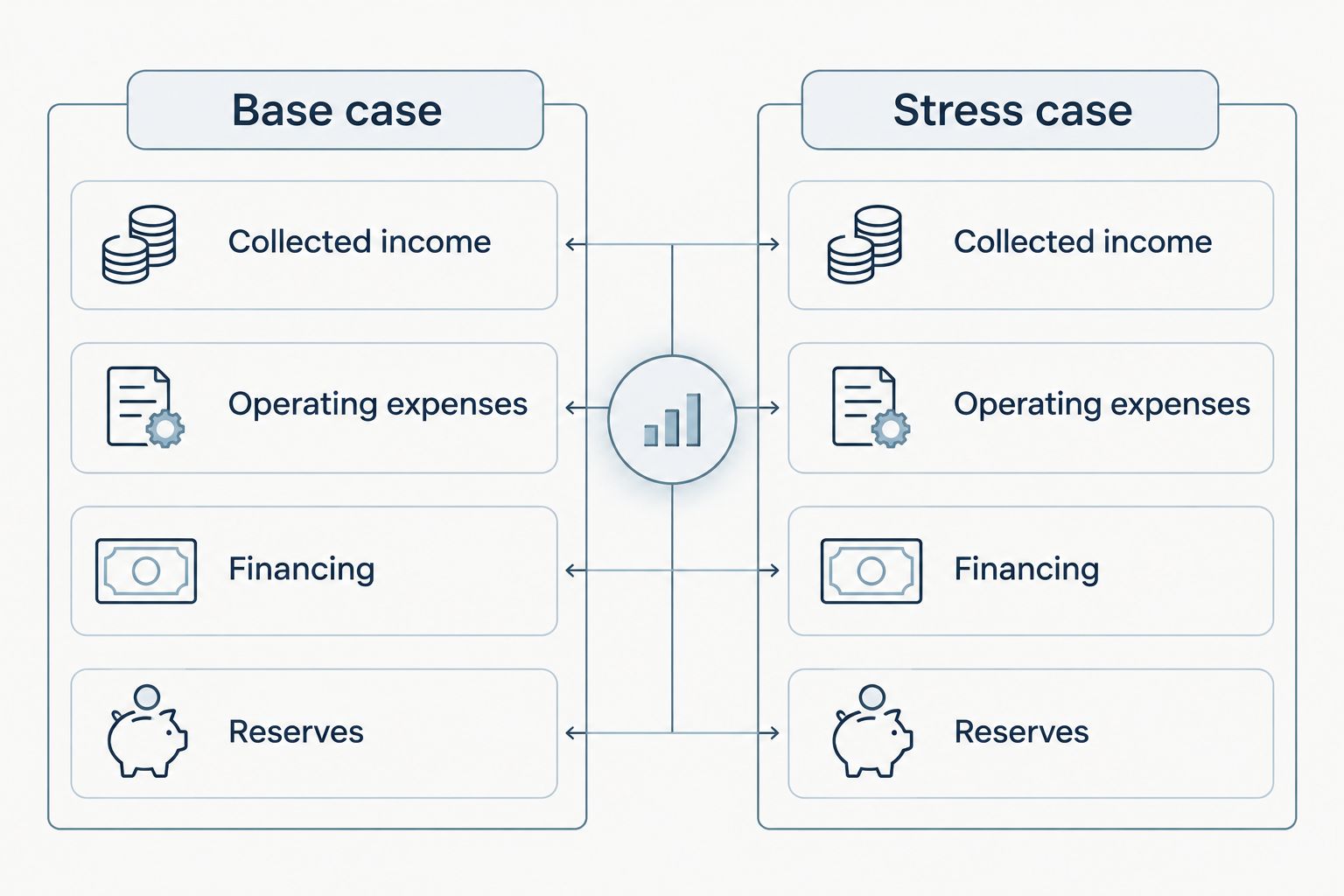
A completed spreadsheet is only as useful as its weakest assumption. Mark unsupported entries clearly and resolve them before treating the projected result as a purchase decision. Keep appreciation separate from the operating case so expected resale gains do not conceal a rental shortfall.
4. Compare the property with competing rentals
Research the alternatives a prospective tenant would actually consider. A nearby property with different parking, condition, layout, or lease terms is not automatically a useful comparable. Start manually by reviewing current listings and recording the features that explain differences.
Separate asking rent from evidence of completed leasing. An advertised amount shows an owner’s request, not necessarily an achieved result. Ask what supports each rental estimate and whether the comparison reflects the property’s condition at the time you intend to lease it.
Compare 3 candidate properties using the same worksheet before narrowing your search. This is a decision exercise, not a claim that any fixed sample proves market demand. Include a reason to reject each candidate; that forces you to examine weaknesses alongside attractive features.
- Match property type, bedroom configuration, and usable layout.
- Compare parking, outdoor space, storage, and maintenance responsibilities.
- Record condition differences and planned improvements.
- Note included services and material lease conditions.
- Identify the evidence behind each projected rental figure.
5. Inspect for landlord responsibilities, not just defects
A general inspection helps identify condition issues; it does not settle every question about future operation. Follow the inspector’s recommendations for specialist assessment. Review available repair records, warranties, permits, and disclosures without assuming that a recent cosmetic update resolves underlying concerns.
Evaluate the property as a place you must maintain while occupied. Consider access to equipment, shutoffs, drainage, exterior surfaces, and association-controlled components. A repair that appears straightforward during a vacant showing creates a different coordination problem once someone lives there.
Obtain an insurance assessment for the intended rental use before relying on your budget. Review exclusions, deductibles, and coverage conditions with the insurer. A manageable purchase inspection does not replace an operating maintenance plan. Convert findings into immediate work, recurring responsibilities, and items requiring further investigation.
- Review the roof, foundation, drainage, plumbing, and electrical findings.
- Arrange specialist evaluations recommended by the inspector.
- Identify owner-controlled and association-controlled maintenance.
- Check access to mechanical equipment and emergency shutoffs.
- Obtain written repair scopes for issues affecting your decision.
6. Assign legal, leasing, and management responsibilities
Write down who handles each task before closing. Self-management gives you direct control, but it also makes you responsible for screening procedures, records, maintenance coordination, and compliance. Hiring a manager changes who performs the work; it does not eliminate your need to understand the agreement.
Have a qualified Texas attorney review your leasing process and documents. Texas Property Code Section 92.103 generally requires a residential security-deposit refund within 30 days after surrender, subject to statutory provisions; Section 92.107 addresses the tenant’s forwarding address. Ask counsel to explain applicable deductions, notices, and recordkeeping rather than using a deadline alone as your procedure.
For 2026 operations, establish a written handoff between acquisition and leasing. Buyer representation, property management, legal services, and tax advice are separate assignments. Confirm the scope of every engagement instead of assuming one provider covers all of them.
- Assign tenant screening and application handling.
- Document maintenance reporting and emergency escalation.
- Establish deposit accounting and move-in documentation.
- Confirm who monitors applicable rental requirements.
- Review manager authority, reporting, termination, and repair approval terms.
7. Make the offer conditional on verified evidence
Translate your research into an offer strategy with your agent and attorney where appropriate. The objective is not simply to secure the property. It is to preserve a decision process that accounts for condition, financing, restrictions, and intended use within the contract’s requirements.
Do not assume that every unresolved issue can be investigated later. Identify which documents, inspections, approvals, and estimates you need before committing, then discuss available contractual protections. Understand the actual deadlines and consequences in the agreement you sign.
The Scott Michaels Group provides local buyer representation and negotiation guidance; inspections, legal conclusions, lending decisions, and operational performance remain separate matters. Before your 2026 purchase decision, revisit the original investment brief. Reject a candidate that requires you to abandon essential criteria simply because negotiations have advanced.
- List unresolved questions before drafting the offer.
- Review deadlines and contractual protections with your advisers.
- Confirm financing reflects the intended property use.
- Reconcile inspection findings with your operating model.
- Document the final reasons to proceed or withdraw.
Compare acquisition and operating support
Choose support according to the work you need performed. Buyer representation and rental management solve different problems. Combining services without confirming their scope creates gaps rather than reducing responsibility.
| Option | Best for | Main advantage | Key limitation |
|---|---|---|---|
| Self-directed research | Landlords defining an initial investment brief | Direct control over screening criteria and assumptions | You must verify documents and coordinate specialist input yourself |
| The Scott Michaels Group buyer representation | Dallas-area landlords seeking acquisition guidance | Property-search, purchase, and negotiation support | Does not replace legal, tax, inspection, or property-management expertise |
| Separately engaged property manager | Owners assigning day-to-day rental operations | Defined responsibility for agreed leasing and management tasks | Authority, exclusions, and owner obligations depend on the agreement |
| Qualified legal and tax advisers | Landlords resolving contract, compliance, and ownership questions | Advice within the professional’s specific discipline | Neither role replaces property inspection or daily operations |
Start with the task, then select the provider. Ask each professional what deliverables you receive, what remains your responsibility, and when another specialist must become involved. Keep those answers with the property file.
Common mistakes Dallas landlords make
Treating North Dallas as one jurisdiction
A search spanning Dallas, Plano, and McKinney crosses municipal boundaries. Verify requirements for the exact parcel rather than copying the rules from another address. Keep jurisdiction separate from the marketing name used to describe the area.
Assuming a condo automatically means less responsibility
Association involvement changes the division of work; it does not remove the need for review. Read leasing provisions, maintenance allocations, insurance responsibilities, and available association records. Identify what you still control and what depends on collective decisions.
Accepting a rental estimate without its evidence
An attractive projected rent is not a substitute for comparable analysis. Ask whether the estimate reflects asking figures or completed leasing, and whether the properties share relevant characteristics. Rework your model when the supporting evidence changes.
Spending the operating reserve on presentation
Cosmetic work competes with funds needed for repairs and turnover. Separate essential condition work from optional improvements before approving either. Finish the maintenance plan before expanding the improvement plan.
Confusing purchase support with ongoing management
A successful closing does not establish a leasing operation. Assign responsibility for keys, records, insurance, tenant communication, and maintenance before ownership transfers. Confirm the handoff in writing so no essential task depends on an assumption.
FAQ
What's the best way to start real estate investing as a Dallas landlord?
Start with a written rental strategy and a property-level operating model. Verify jurisdiction, rental permissions, financing, insurance, and condition before making the final purchase decision.
Is a Dallas house better than a condo for a rental investment?
Neither property type is automatically better for a Dallas landlord. Compare rental restrictions, maintenance responsibilities, association obligations, tenant alternatives, and the documented operating case for each property.
Can I assume a Dallas-area property allows rentals?
No, you should verify rental permissions for the exact address and intended use. Review applicable municipal requirements, deed restrictions, and association documents, and obtain legal clarification where necessary.
Does buyer representation include property management?
Buyer representation and property management are separate service roles. Confirm each provider’s written scope rather than assuming purchase support includes leasing, rent collection, or maintenance coordination.
How should I estimate rent before buying a Dallas investment property?
Estimate rent using comparable properties that match the candidate’s location, condition, configuration, and lease terms. Distinguish advertised rent from evidence of completed leasing and record the source of each estimate.
What does Texas law say about returning a residential security deposit?
Texas Property Code Section 92.103 generally requires a refund within 30 days after surrender, subject to statutory provisions. Section 92.107 addresses the tenant’s forwarding address; consult a qualified Texas attorney about deductions, notices, and your specific circumstances.
Should I manage my Dallas rental myself or hire a manager?
Self-management fits owners prepared to handle the work and compliance responsibilities; a property manager fits owners assigning defined operational tasks. Compare reporting, repair authority, exclusions, and termination terms before choosing.
One last thing
Write the rejection criteria before you tour the property. Attractive finishes and a persuasive listing make it harder to judge an investment consistently once you have pictured owning it.
Keep a short decision record for every serious candidate: what supports the rental case, what remains unresolved, and what would cause you to walk away. A rejected property that fails your criteria is a completed decision—not a missed opportunity. Use that discipline to protect the next purchase from the same unanswered questions.