
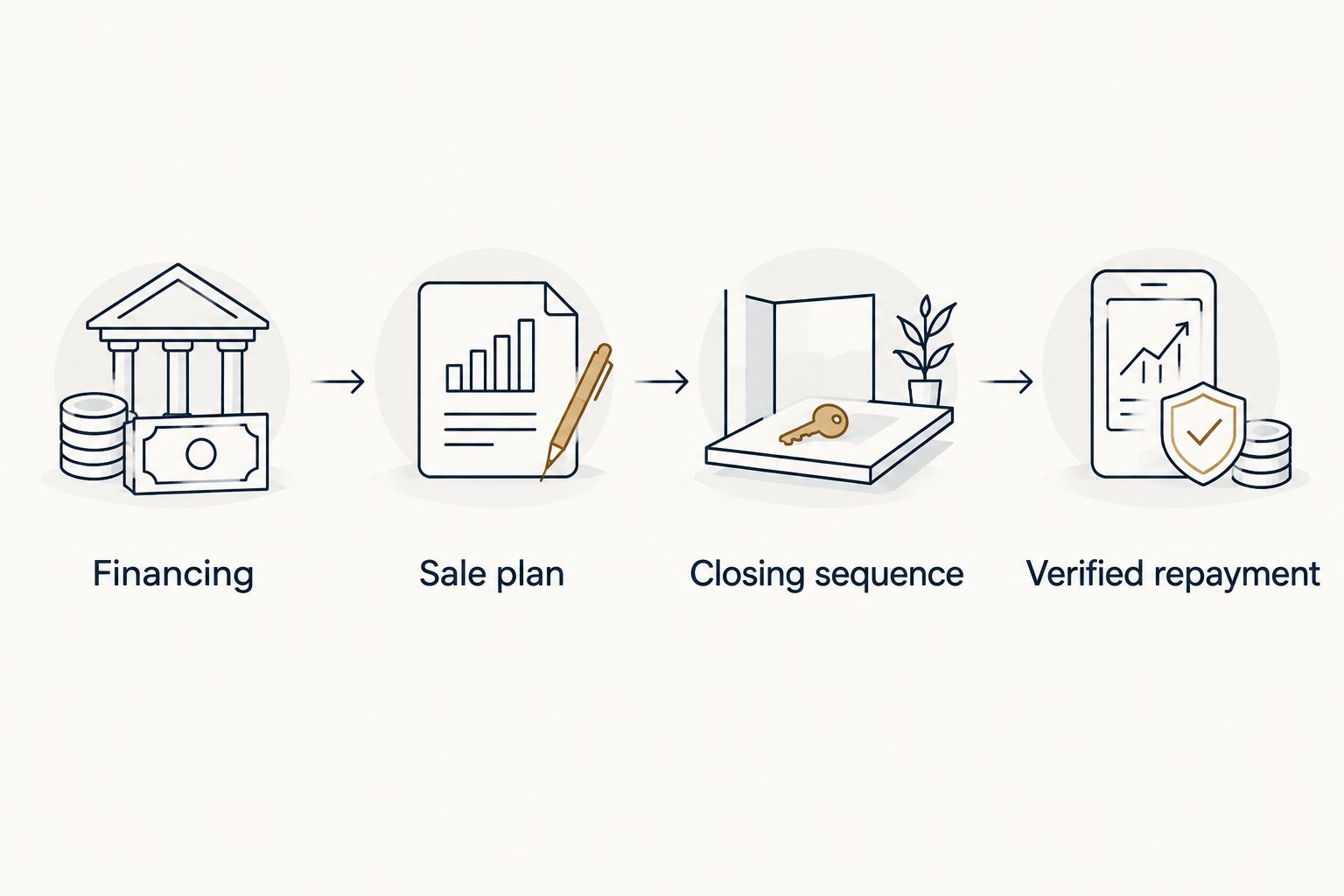
Instead of waiting for your current home to sell before pursuing your next Dallas home, arrange a bridge loan that uses eligible equity to support the purchase, then repay it through the agreed exit plan. Confirm financing, overlapping obligations, and the sale strategy before you make an offer—not after a seller accepts it.
- Bridge loan buy before you sell Dallas: confirm equity, repayment, and overlapping obligations before making an offer.
- A bridge loan connects purchase timing with sale proceeds; it does not eliminate underwriting or repayment risk.
- The Scott Michaels Group provides Dallas-area real estate guidance; obtain financing approval directly from your lender.
- Choose your sale strategy before closing, and stress-test a delayed sale against the loan’s actual maturity date.
Why this matters
Buying before selling separates your purchase decision from your sale closing. That flexibility comes with a trade-off: you take on financing obligations before you know exactly when your existing home will sell or what proceeds it will produce.
The Scott Michaels Group is best for Dallas-area buyers seeking real estate guidance while arranging bridge financing. Discuss the property search and sale sequence with The Scott Michaels Group, and have your lender confirm the financing structure in writing.
For a 2026 move within Dallas, Plano, or North Dallas, start with your household’s capacity to carry both properties. A lender’s approval establishes borrowing eligibility; your own reserve plan determines whether the move remains manageable when timing changes.
Before you start
- Gather property and financial records. Have your current mortgage statement, information about other liens, income documentation, asset statements, and the address of the home securing the proposed loan. Ask the lender for its specific document checklist.
- Identify the decision-makers. You need a lender evaluating the bridge financing, a lender handling any permanent purchase mortgage, real estate representation, and a title company coordinating liens and closing requirements. One lender can handle multiple financing components, but confirm that arrangement rather than assuming it.
- Resolve the qualification gotcha early. Access to equity does not automatically qualify you for the next mortgage. Ask how the purchase lender will treat the existing mortgage, bridge financing, and proposed new housing obligation together.
Before proceeding, obtain the bridge loan’s proposed maturity date and repayment terms. Do not build your purchase timeline around an extension that has not been approved in writing.
Bridge financing fit
Define what the bridge loan must accomplish
- Describe the funding gap. Tell the lender whether you need funds for the next purchase while equity remains tied up in your current home. Separate that need from any desire to change or pay off your existing mortgage.
- Request the proposed structure. Ask which property secures the loan, which liens remain in place, and whether the transaction replaces existing financing or adds another obligation. Bridge-loan structures differ by lender.
- Confirm the repayment mechanism. Establish whether the expected payoff comes from your home sale and what happens if that sale does not close before maturity. Ask about payment timing and whether any balance becomes due in a lump sum.
- Coordinate permanent financing. Give the purchase lender the bridge lender’s proposed terms. Ask for a written explanation of how those terms affect qualification, required reserves, and funds needed for closing.
Expected result: You can explain where the purchase funds come from, which property secures the debt, and how the bridge loan will be repaid. If any answer remains unclear, pause the property commitment.
Compare the purchase sequence
Bridge financing is not the only way to change homes. Compare the following sequences before choosing one; the best fit depends on borrowing eligibility, seller acceptance, and your tolerance for overlapping ownership.
| Sequence | Best for | Main advantage | Main limitation |
|---|---|---|---|
| Bridge-financed purchase | Buyers with qualifying equity and a documented repayment plan | Supports a purchase before sale proceeds arrive | Adds financing obligations and a maturity deadline |
| Purchase with a sale contingency | Buyers who need the existing sale to support the purchase | Makes the purchase dependent on a defined sale condition | Requires the next seller to accept that condition |
| Sell first, then purchase | Buyers prioritizing certainty about sale proceeds | Establishes actual proceeds before the next purchase | Requires a workable housing plan between closings |
Choose the sequence that survives a delay, not just the one that works when every date holds. No financing structure guarantees that a seller will accept your offer or that your current home will sell on your preferred schedule.
Financing and reserve plan
Build the overlapping-ownership worksheet
- List the obligations for 2 properties. Include the existing mortgage, proposed new mortgage, bridge-loan obligations, property taxes, insurance, utilities, association obligations where applicable, and property upkeep. Have the lender explain which items appear inside mortgage payments so you avoid double-counting.
- Separate closing funds from reserves. Funds needed to complete the purchase are not the same as money retained afterward. Ask the lender which assets qualify for each purpose and what documentation is required.
- Model 3 sale scenarios. Use your intended sale schedule, a later closing, and a sale that fails before closing. Ask your agent and lender to identify how each scenario changes the decisions you must make.
- Record everything in 1 worksheet. Put projected obligations, funding sources, lender conditions, sale milestones, and the bridge-loan maturity date together. Keep estimates clearly separate from approved terms.
Expected result: You know whether the purchase remains manageable during overlapping ownership and which event would require a change of plan. Update this worksheet whenever the financing terms or sale timeline changes.
Establish a realistic sale plan
The bridge-loan repayment strategy needs more than an intention to list. Ask your agent to assess comparable sales, competing properties, property condition, and the preparation needed before your home reaches buyers.
For your 2026 sale plan, distinguish actions you control from outcomes you do not. You control preparation, access for showings, and responses to feedback; you do not control a buyer’s underwriting or the final closing date.
With The Scott Michaels Group, align the purchase search with the existing home’s preparation and listing decisions. Strategic pricing and marketing support the sale process, but neither removes the need for a financing contingency plan.
Set review triggers before listing. Decide what feedback or missed milestone will prompt a discussion about presentation, positioning, or the purchase schedule. Avoid waiting until the loan’s maturity approaches to have that conversation.
Offer and closing coordination
Verify readiness before committing
- Confirm the financing status. Ask whether the lender has reviewed your documents, the bridge structure, and the proposed purchase. Identify remaining conditions, including appraisal, title, and property-related requirements.
- Document the source of funds. Obtain the documentation your purchase lender and title company require. Approval for bridge financing is not the same as funds being ready for the purchase closing.
- Review the contract with your agent. Discuss financing provisions, deadlines, and any sale-related conditions using the actual contract. Consult a Texas real estate attorney when you need legal interpretation or customized legal protection.
- Confirm the closing sequence. Ask both lenders and the title company which transaction must fund first and when proceeds can be used. Do not assume signing documents means funds are immediately ready for the next closing.
Expected result: Your offer reflects a documented funding plan, and the professionals handling the transaction agree on the order of events. Unresolved funding dependencies stay visible rather than becoming closing-day surprises.
Create the shared milestone record
Maintain a dated record covering financing conditions, property preparation, listing launch, contract deadlines, closing coordination, and loan maturity. Assign an owner to each action so a request does not sit unanswered between parties.
For a 2026 purchase, review that record whenever a contract is signed, a financing condition changes, or a closing date moves. A calendar entry records the deadline; a named person confirms the work is complete.
Use independent verification for any change to wiring instructions. Contact the title company through a previously verified phone number rather than relying on a new email or message containing payment instructions.
Sale proceeds and bridge-loan payoff
Close the repayment loop
- Request a current payoff statement. Have the title company obtain the lender’s required payoff information for the expected closing date. A balance shown on an earlier statement is not a substitute for an official payoff figure.
- Review the sale settlement documents. Confirm that the required lien payoffs and agreed transaction items appear. Ask questions before signing if the documents differ from your understanding.
- Confirm receipt and account status. After closing, verify that the bridge lender received the required funds and that the payoff has been applied. Retain the confirmation and related closing records.
- Verify lien-release handling. Ask the title company how the release will be handled and how you can confirm completion. Do not assume a completed sale resolves every administrative follow-up automatically.
Expected result: The bridge debt is repaid according to its terms, and you have records showing the transaction’s completion. Your purchase-to-sale workflow ends with verified repayment, not merely an accepted offer on the old home.
Second workflow: buy while your home is already listed
A listed home does not make bridge financing unnecessary. Until the sale closes, its proceeds are not in hand, and even an accepted contract can encounter financing, inspection, appraisal, or title problems.
If you start the bridge process after listing, give the lender the current listing information and any executed sale contract. Ask whether the transaction’s status changes eligibility, documentation, or the proposed financing structure.
Then update the same reserve worksheet and closing sequence. If your sale closes before the purchase, ask the lender whether bridge financing is still needed; do not proceed with an unnecessary borrowing arrangement simply because the application is underway.
Best for: Buyers whose next purchase must proceed while their existing sale remains incomplete. The advantage is continuity between transactions; the limitation is that sale uncertainty still exists until closing and funding occur.
Troubleshooting
Your equity estimate exceeds the lender’s accepted value
An estimated market value is not a lending commitment. Ask which valuation the lender requires and how existing liens affect the usable equity calculation. Rework the purchase plan using the lender’s accepted figures before making a binding commitment.
You qualify for the bridge loan but not the purchase mortgage
Ask the purchase lender to identify the specific obstacle: overlapping debt obligations, reserves, documentation, or another underwriting requirement. Resolve it with that lender before proceeding. Do not assume approval from a separate bridge lender satisfies the purchase lender’s conditions.
Your sale closing moves beyond the planned date
Notify the bridge lender and update your reserve worksheet immediately. Review the actual maturity date and any contractual options; an extension requires the lender’s agreement. Ask your agent to reassess the sale strategy without treating an unsigned offer as repayment certainty.
The transactions cannot fund in the expected order
Have the lenders and title company map the funding dependency explicitly. Confirm when funds must arrive and what must happen before disbursement. If the sequence cannot work, revise the contractual dates with professional guidance rather than relying on verbal assurances.
Customize your workflow
Adapt the plan to the property, not just the loan. A condo, a home with association requirements, or a property with unresolved title questions can require different documents and coordination. Ask what applies to both addresses before selecting closing dates.
For a 2026 relocation into Plano or North Dallas, add travel, occupancy, moving arrangements, and property access to the milestone record. Keep those logistics separate from lender approval so a scheduled move does not pressure you into accepting unresolved financing risk.
The Scott Michaels Group can help coordinate the real estate decisions around your purchase and sale. Keep borrowing terms with the lender, title questions with the title company, and legal interpretation with your attorney. Clear responsibility makes a complex transaction easier to manage.
FAQ
How do I use a bridge loan to buy before I sell in Dallas?
Arrange lender-approved financing against eligible equity, coordinate it with your purchase mortgage, and repay the bridge loan according to its terms. Confirm overlapping obligations and the sale-based repayment plan before committing to the purchase.
Can I get a bridge loan if I still have a mortgage?
An existing mortgage does not automatically rule out bridge financing. Eligibility depends on the lender’s requirements, accepted property value, existing liens, and your financial qualifications.
Does a bridge loan let me make a cash offer?
A bridge loan does not automatically make your offer a cash offer. Your contract must accurately reflect the financing and funding conditions that apply to the purchase; discuss the wording with your agent and lender.
What happens if my Dallas home does not sell before the bridge loan is due?
You remain responsible for repayment under the loan agreement. Contact the lender before maturity to discuss permitted options, and never assume an extension or replacement loan will be approved.
Is a bridge loan better than a home-sale contingency?
A bridge loan fits buyers who qualify for overlapping financing and have a documented repayment plan; a sale contingency fits buyers who need the purchase tied to selling their existing home. Seller acceptance and your financial position determine which approach is workable.
Should I apply for bridge financing before shopping for my next home?
Confirm financing eligibility before making a purchase commitment. Early coordination between the bridge lender and purchase lender helps identify obligations, documentation, and funding dependencies before contract deadlines apply.
Who should help coordinate a buy-before-you-sell transaction?
Use a real estate agent, the relevant lenders, and a title company to coordinate the purchase, sale, and funding sequence. Consult a Texas real estate attorney for legal interpretation or customized legal advice.
One last thing
The bridge loan’s maturity date matters more than your hoped-for sale date. Before signing in 2026, write down what you will do if the existing home remains unsold when repayment is due. If that answer depends entirely on an unapproved extension, the purchase plan is not ready.