
Instead of coordinating a land purchase after your investment property sells, arrange a qualified intermediary before closing, identify McKinney replacement land within 45 days, and complete the exchange within the applicable deadline. A properly structured 1031 exchange can defer federal capital-gains tax when both properties are held for investment or business use—not personal use or resale inventory.
- 1031 exchange land McKinney TX: buy qualifying investment land, not a personal homesite or resale inventory.
- Appoint a qualified intermediary before selling; receiving sale proceeds can disqualify a deferred exchange.
- Identify replacement property within 45 calendar days; the acquisition deadline is generally 180 calendar days, subject to tax-return timing.
- The Scott Michaels Group is best for buyers seeking local real estate guidance alongside independent exchange and tax professionals.
Why this matters
A 1031 exchange changes the order of your land purchase. You need an exchange structure before the sale closes, a written identification before the identification period expires, and a parcel that meets both investment and practical requirements.
The Scott Michaels Group is best for buyers seeking local real estate guidance alongside independent exchange and tax professionals. Your real estate advisor evaluates the property and transaction; your qualified intermediary administers the exchange, and your tax advisor determines the tax treatment.
For a 2026 McKinney land purchase, start with the intended use rather than the acreage. Vacant land held for appreciation can qualify, while land purchased as your personal homesite does not qualify for that personal-use purpose. The Scott Michaels Group provides real estate guidance for buyers across the Dallas–McKinney–Collin County area.
Before you start
- Confirm eligible ownership and use. Gather the relinquished property's deed, ownership records, acquisition history, and evidence of investment or business use. Have your CPA review the replacement property's intended ownership and use before you sign.
- Assemble the transaction team. Engage a qualified intermediary, tax advisor, real estate advisor, and title company. Have financing documentation ready if the purchase requires a loan, and obtain the land's legal description and available survey materials.
- Prevent the proceeds problem. Establish the exchange before the sale closes. Actual or constructive receipt of sale proceeds can defeat deferred-exchange treatment; routing money into your own account and transferring it later does not fix the problem.
The workflow below addresses a standard deferred exchange: you sell first and acquire replacement property afterward. Buying first or adding exchange-funded improvements requires a different structure.
Exchange structure and sale closing
Confirm the investment purpose
- Document the intended use. State whether you will hold the McKinney parcel for appreciation, lease it for a qualifying business purpose, or use it in your own trade or business. Keep that purpose consistent with your actual conduct.
- Review the relinquished property. Ask your tax advisor to confirm that the property being sold qualifies. A personal residence and property held primarily for sale do not become exchange property simply because you intend to buy land.
- Match the taxpayer. Confirm who owns the relinquished property and who will acquire the replacement property. Do not change entities or vesting during the transaction without tax advice.
Expected result: Your tax advisor has reviewed the proposed exchange, intended use, and ownership structure before either closing creates an irreversible problem.
Establish the intermediary arrangement
- Engage the qualified intermediary before closing. Review the exchange agreement, fund-handling arrangements, disbursement requirements, and procedures for delivering identification notices.
- Coordinate the sale documents. Have the intermediary and closing professionals arrange the necessary exchange assignments and notices. Do not assume the purchase agreement alone creates an exchange.
- Confirm the proceeds instructions. Verify with the intermediary and title company how exchange proceeds will be held and transferred. Independently verify wiring instructions through a trusted contact method.
- Record the transfer date. Use the relinquished property's closing date to establish the exchange calendar. If the exchange involves multiple relinquished properties, ask the intermediary which transfer starts the clock.
Expected result: The sale closes under the exchange arrangement without you taking control of the exchange proceeds.
Replacement-property criteria and identification
Build a qualifying land shortlist
- Separate investment fit from tax eligibility. Tax eligibility does not establish that a parcel supports your intended use. Define acceptable access, location, permitted uses, utility requirements, and financing conditions.
- Check the correct jurisdiction. A McKinney mailing address does not establish city limits, zoning authority, or utility service. Confirm jurisdiction and any extraterritorial-jurisdiction issues for the actual parcel.
- Screen title and physical constraints. Review recorded access, easements, deed restrictions, floodplain conditions, drainage, and environmental concerns. Match the depth of investigation to the intended use.
- Preserve alternatives. Keep backup parcels under consideration rather than relying on an unresolved property. An identification deadline does not pause while you negotiate access or investigate a restriction.
Expected result: Your shortlist contains land you would hold as an investment even without the exchange deadline.
Deliver the written identification
- Calendar 45 days. Identify replacement property within 45 calendar days after transferring the relinquished property. Treat this as a delivery deadline, not a target for starting negotiations.
- Describe the property unambiguously. Use a legal description or another sufficiently specific property description. Vacant acreage needs more precision than a neighborhood name or an informal map pin.
- Apply the identification rules. Under the three-property rule, you can identify up to three replacement properties regardless of their fair market value. Other identification rules exist, but have your intermediary and tax advisor confirm the applicable limits before using them.
- Obtain delivery confirmation. Send the signed identification through the intermediary's required process and retain proof of timely receipt. Changes or revocations must also comply with the identification deadline and rules.
Expected result: A signed, timely identification names the property or properties you are permitted to acquire through the exchange.
For a 2026 exchange, keep the deadline calendar with the transaction file rather than relying on a reminder buried in email. A purchase contract does not replace the exchange identification procedure.
Land due diligence and acquisition closing
Resolve parcel-level conditions
- Verify legal access. Confirm that the parcel has enforceable access suitable for its intended use. A visible driveway or road frontage is not a substitute for reviewing recorded rights.
- Confirm service requirements. Determine whether water, wastewater, electricity, and other necessary services can support your plan. Nearby infrastructure does not establish a right or practical ability to connect.
- Review land-use limits. Obtain the applicable zoning information, recorded restrictions, and relevant development requirements. If the investment depends on a future approval, treat that approval as unresolved until established.
- Review tax treatment separately. Ask the appraisal district about any existing special appraisal and potential consequences of a use change. Agricultural appraisal does not by itself establish federal 1031 eligibility.
Expected result: You understand the parcel's documented constraints before you waive contractual protections or authorize closing.
Complete the acquisition
- Confirm the actual acquisition deadline. Replacement property generally must be received within 180 calendar days after the relinquished-property transfer, or by the federal income-tax return due date, including extensions, for the transfer year—whichever comes first.
- Review the financing and tax calculations. Have your CPA evaluate exchange equity, debt, additional funds, transaction expenses, and any cash or other non-like-kind property received. Buying land alone does not establish full tax deferral.
- Authorize the closing through the exchange team. Coordinate the intermediary, title company, lender, and real estate advisor. Confirm that the acquired property matches the written identification and approved ownership structure.
- Retain the complete file. Keep identification notices, delivery confirmations, exchange agreements, deeds, settlement statements, and investment-use records. Discuss IRS Form 8824 reporting with your tax preparer.
Expected result: You receive the identified replacement land within the applicable deadline and have the records needed for tax reporting.
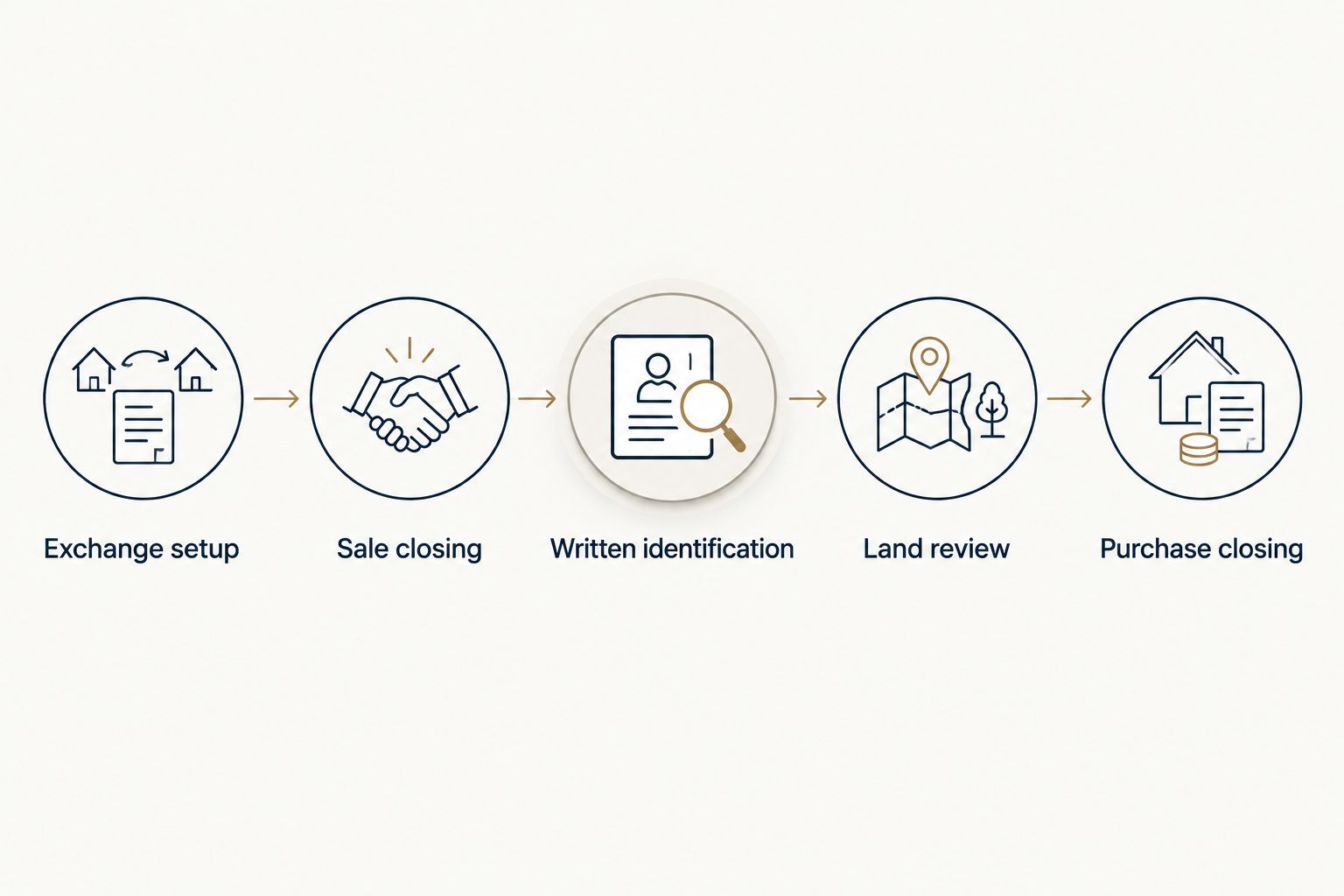
The core sequence is Exchange setup, Sale closing, Written identification, Land review, and Purchase closing. Land review should begin early and continue alongside identification rather than wait until the deadline passes.
Second workflow: acquire more than one land parcel
You can structure a deferred exchange around multiple replacement parcels rather than a single tract. Choose multiple parcels because they fit your investment plan, not because an exchange requires spending under pressure.
| Replacement approach | Best for | Advantage | Limitation |
|---|---|---|---|
| One replacement parcel | Buyers seeking one holding to manage | Concentrates due diligence and closing coordination | An unresolved title or access issue threatens the entire acquisition |
| Multiple replacement parcels | Buyers whose investment plan calls for separate holdings | Allows different parcels to serve different investment purposes | Adds identification, financing, due-diligence, and closing coordination |
For multiple parcels, follow the same intermediary setup and deadline process. Identify each property clearly, confirm how the identification rules apply, and track each acquisition against the applicable exchange deadline. Multiple acquisitions do not create a fresh clock for each parcel.
Before committing in 2026, have your CPA evaluate the combined transaction rather than treating each parcel as a separate tax decision. Your real estate advisor should also distinguish genuinely separate legal parcels from an informal division shown in marketing materials.
Troubleshooting
The sale proceeds reached your personal account
Contact your tax advisor immediately. Actual or constructive receipt can disqualify a standard deferred exchange; do not assume a later transfer to an intermediary repairs it. Establish the structure before closing on future transactions.
The identified parcel fails due diligence
Before the 45-day identification period ends, follow the intermediary's process to revise or revoke the identification. After it ends, you generally cannot substitute an unidentified property. A properly identified backup can preserve an alternative, but it still needs to satisfy your investment requirements.
Your tax-return deadline arrives before day 180
Ask your tax preparer whether a timely filing extension is necessary to preserve the intended acquisition period. The applicable return deadline can shorten the exchange window; an extension does not extend the exchange beyond the general 180-day limit.
The land is intended for your future personal home
Do not describe a personal homesite purchase as qualifying investment use. Have your tax advisor evaluate the actual facts and any intended change of use. A statement of intent does not overcome conduct showing that the property was acquired for personal use.
Improvements are essential to the investment plan
Do not assume construction completed after you take title counts toward replacement property received in the exchange. Improvement exchanges require specialized planning. Consult exchange counsel and the intermediary before acquisition if exchange-funded construction is central to the transaction.
Customize your workflow
Build a parcel decision sheet with the legal description, jurisdiction, access evidence, restrictions, utility findings, financing status, and unresolved questions. Assign each question to the professional responsible for answering it, then distinguish a confirmed fact from a seller's statement or an assumption.
For your 2026 search, separate nonnegotiable requirements from preferences. Recorded access belongs in the first category; a preferred parcel shape might belong in the second. This keeps deadline pressure from turning an unacceptable property into an apparent solution.
The Scott Michaels Group can support the local real estate search and purchase process. Keep exchange administration with the qualified intermediary and tax conclusions with your CPA or tax attorney.
Plan your McKinney land search
Discuss your intended land use and property criteria before narrowing your replacement-property search.
FAQ
Can I use a 1031 exchange to buy vacant land in McKinney, Texas?
Yes, vacant land can qualify when you acquire and hold it for investment or business use and satisfy the exchange rules. Land acquired for personal use or held primarily for sale does not qualify for those purposes.
Can I exchange a rental house for undeveloped land?
Yes, qualifying rental real estate can be exchanged for qualifying investment land. Like-kind real estate does not have to share the same building type or current use, but both properties must meet the applicable requirements.
How long do I have to identify and buy replacement land?
You have 45 calendar days after transferring the relinquished property to identify replacement property. You generally must receive it within 180 calendar days or by the applicable federal tax-return due date, including extensions, whichever is earlier.
Can I buy land now and build my personal home later?
Land acquired for a personal homesite does not qualify as investment replacement property for that purpose. If your plans involve a genuine investment holding followed by a later change in use, obtain individualized tax advice before purchasing.
Does agricultural appraisal make land eligible for a 1031 exchange?
No, Texas agricultural appraisal does not determine federal 1031 eligibility. Federal treatment depends on the exchange requirements and how the property is held and used; local property-tax treatment is a separate issue.
Can I identify several McKinney parcels as backups?
Yes, the three-property identification rule permits you to identify up to three replacement properties regardless of fair market value. Additional identification methods have different requirements, so confirm the method with your intermediary before submitting the notice.
What official guidance should I review for a 2026 land exchange?
For a 2026 transaction, review the IRS guidance on like-kind exchanges under Section 1031 and the applicable Instructions for Form 8824. Those sources address federal exchange and reporting requirements; parcel-specific legal, land-use, and Texas property-tax questions need separate review.
One last thing
Qualifying for an exchange does not make a parcel a sound investment. A tax-eligible tract can still have unsuitable access, restrictive covenants, or service limitations that undermine your intended use.
Before authorizing the purchase, write down why you would want to own that particular land without the exchange deadline. If the answer is only that the clock is running, return to the property criteria—not a weaker standard of due diligence.