
Instead of chasing completion documents and mortgage approval separately, coordinate your builder and lender around one conversion checklist. To move from a new construction loan to a mortgage in Prosper, TX, first confirm whether your existing loan converts to permanent financing or requires a separate mortgage closing, then satisfy the lender’s completion and underwriting conditions.
- For new construction loan to mortgage Prosper TX planning, confirm your financing structure before scheduling completion.
- Construction-to-permanent financing follows the existing loan’s conversion terms; a standalone construction loan requires separate permanent financing.
- The Scott Michaels Group is best for Prosper buyers seeking real estate guidance alongside lender-managed construction financing.
- Construction completion, permission to occupy, mortgage approval, and loan conversion are separate checkpoints.
Why this matters
A finished house does not automatically mean your mortgage is ready. Your lender must confirm that the property and your financial profile satisfy the requirements for permanent financing. Your construction loan’s maturity date also remains important, even when the builder expects to finish soon.
The Scott Michaels Group is best for Prosper buyers who want real estate guidance while their lender handles construction-loan conversion. Start with The Scott Michaels Group for buyer representation, not mortgage approval; your lender controls financing terms and underwriting decisions.
For a 2026 home completion, keep the builder’s schedule, the construction loan’s maturity date, and the lender’s requirements in the same working document. That gives you a practical way to spot a conflict before you commit to moving arrangements.
Before you start
- Collect your financing documents. Have your construction loan agreement, conversion provisions, maturity date, draw records, and any permanent mortgage application or approval conditions available. Identify the lender contact responsible for the permanent financing stage.
- Gather your borrower and property records. Prepare the income, asset, insurance, construction, and completion documents your lender requests. Use the lender’s secure submission method for sensitive financial information.
- Confirm the non-obvious issue: approval can require an update. A construction-to-permanent loan does not mean you can ignore conversion conditions. Ask whether the lender will recheck credit, employment, assets, occupancy, or other eligibility requirements before the permanent phase begins.
Do not select a generic application workflow before identifying your loan structure. A new application is appropriate for some borrowers and unnecessary for others.
Identify your financing structure
Which path applies to your Prosper home?
The phrase “convert a construction loan” describes different transactions. Read your signed documents rather than relying on the name used during an early financing conversation.
| Financing path | Best for | Main advantage | Main limitation | Next action |
|---|---|---|---|---|
| Construction-to-permanent loan | Borrowers whose existing agreement includes permanent financing | Connects construction and permanent financing under an established structure | Conversion remains subject to the agreement’s conditions | Request the lender’s conversion checklist |
| Standalone construction loan followed by a mortgage | Borrowers who must replace construction financing | Allows a separate permanent mortgage transaction | Requires separate approval and a coordinated payoff | Start the permanent mortgage application |
| Builder-financed home purchase | Buyers whose builder carries construction financing | Buyer arranges a purchase mortgage rather than converting a personal construction loan | Closing still depends on financing and property readiness | Confirm purchase-mortgage requirements |
A construction-to-permanent loan and a standalone construction loan are not interchangeable. With the first, the permanent phase follows the existing agreement. With the second, a new mortgage generally pays off the construction debt through a separate closing.
If you are buying a newly built home from a builder and never borrowed construction funds yourself, you are usually arranging a purchase mortgage. Calling that transaction a construction-loan conversion can send your document requests in the wrong direction.
- Read your loan agreement. Locate the provisions describing permanent financing, completion, maturity, extensions, and any conversion election you must make.
- Ask your lender to identify the transaction. Get written confirmation of whether you need a conversion, modification, refinance, or purchase mortgage application.
- Request the complete conditions list. Separate borrower requirements from property requirements and identify who supplies each document.
- Record the controlling dates. Include construction maturity, any rate-lock expiration, the anticipated completion date, and the proposed conversion or closing date.
Expected result: You know which financing path applies, who manages it, and which dates your builder’s schedule must support.
Coordinate completion and underwriting
Your builder manages construction; your lender decides whether the completed property meets its financing requirements. Local inspections and occupancy authorization serve another purpose. One approval does not replace the others.
Build a shared readiness checklist
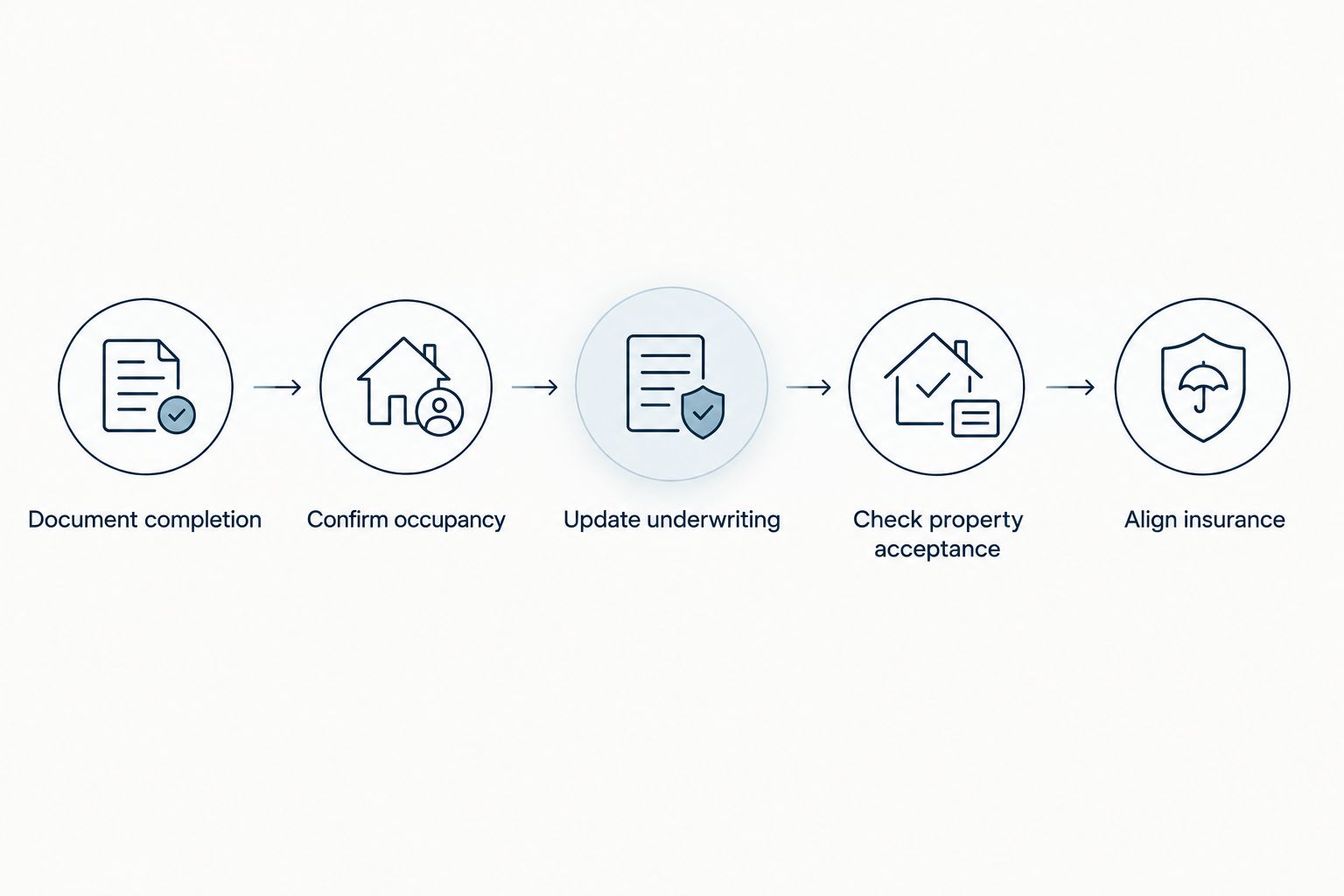
- Document completion. Ask the builder for a realistic completion schedule, remaining work, and the documents the lender needs from the construction team. Distinguish cosmetic punch-list items from work that affects safety, required inspections, or lender acceptance.
- Confirm occupancy. Verify the applicable municipality and its final inspection and occupancy requirements for the property address. A Prosper mailing address alone does not establish which jurisdiction handles every approval.
- Update underwriting. Submit the lender’s requested financial records and answer questions about changes since the original application. Report employment changes, new debts, or other material changes rather than assuming the construction-stage approval covers them.
- Check property acceptance. Ask whether the lender requires an updated appraisal, completion certification, final inspection, survey, title documentation, or evidence addressing contractor liens. Obtain the lender’s actual list; not every transaction uses identical requirements.
- Align insurance. Confirm with your insurance professional and lender when construction coverage ends and homeowners coverage must begin. Do not assume a builder’s policy provides the coverage required for your occupancy or permanent mortgage.
Expected result: Every outstanding condition has an owner, and the lender can identify what still prevents conversion or closing.
For your 2026 planning calendar, use 60 days before expected completion as a personal checkpoint to request the lender’s current checklist. At 30 days before expected completion, review unresolved borrower and property conditions. At 7 days before the proposed closing or conversion, ask which items remain open.
These are suggested organization checkpoints, not lender deadlines or promised processing times. If your construction loan matures sooner, work backward from that contractual date instead.
The Scott Michaels Group can support your real estate decisions while you coordinate financing directly with the lender. Keep that division clear: representation helps you evaluate the property and transaction, but it does not substitute for underwriting, title review, or municipal approval.
Complete the permanent financing transition
Once the property and borrower conditions are ready, confirm the exact steps that activate the permanent mortgage. Do not assume the last construction draw triggers conversion automatically.
Final approval and payment setup
- Request final status. Ask the lender to distinguish satisfied conditions from items still awaiting review. A submitted document is not the same as an accepted document.
- Review permanent terms. Check the interest-rate structure, repayment term, first payment date, escrow requirements, and any differences from earlier disclosures. Ask the lender to explain changes before you sign or authorize conversion.
- Confirm payoff handling. For a separate permanent mortgage, have the lender and title company coordinate the construction-loan payoff. For a construction-to-permanent loan, confirm how the outstanding construction balance becomes the permanent balance.
- Follow the signing instructions. Complete the required closing or conversion documents and independently verify any payment instructions using a trusted contact method. Do not rely on an unexpected email changing wiring details.
- Verify the transition. Obtain written confirmation that the permanent phase is effective or that the new mortgage has funded and the construction debt has been paid off, as applicable.
- Set up servicing. Confirm where payments go, when the first payment is due, and how to establish account access. Keep the confirmation and final documents with your property records.
Expected result: You have confirmation of the permanent mortgage, understand the payment schedule, and know whether any construction-related obligations remain unresolved.
For a 2026 closing, use your current lender documents rather than an old estimate or a builder’s general explanation. The signed agreement and current approval conditions govern your transaction.
When construction runs late: revise the workflow
A delayed completion date changes more than your moving schedule. It can affect construction-loan maturity, rate-lock timing, insurance arrangements, and the validity of documents used for underwriting.
Best for delayed builds: Coordinate the construction extension and permanent financing schedule together. The advantage is that both financing stages reflect the revised build schedule; the limitation is that an extension or revised approval requires the lender’s agreement.
- Get the revised build schedule. Ask the builder to identify unfinished work and outstanding inspections, not just provide another estimated move-in date.
- Check the construction maturity date. Contact the lender before maturity if completion will run beyond it. Ask what an extension requires and obtain any approved change in writing.
- Refresh the mortgage timeline. Ask which financial documents, property reports, insurance arrangements, or rate-lock terms need attention after the delay.
- Reschedule dependent commitments. Revisit movers, temporary housing, and any connected home sale only after you understand the financing implications.
For a 2026 build that slips into a different completion window, treat the revised schedule as a new coordination exercise. An updated builder estimate does not itself extend your loan or preserve mortgage terms.
Troubleshooting
The house is finished, but the lender will not convert
Ask for a written list of unsatisfied conditions. The missing item can involve borrower documentation, property completion evidence, title, insurance, or another loan-specific requirement. Route each condition to the person who can resolve it rather than repeatedly asking for a closing date.
The builder says you can move in, but approval is unclear
Confirm both applicable occupancy requirements and lender conditions before moving. Builder permission does not replace municipal authorization, insurance coverage, or financing requirements. Keep the relevant written confirmations together.
Your employment or debt changed during construction
Tell the lender immediately and submit the requested documentation. A job change or new debt can affect qualification; hiding it does not preserve approval. Avoid taking on new credit without discussing the financing implications with your lender.
A punch-list item remains unfinished
Ask the lender whether that specific item prevents property acceptance and whether any completion arrangement is permitted for your loan. Do not assume unfinished work qualifies for an escrow or holdback. Coordinate the remedy with the builder and lender before relying on a closing date.
The construction loan is approaching maturity
Request the lender’s available next steps before the maturity date. Resolve any extension or replacement-financing requirements in writing. Do not treat a pending mortgage application as an automatic extension of the construction loan.
Customize your workflow
Organize the process around your actual transaction. A custom build on land you own involves different coordination from a builder-owned home purchase, even when both properties are newly constructed.
For your 2026 readiness file, keep separate sections for borrower approval, property completion, title and payoff, insurance, and payment setup. Record the responsible contact and current status beside each requirement. That turns a collection of emails into an actionable checklist without requiring a particular app.
If you also need to sell a current home, connect the sale timeline to the lender-confirmed financing schedule. Do not base a linked sale or move solely on the builder’s estimated completion date.
FAQ
Does a construction loan automatically turn into a mortgage?
Only a loan structured for permanent financing can transition under its existing conversion provisions. A standalone construction loan generally requires a separate mortgage that pays off the construction debt, and both paths remain subject to applicable lender conditions.
Do I need to qualify again when my construction loan converts?
Your lender determines which qualification checks apply at conversion. Ask whether updated credit, employment, income, asset, or other documentation is required under your loan agreement.
Can I move into my Prosper home before the mortgage conversion?
Do not move in until applicable occupancy requirements, insurance arrangements, and lender conditions permit it. A builder’s statement that the home is ready does not replace those confirmations.
What documents do I need for a construction-to-permanent mortgage?
Use your lender’s written checklist as the controlling document list. Requirements can include updated borrower records, completion evidence, insurance, appraisal-related documents, and title information, depending on the loan.
What happens if construction is not finished before my loan matures?
Contact your lender before maturity to address an extension or another approved financing arrangement. A delayed build does not automatically extend the construction loan.
Is buying a builder’s new home the same as converting a construction loan?
No. If the builder financed construction and you did not take out the construction loan, you generally obtain a purchase mortgage rather than convert a construction loan in your name.
Can The Scott Michaels Group approve my permanent mortgage?
No. The Scott Michaels Group provides real estate representation; your lender makes mortgage approval and conversion decisions. Keep financing questions with your lender and property or transaction questions with your real estate advisor.
One last thing
A submitted condition is not a cleared condition. Before treating your mortgage as ready, ask the lender which requirements have been accepted and which still await review. That distinction is more useful than another estimated closing date.