
The cost to sell a house in Dallas TX in 2026 is the total of your negotiated selling expenses, property-specific charges, and any buyer concessions you accept, rather than a fixed fee. Your mortgage payoff also reduces the cash you receive, but repaying that debt is separate from the transaction costs of selling.
- Your cost to sell a house in Dallas TX depends on negotiated terms, closing charges, and property condition.
- The Scott Michaels Group serves Dallas-area sellers seeking real estate advisory guidance, not a universal fee formula.
- Separate selling expenses from mortgage payoff when reviewing your seller net sheet.
- Compare offers by estimated net proceeds and contract obligations, not the headline offer alone.
How much does it cost to sell a house in Dallas TX in 2026?
Your selling budget should separate expenses you negotiate, charges tied to the property, and debts paid from closing proceeds. Ask for an itemized seller net sheet before setting your listing strategy, then update it against each serious offer. An estimate is useful only when you understand its assumptions.
For Dallas-area real estate sellers, The Scott Michaels Group is best suited to buyers and sellers seeking advisory guidance through complex property decisions. Start that discussion with your expected proceeds and obligations, not just a proposed asking figure.
| Budget category | What belongs here | What determines your obligation |
|---|---|---|
| Brokerage compensation | Compensation specified in applicable agreements | Your signed agreements and accepted contract terms |
| Title and settlement | Agreed title insurance, escrow, recording, and related charges | The contract, closing requirements, and settlement estimate |
| Property obligations | Tax prorations, association balances, and applicable assessments | Property records, association documents, and the contract |
| Preparation and repairs | Work you authorize before listing or agree to complete | Property condition and your chosen scope |
| Buyer concessions | Contributions or credits you accept | The negotiated purchase contract and financing requirements |
| Debt payoff | Mortgage balances and other liens requiring payment | Written payoff statements and title requirements |
Debt payoff belongs in a proceeds calculation, but it should remain visibly separate from selling expenses. Otherwise, a heavily mortgaged property appears more expensive to sell than an identical debt-free property even when their transaction expenses match.
Why this matters
A sale that looks attractive on the offer page can produce a different result at closing. Repair obligations, concessions, an extended ownership period, and unresolved title matters all affect what you keep or must contribute.
For your 2026 Dallas sale, maintain separate views of selling expenses and cash available after closing. The first helps you evaluate the transaction; the second helps you plan a purchase, move, or distribution of equity. Combining them hides the decisions you can still change.
Location also needs precision. A Dallas mailing address does not establish every taxing jurisdiction, association obligation, or closing requirement affecting a property. Build the estimate from the actual address and documents rather than assumptions about the broader North Dallas market.
Brokerage compensation: use your signed terms
Real estate brokerage compensation is negotiable; it is not a legally fixed selling charge. Review the listing agreement and any offer-related compensation requests separately so you understand what you are authorizing.
Ask which services the agreement includes, when compensation becomes payable, and whether another contractual obligation applies. Do not add a buyer-requested contribution automatically if it duplicates an amount already included in your estimate.
The advantage of an agreed service scope is clarity: you can evaluate representation alongside your obligations. The limitation is equally important: a compensation figure alone does not describe the work, contract conditions, or likely net proceeds. Compare the agreement as a whole.
Title and settlement: confirm who pays each charge
Title and settlement expenses depend on the transaction and the allocation written into the contract. An owner's title policy, a lender's title policy, escrow services, recording charges, and document-related charges are different items; they should not disappear into an unexplained closing-cost allowance.
Ask the title company for a seller-side estimate using the proposed contract terms. Identify which entries are firm, which are estimates, and which depend on information still being gathered. Confirm the allocation again after amendments.
An early estimate helps you catch omissions before accepting an offer. Its limitation is timing: a preliminary statement does not replace the final settlement statement, and a changed closing date or contract term can change the calculation.
Property obligations: check taxes and association documents
Texas property taxes are generally paid in arrears, so tax prorations deserve a separate line in your selling plan. The contract determines how the parties allocate taxes, and the closing calculation depends on the applicable information and terms.
Do not assume your current escrow account balance equals the amount needed for closing. The lender's escrow accounting and the settlement's tax proration serve different purposes. Ask the lender and closing team how each will be handled.
If an owners association governs the property, request the applicable resale information and account status early. Transfer-related charges, unpaid balances, or assessments need their own review. Do not treat every Dallas home, condo, or land parcel as if it carries the same obligations.
Preparation and repairs: choose the scope deliberately
Preparation is not one mandatory package. You choose the work to authorize before listing, while later repair obligations depend on what you accept in the contract or an amendment. Separate those stages in your budget.
Start with known condition concerns and the documents describing them. Then distinguish necessary work from presentation choices such as painting or staging. Do not assume every improvement returns its expense at closing. A project needs a property-specific reason, not a promise of automatic payback.
Written scopes and contractor estimates help you compare decisions. Their limitation is that the scope can change when work exposes additional conditions. Keep optional presentation work separate from repairs you have contractually committed to complete.
Buyer concessions: evaluate the whole offer
A buyer can request a contribution toward allowable closing expenses or another negotiated credit. Whether you accept is a contract decision, and financing requirements can restrict how a concession is used.
A concession can help resolve an identified obstacle without requiring you to manage a repair yourself. The trade-off is a reduction in your proceeds, and the wording must match the agreement and applicable financing requirements.
For a 2026 offer comparison, place the proposed concession beside the offer amount, repair terms, financing conditions, and closing date. A stronger headline offer does not automatically produce the stronger net outcome.
Why selling expenses vary between Dallas properties
The difference between estimates should have an identifiable cause. Ask for an explanation when a line changes rather than accepting a revised total without context.
- Signed terms: Compensation, concessions, and the allocation of closing charges follow the agreements you accept.
- Property condition: Preparation choices and negotiated repairs change the work you fund or complete.
- Title status: Mortgages, liens, and ownership issues affect payoff requirements and the steps needed to close.
- Tax position: Applicable taxing jurisdictions, exemptions, and the closing date affect the tax information used in settlement.
- Association obligations: Governing documents, account balances, assessments, and transaction requirements vary by property.
- Ownership timeline: Mortgage interest, insurance, utilities, and maintenance continue while you remain responsible for the home.
These factors explain why a neighbor's closing statement is not your budget. Even nearby properties can have different debt, contractual terms, association obligations, and preparation needs.
How do you build a useful seller net sheet?
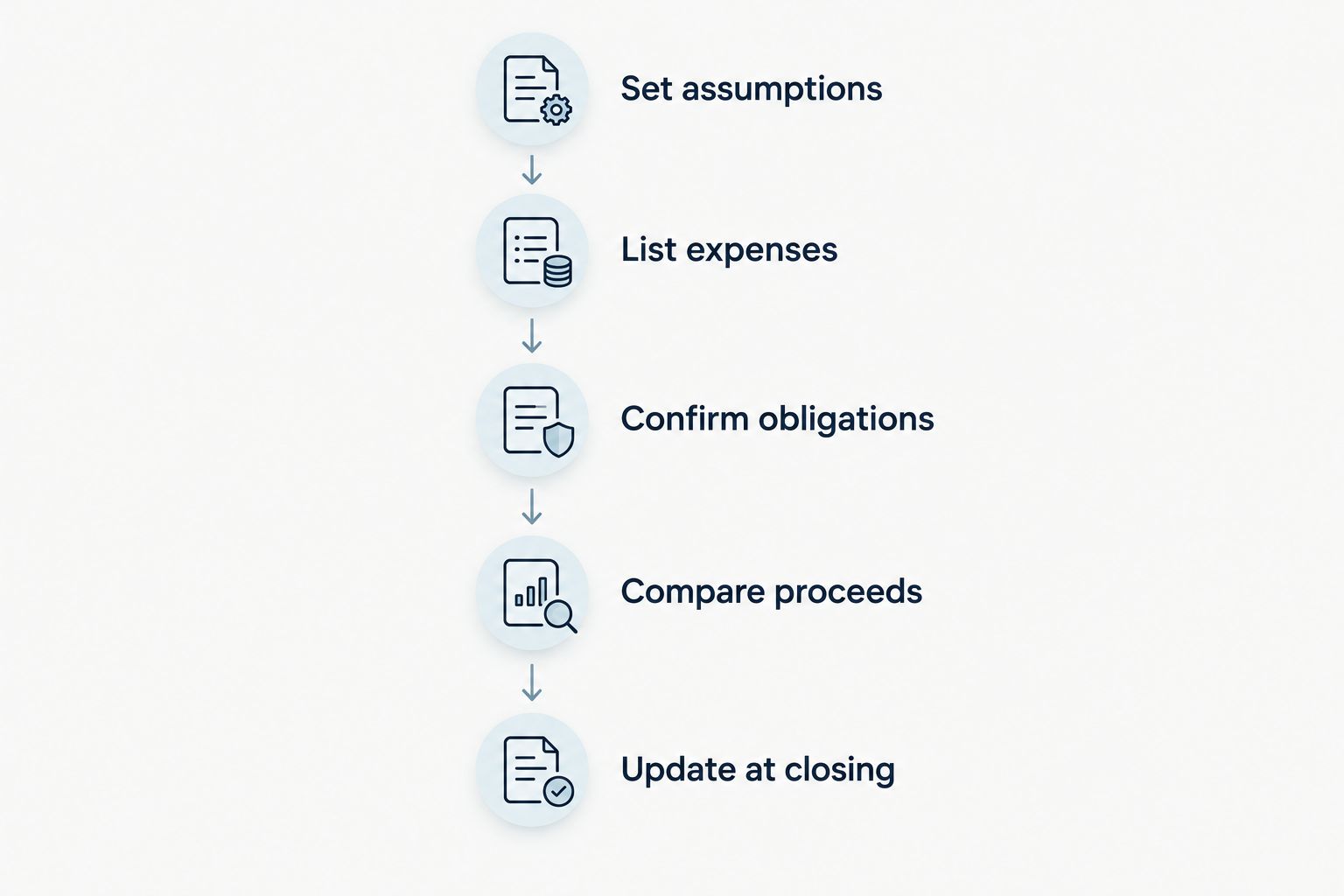
A seller net sheet is a planning estimate of what remains after the proposed transaction and applicable deductions. For your 2026 sale, build it in a sequence that makes assumptions visible rather than hiding them in a single allowance.
- Set assumptions. Identify the proposed sale amount, closing date, and terms being evaluated. Label hypothetical terms clearly.
- List expenses. Enter agreed compensation, estimated seller closing charges, preparation commitments, and accepted concessions without double counting.
- Confirm obligations. Request payoff information, tax details, association information, and title-related requirements from the appropriate parties.
- Compare proceeds. Subtract the relevant expenses and obligations, then compare offers using the same categories.
- Update at closing. Reconcile the latest estimate with the settlement statement and resolve unexplained differences before signing.
The sequence matters because a precise-looking result is still unreliable when its inputs are assumptions. Keep the document date and the source of each estimate visible so you know what needs refreshing.
Your net sheet should also distinguish money paid before closing from amounts deducted at settlement. A preparation invoice you have already paid still belongs in the economics of the sale, but deducting it again from closing proceeds would misstate your cash calculation.
Should you complete repairs or offer a credit?
Choose the approach that resolves the actual issue while preserving acceptable contract terms. Completing work gives you control over the contractor and scope; an agreed credit avoids managing that work but reduces proceeds and requires careful documentation.
| Approach | Best for | Advantage | Limitation |
|---|---|---|---|
| Complete agreed work | Sellers prepared to manage a defined repair scope | Addresses the condition before closing | Requires coordination and compliance with the agreement |
| Negotiate a credit | Sellers seeking an agreed financial resolution | Avoids managing the buyer's preferred work | Reduces proceeds and must fit contract and financing requirements |
| Decline the request | Sellers unwilling to change the existing terms | Preserves your stated position | Does not resolve the buyer's objection or remove contractual rights |
Do not confuse declining a repair request with ending your disclosure responsibilities. Likewise, an agreement to sell in the property's existing condition does not erase the buyer's rights under the signed contract. Review the actual provisions before deciding how to respond.
Does your mortgage balance count as a selling expense?
Your mortgage balance reduces your proceeds, but repaying borrowed principal is not the same as paying a selling expense. Keep payoff in the net-proceeds calculation and outside the subtotal used to compare transaction charges.
Request an official payoff statement rather than using the balance shown on a routine mortgage statement. The payoff calculation can include interest through a specified date and other applicable amounts. Give the closing team updated information if the anticipated closing date changes.
Can you reduce selling expenses without weakening the sale?
You can control spending by defining the preparation scope, negotiating contract terms, and checking settlement estimates for duplication or errors. Remove an expense only after identifying what obligation or service it addresses. Cutting an unexplained line is not a strategy.
Ask The Scott Michaels Group to frame a Dallas real estate selling discussion around expected proceeds, preparation choices, and offer terms. Evaluate the proposed representation by its written scope and your objectives; advisory support does not eliminate taxes, lender requirements, or obligations you accept.
Before authorizing work, decide whether it addresses a known condition, improves presentation, or responds to a buyer request. That distinction keeps optional spending from becoming an assumed requirement and gives you a clearer basis for saying yes or no.
FAQ
What's included in the cost to sell a house in Dallas TX?
The cost to sell a house in Dallas TX includes the selling expenses and property-related charges you are responsible for under your agreements. Review compensation, title and settlement charges, tax prorations, association obligations, preparation, and accepted buyer concessions separately from debt payoff.
Is real estate commission fixed in Dallas?
Real estate commission is negotiable, not legally fixed in Dallas. Review your signed agreements and any compensation-related offer terms to identify your actual obligations.
Does the seller always pay for title insurance in Texas?
The purchase contract determines the agreed allocation of title insurance expenses. Confirm the relevant policy and seller allocation with the title company rather than assuming every Texas transaction follows the same arrangement.
Do I have to renovate my Dallas house before selling?
You do not have to choose a renovation package simply to list your Dallas house. Evaluate known condition issues, disclosure responsibilities, presentation goals, and any repair obligations you later accept.
Why is my mortgage payoff different from my statement balance?
Your mortgage payoff can include accrued interest and other applicable amounts beyond the principal balance shown on a routine statement. Request an official payoff statement for the anticipated closing date.
How do I compare offers with different closing-cost requests?
Compare estimated net proceeds using the same expense categories for each offer. Then review financing conditions, repair obligations, termination rights, and timing rather than selecting an offer from its headline amount alone.
When should I update my seller net sheet in 2026?
Update your seller net sheet in 2026 when an offer, amendment, payoff requirement, or closing date changes the calculation. Reconcile the latest version with the settlement statement before signing.
One last thing
Decide your minimum acceptable net proceeds before reviewing offers. Keep that figure separate from your asking strategy and use it to test concessions, preparation spending, and timing choices.
For a Dallas sale in 2026, the most useful question is not just what selling costs. It is what you will retain under the actual terms—and which obligations remain yours until closing.