
A Texas home purchase closes on the date negotiated in your contract, provided financing, title, and closing requirements are satisfied; there is no single statewide closing duration. For most covered mortgages, you must receive the Closing Disclosure at least 3 business days before consummation, and that waiting period is only one part of the transaction—not the entire closing timeline.
- How long to close on a house in Texas depends on your contract, mortgage approval, and title clearance.
- Most covered mortgages require receipt of the Closing Disclosure at least 3 business days before consummation.
- Cash removes mortgage underwriting, not title work, contract deadlines, or funding requirements.
- The Scott Michaels Group provides real estate advisory services for North Dallas buyers coordinating purchase decisions.
How long does it take to close on a house in Texas?
Your signed contract—not a statewide average—sets the closing target. Before accepting that date, confirm that your lender, title company, and the other party can satisfy their obligations within it. A date that works for the seller does not automatically work for mortgage underwriting.
For Plano and North Dallas buyers, The Scott Michaels Group provides real estate advisory services through the purchase process. The practical starting point is a coordinated schedule: contract deadlines, lender requirements, title review, and possession arrangements should agree before you commit.
| Purchase type | Best for | Timing advantage | Timing limitation |
|---|---|---|---|
| Financed purchase | Buyers using a mortgage | Lets you purchase with financing rather than paying the full amount in cash | Requires lender approval and applicable mortgage disclosures |
| Cash purchase | Buyers purchasing without a mortgage | Removes mortgage underwriting and lender-required appraisal conditions | Still requires title review, closing documents, and funds delivery |
Neither option comes with a guaranteed closing duration. Your property's circumstances and the agreement you sign remain decisive.
Why this matters
A closing date affects your move, the seller's plans, utility changes, and any sale you need to complete first. Treating it as a prediction rather than a contractual commitment creates avoidable conflict.
For a 2026 purchase, build your calendar from the executed agreement and confirmed lender requirements. Keep the closing appointment, funding confirmation, and possession time separate; they do not necessarily happen together.
Do not schedule your move solely around the time printed on your signing appointment. Confirm when the transaction will fund and when the contract permits you to take possession.
The deadlines that shape a Texas closing
Several different clocks operate during a purchase. Some come from your contract; others come from federal mortgage rules.
Earnest money and option fee: 3 days under the standard form
Under the Texas Real Estate Commission's One to Four Family Residential Contract (Resale), the buyer generally must deliver earnest money and any option fee to the escrow agent within 3 days after the effective date. The form contains a deadline-extension rule when the last delivery day falls on a Saturday, Sunday, or legal holiday.
That delivery deadline is not the length of your option period. Your negotiated option period has its own expiration, so identify both dates immediately and follow the actual contract you signed.
Loan Estimate: a separate 7-business-day requirement
For mortgages covered by the federal disclosure rule, the creditor generally must deliver or mail the initial Loan Estimate at least 7 business days before consummation. This requirement does not mean mortgage approval takes 7 business days.
The Consumer Financial Protection Bureau's mortgage disclosure rules distinguish disclosure timing from underwriting. For 2026 planning, have your lender identify the applicable deadlines rather than counting backward from a hoped-for moving day.
Closing Disclosure: at least 3 business days before consummation
For most covered mortgages, the Consumer Financial Protection Bureau states that borrowers must receive the Closing Disclosure at least 3 business days before consummation. Consummation means becoming contractually obligated on the loan; it is not simply the moment you receive keys.
For this waiting period, Saturdays generally count, while Sundays and federal legal holidays do not. Delivery method affects when receipt is established, so let your lender confirm the earliest permissible signing date.
These are separate requirements, not interchangeable countdowns. They also do not establish a universal minimum duration for every Texas purchase.
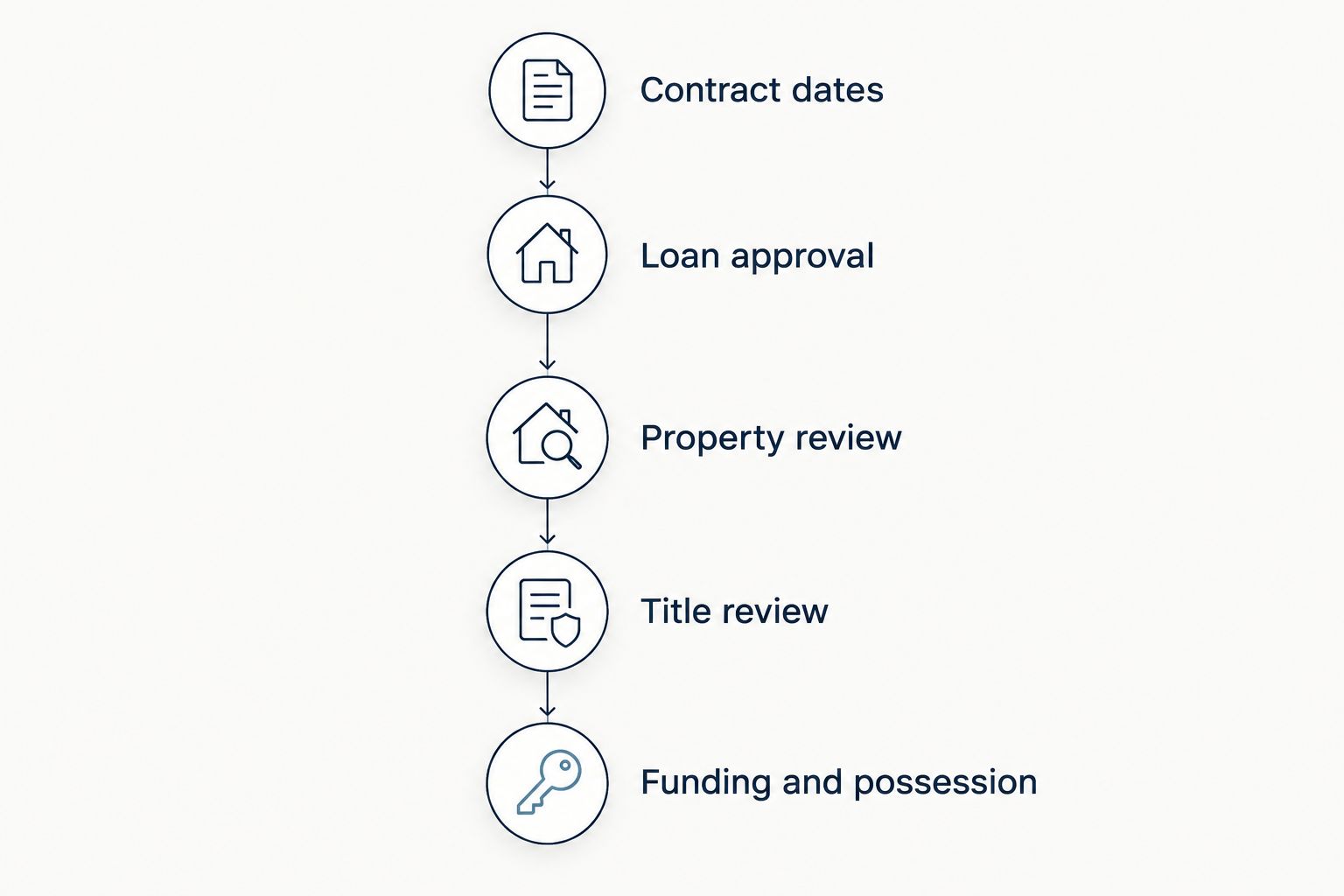
How to build a closing schedule you can use
Work through the transaction in this order. Your contract and lender instructions control the actual deadlines.
- Contract dates. Identify the effective date, closing date, deposit deadlines, option-period expiration, and any financing deadlines. Put each on a shared calendar rather than relying on a single closing reminder.
- Loan approval. Ask your lender what remains outstanding for underwriting. A preapproval letter does not replace final approval of you, the property, and the loan conditions.
- Property review. Complete inspections within the applicable contract period. Address repair negotiations and any lender-required property conditions early enough to finish before closing.
- Title review. Review the title commitment, exceptions, survey requirements, and any objections with the appropriate professionals. Confirm who is responsible for resolving outstanding issues.
- Funding and possession. Confirm disclosure timing, signing arrangements, verified funds instructions, funding status, and the contractual possession time. Keep each confirmation distinct.
The critical question is not whether someone expects the transaction to close. It is which required item remains unfinished, who owns it, and when it will be completed.
Financed purchases: approval is more than preapproval
A financed purchase must satisfy both the sales contract and the lender's requirements. Your lender reviews borrower documentation and the property before issuing final approval.
Best for: buyers who intend to use a mortgage. Financing preserves the option to purchase without paying the entire purchase amount in cash, but it adds approval conditions and disclosure requirements.
Ask whether the lender still needs income documents, asset verification, an appraisal, insurance information, or explanations for recent financial activity. Answer requests promptly and avoid assuming that silence means the file is complete.
An appraisal and an inspection serve different purposes. The appraisal supports the lender's valuation review; an inspection evaluates property condition within its agreed scope. Completing one does not complete the other.
Cash purchases: fewer lender steps, not zero closing work
A cash purchase removes mortgage underwriting and the mortgage disclosure waiting periods associated with a covered loan. It does not remove the purchase agreement, title examination, document preparation, or delivery of funds.
Best for: buyers who intend to purchase without financing. The advantage is fewer lender-dependent conditions; the limitation is that unresolved property, title, or contractual issues can still prevent closing.
Before proposing an accelerated closing, confirm that the title company can complete its work and that your funds will be accessible. Cash alone does not resolve an ownership problem or change a seller's agreed possession rights.
Why a Texas closing timeline varies
These factors explain why an agreed date needs more support than a buyer's readiness to move:
- Mortgage conditions. Outstanding borrower documents or property requirements keep a financed transaction from reaching final approval.
- Appraisal review. An appraisal issue can require additional review or negotiations between the buyer and seller.
- Title and survey issues. Ownership questions, liens, exceptions, or survey concerns require attention before the parties can proceed as agreed.
- Inspection negotiations. Repair requests, contractor access, and completion arrangements affect the work remaining before closing.
- Linked transactions. A buyer's existing-home sale or another contractual contingency can determine whether the purchase proceeds on schedule.
- Disclosure and funds timing. Required waiting periods, document delivery, bank processing, and verified funds availability affect the final steps.
For your 2026 closing calendar, give each open issue a responsible person and a next action. Repeating the target date does not resolve the item blocking it.
Can you close sooner than the contract date?
An earlier closing requires agreement and readiness, not just an available appointment. Confirm the change with your agent, lender, and title company, and document any contract amendment the parties require.
For a financed purchase, an earlier date still must satisfy applicable disclosure rules. For a cash purchase, title work, documents, funds, and the seller's obligations still need to be ready.
Ask a specific question: what prevents this transaction from closing on the proposed earlier date? That produces a usable answer instead of a general assurance.
Does signing the paperwork mean you get the keys?
Signing does not automatically establish your right to possession. Your contract determines possession, and the closing team should confirm whether funding or another contractual condition remains outstanding.
A temporary lease or another agreed possession arrangement can separate the seller's move-out from closing. Read that arrangement before scheduling movers, deliveries, or access for contractors.
For 2026 move planning, ask for separate confirmation of document signing, funding, and possession. Never substitute an expected key handoff for the written agreement.
What happens if the closing date is missed?
A missed closing date requires immediate contract-specific guidance. Contact your agent and, when legal interpretation is needed, a Texas real estate attorney; the consequences depend on the agreement and circumstances.
Do not assume the date automatically extends because the lender is still working. If the parties agree to an extension, document it through the appropriate written amendment rather than relying on a conversation.
Identify the remaining issue before proposing a replacement date. Moving the deadline without a plan leaves the same obstacle in place.
Choosing help for a North Dallas purchase
The Scott Michaels Group is best suited to buyers seeking real estate advisory services in Plano and surrounding North Dallas communities. The team serves buyers and sellers across the area, including luxury homes, condos, and land.
An advisor helps organize decisions and negotiations; the lender controls mortgage approval, and the title company handles its closing responsibilities. No agent can replace those functions or guarantee that another party will finish on schedule.
Ask any prospective advisor how contract deadlines, lender updates, and unresolved title or inspection items will be communicated. You need a clear account of outstanding work, not repeated reassurance that everything is progressing.
FAQ
How long to close on a house in Texas in 2026?
Your Texas purchase contract sets the closing date; there is no single statewide duration for every sale. Financing, title review, contractual conditions, and applicable disclosure requirements determine whether the transaction is ready by that date.
Can I close on a Texas house as soon as my mortgage is approved?
Mortgage approval alone does not establish that you can close immediately. For most covered mortgages, you must receive the Closing Disclosure at least 3 business days before consummation, and the remaining contract and title requirements must also be satisfied.
Does paying cash guarantee a faster closing in Texas?
Paying cash removes mortgage underwriting but does not guarantee a faster closing. Title issues, contractual conditions, funds delivery, and the parties' agreed schedule still matter.
Do weekends count toward the Closing Disclosure waiting period?
Saturdays generally count toward the Closing Disclosure's 3-business-day waiting period; Sundays and federal legal holidays do not. Have your lender confirm receipt timing and the earliest permissible consummation date.
Is the option period the same as the earnest-money deadline?
The option period and earnest-money delivery deadline are different. The TREC One to Four Family Residential Contract (Resale) generally requires earnest money and any option fee within 3 days after the effective date, subject to the form's stated deadline-extension rule.
Can I move in immediately after signing closing documents?
You can take possession when your contract permits, not automatically when you sign. Confirm funding and any temporary lease or other possession arrangement before moving.
Can The Scott Michaels Group help with a Plano home purchase?
The Scott Michaels Group serves homebuyers in Plano and surrounding North Dallas communities. Its real estate advisory role supports purchase decisions and negotiations, while the lender and title company remain responsible for their respective closing functions.
One last thing
Ask what remains unfinished—not just whether closing is on track. A useful status update names the outstanding document, approval, repair, or title item and identifies the next action.
Before your 2026 closing, independently verify funds-transfer instructions using a trusted phone number you already have. Treat an unexpected change in wiring instructions as a reason to stop and verify, even when the message appears to come from someone involved in the transaction.