Veteran home buying in McKinney is the process of using your VA mortgage eligibility to purchase a primary residence while coordinating financing, property condition, and contract deadlines. This 2026 guide explains how to find suitable homes, compare loan options, and protect your interests before you commit.
- For VA loan homes for veterans in McKinney TX, confirm eligibility and financing before narrowing your home search.
- The Scott Michaels Group is best for veterans seeking buyer representation in McKinney and North Dallas, not mortgage underwriting.
- VA purchase loans can offer 0% down for eligible borrowers, but closing expenses and lender approval still matter.
- A VA appraisal does not replace an independent home inspection; review both value and condition before closing.
Why home buying matters for McKinney veterans
A home advertised for sale is not automatically suitable for VA financing. Your lender must approve the borrower, and the property must satisfy the applicable appraisal and property requirements. A listing description cannot settle either question.
McKinney buyers also need to separate the house from its ongoing obligations. Property taxes, homeowners insurance, association requirements, and any special assessments belong in the decision before an offer—not after the inspection.
The Scott Michaels Group provides buyer representation across McKinney and North Dallas. Your real estate advisor coordinates the property search and transaction strategy; your lender determines mortgage eligibility and approval.
For your 2026 purchase, use the U.S. Department of Veterans Affairs’ purchase-loan, Certificate of Eligibility, occupancy, and appraisal guidance as the reference for program rules. Ask your lender to explain how those rules apply to your entitlement, intended occupancy, and chosen property. A general explanation of VA benefits is not an approval for a particular transaction.
Build your 2026 VA home-buying plan
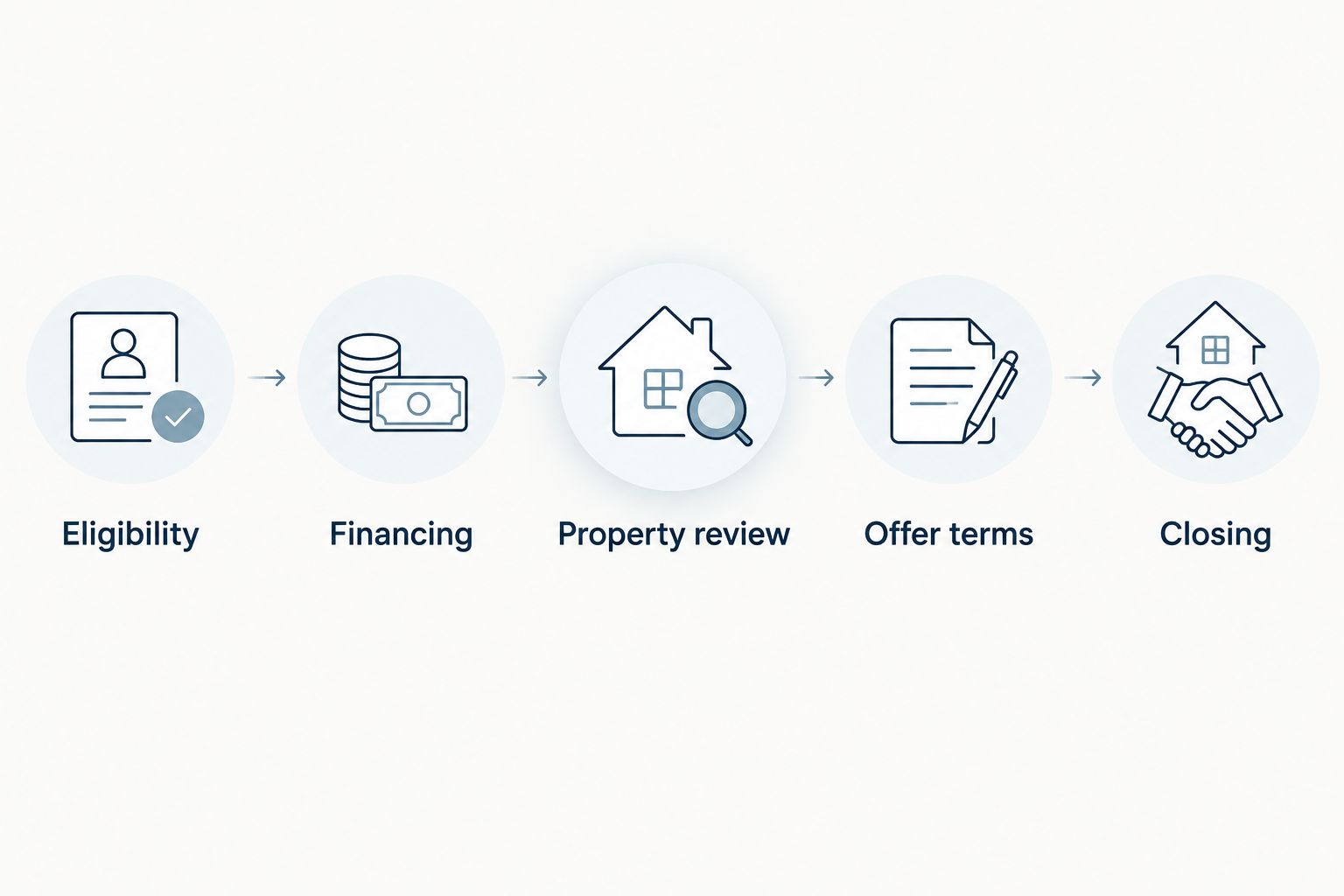
Organize the purchase around five checkpoints: Eligibility, Financing, Property review, Offer terms, and Closing. Keep each decision documented so a change in financing or property condition does not quietly change the rest of your plan.
1. Confirm your eligibility and occupancy plan
Start with the VA’s official guidance and request your Certificate of Eligibility, commonly called a COE. You can request it through the VA, and a participating lender can often help obtain it. A COE establishes eligibility for the benefit; it does not guarantee mortgage approval.
Tell the lender about any previous VA-backed purchase, an existing VA loan, or a property you still own. Remaining entitlement and the treatment of existing obligations require a borrower-specific review.
VA purchase financing is for a primary residence, not a vacation home or a property bought solely as an investment. VA guidance generally expects occupancy within 60 days after closing, with qualifying exceptions that require review. Explain deployment, retirement, or relocation circumstances before selecting a closing date.
- Request your COE through the VA or your lender.
- Disclose prior VA loans and current property ownership.
- Identify who will occupy the home and when.
- Ask the lender to document any applicable occupancy exception.
2. Compare lenders before setting your search boundaries
Begin by gathering your income, asset, debt, and service documentation. Then ask lenders what they need to evaluate your complete file. A payment calculator is useful for planning, but it does not assess underwriting requirements or establish approval.
Eligible borrowers can purchase with 0% down, subject to entitlement, lender approval, and the transaction’s terms. That does not mean every purchase requires no cash. Closing expenses, prepaid items, reserves required by a lender, and an appraisal-related shortfall need separate consideration.
Compare written Loan Estimates using the same loan amount and assumptions. Evaluate the financing structure, lender charges, mortgage-insurance treatment, and treatment of the VA funding fee, including any applicable exemption. Keep a personal cash reserve outside the amount committed to closing.
- Gather income records, asset statements, and debt information.
- Request comparable Loan Estimates from lenders.
- Confirm whether the VA funding fee applies to you.
- Ask which conditions remain before final approval.
- Set a cash reserve you will not use for the purchase.
3. Define a McKinney search that fits your daily life
Start manually with a written list of requirements and a map. Separate needs from preferences: accessibility, workspace, yard maintenance, property type, and travel patterns create a more useful search than a broad bedroom count alone.
The Scott Michaels Group can help turn those criteria into a focused property search and coordinate showings. That assistance supports your decisions; it does not replace checking a commute, reviewing association documents, or confirming a property’s boundaries.
For a 2026 move, verify addresses and service boundaries directly with the relevant organizations. Do not assume a mailing address settles municipal services or school assignment. Evaluate neighborhoods against your own practical requirements rather than broad labels about who lives there.
- Write separate must-have and preference lists.
- Test essential routes at the times you expect to travel.
- Verify school assignments directly with the district if relevant.
- Check municipal services and property jurisdiction.
- Record accessibility and maintenance concerns during each showing.
4. Screen property types and condition before offering
Use listing photographs and disclosures for an initial review, then inspect the property in person. Ask about visible damage, incomplete work, utilities, and known defects. A home marketed as needing repairs deserves an early conversation with your lender—not an assumption that repairs can wait until after closing.
VA financing can cover eligible properties with up to 4 residential units when the borrower occupies a unit and the transaction meets applicable requirements. Condominiums involve project-approval considerations, so ask the lender to confirm the project’s status before you spend time and money pursuing a unit.
The VA appraisal is not a home inspection. The appraisal addresses value and applicable minimum property requirements. An independent inspector examines accessible systems and conditions within the inspection’s scope; specialist evaluations can address concerns that need closer attention.
- Ask your lender about the intended property type.
- Confirm condominium project eligibility when applicable.
- Review seller disclosures and available repair records.
- Flag visible condition issues before drafting an offer.
- Plan an independent inspection and any necessary specialist reviews.
5. Write an offer around your actual financing
Begin with comparable sales and the property’s condition rather than an automatic offer formula. Your offer should reflect your financing, available cash, desired possession date, and tolerance for unresolved issues. A strong offer is one you can carry through to closing.
Ask your real estate advisor and lender to coordinate before the contract is submitted. The contract needs the appropriate financing provisions and applicable VA protections. Have the required VA amendatory or escape-clause language explained before you sign.
In Texas, an agreed termination-option period can provide a defined opportunity to evaluate the property under the contract’s terms. Understand the deadline, notice requirements, and distinction between the option fee and earnest money. Do not treat a verbal assurance as a contractual right.
- Review comparable sales and known condition concerns.
- Confirm financing terms with your lender before submission.
- Discuss applicable VA contract protections with your advisor.
- Record inspection, financing, and notice deadlines.
- Put agreed repairs and concessions in writing.
6. Evaluate the inspection and appraisal separately
After the contract is signed, order the independent inspection promptly and follow the lender’s appraisal process. These reports answer different questions. A property can have repair concerns even when its appraised value supports the purchase.
Read the inspection report for safety issues, moisture intrusion, structural concerns, and major system conditions. Ask qualified specialists to evaluate issues outside the general inspector’s scope. Decide which findings justify further investigation, a negotiated response, or use of an available contractual right.
If the appraisal identifies required repairs or a value below the contract amount, speak with your lender and advisor before agreeing to a solution. Review the contract’s protections and any available VA appraisal-review process. Do not assume additional borrowing will cover a gap.
- Review the inspection report before relevant deadlines expire.
- Obtain specialist opinions for unresolved material concerns.
- Separate negotiated inspection repairs from lender-required repairs.
- Confirm how appraisal conditions will be satisfied.
- Document every agreed change through the appropriate contract paperwork.
7. Verify closing documents and possession details
Keep your financial position stable while underwriting continues. Discuss any new credit, large transfer, employment change, or unusual deposit with the lender before acting. A preapproval does not remove the need for final verification.
Before your 2026 closing, review the Closing Disclosure against your expectations and ask about unexplained changes. Confirm insurance, required repairs, utility arrangements, and possession terms. Use the final walkthrough to check the property’s condition and agreed work, not to repeat the entire inspection.
Treat wiring instructions as a fraud risk. Independently verify instructions by calling a trusted number you obtained separately, rather than using contact details supplied in an unexpected message. Confirm possession timing in the signed documents; receiving loan approval alone does not establish when you can move in.
- Clear outstanding lender conditions promptly.
- Review the Closing Disclosure and question discrepancies.
- Verify wiring instructions through an independent phone call.
- Complete the final walkthrough and check agreed repairs.
- Confirm key delivery, possession timing, and utility arrangements.
Compare financing options for your McKinney purchase
Compare the complete transaction, not just the down-payment feature. VA financing deserves consideration when you qualify, but the appropriate loan depends on your entitlement, finances, property, and intended use. Ask the lender to explain each option using consistent assumptions.
| Option | Best for | Main advantage | Key limitation |
|---|---|---|---|
| VA purchase loan | Eligible veterans buying a qualifying primary residence | No monthly mortgage insurance and potential no-down-payment financing | Requires eligibility, underwriting, occupancy compliance, and an acceptable property; a funding fee can apply |
| Conventional mortgage | Buyers comparing financing outside the VA benefit | Does not require VA eligibility and offers different occupancy structures | Down-payment, credit, and mortgage-insurance requirements depend on the loan |
| FHA mortgage | Buyers whose qualifications fit FHA underwriting | Offers an alternative government-insured financing route | Mortgage-insurance requirements and property standards affect the transaction |
A VA loan’s lack of monthly mortgage insurance is a meaningful feature, not proof that it wins every comparison. Conventional financing also deserves a written comparison when your financial profile supports it. FHA financing is another route to evaluate, not an automatic substitute when a particular home has condition problems.
Buyer representation also has a defined scope. The Scott Michaels Group supports property selection, negotiations, and transaction coordination; lender approval, legal advice, and specialist inspections remain separate responsibilities. Choose advice that clarifies who owns each decision.
Common mistakes veterans make when buying in McKinney
Treating preapproval as final approval
A preapproval is an early financing assessment, not a promise that every property or later financial change will qualify. Continue responding to underwriting requests and ask before changing employment, opening credit, or moving substantial funds. Keep the lender informed through closing.
Assuming zero down means zero preparation
The down payment is only one part of the transaction. You still need a plan for closing obligations, inspections, moving, and repairs after possession. Ask for a written cash-to-close estimate and protect a separate reserve rather than committing every available dollar.
Using the appraisal as the inspection
The VA appraisal does not provide the same examination as an independent inspection. Skipping an inspection leaves you without that separate condition assessment. Use the inspection period to investigate concerns while your contractual choices remain available.
Evaluating only the house, not the property obligations
A floor plan does not reveal association restrictions, special assessments, drainage concerns, or the responsibilities attached to a particular lot. Review the available documents and ask focused questions. For a condominium, examine both unit-level concerns and the association information available to you.
Choosing dates before checking occupancy requirements
A relocation schedule, lease expiration, or seller-requested possession arrangement can conflict with your intended occupancy. Explain your timeline to the lender before agreeing to dates. Resolve the occupancy plan in advance rather than relying on an exception that has not been reviewed.
FAQ
How do I find VA loan homes for veterans in McKinney TX?
Start with lender review, then search for homes that fit your occupancy needs and financing requirements. A listing does not establish VA eligibility; your lender and the appraisal process evaluate the specific transaction.
Can I buy a McKinney home with no down payment using a VA loan?
Eligible borrowers can qualify for a VA purchase loan with no down payment, subject to entitlement, lender approval, and transaction requirements. Closing obligations and any appraisal-related shortfall need separate review.
Does a Certificate of Eligibility mean my mortgage is approved?
No. A Certificate of Eligibility establishes eligibility for the VA home-loan benefit, while the lender separately evaluates income, credit, debts, and the property.
Do I still need a home inspection with a VA appraisal?
Yes, an independent home inspection serves a different purpose from the VA appraisal. The appraisal addresses value and applicable property requirements; the inspection evaluates accessible systems and conditions within its scope.
Can I use a VA loan to buy a condo in McKinney?
VA financing can be used for an eligible condominium when the project and transaction meet applicable requirements. Ask your lender to confirm project status before committing to a particular unit.
Can a VA loan buy a rental property instead of a home I live in?
A VA purchase loan is intended for a primary residence, not a property bought solely as an investment. An eligible multiunit purchase can qualify when you occupy a unit and meet the applicable requirements.
Who helps coordinate my McKinney VA home purchase?
Your real estate advisor coordinates the property search and transaction, while your lender manages mortgage underwriting. The Scott Michaels Group provides buyer representation in McKinney and North Dallas; inspectors and other specialists handle their respective evaluations.
One last thing
Your eligibility follows you; approval does not automatically follow the house. Before getting attached to a property, ask your lender and advisor to identify any unresolved condition, condominium, occupancy, or appraisal question. For a 2026 purchase, clearing those issues early is a better decision than trying to repair the financing plan after the contract is signed.