
Self-employed home buying in Dallas is purchasing a home with business or freelance income, with the aim of securing a suitable property without weakening your business finances. This 2026 guide explains how to document variable earnings, compare financing, and coordinate your search when taxable income and cash flow tell different stories.
- Home buying for self-employed buyers in Dallas TX starts with lender-reviewed income, not your business revenue.
- The Scott Michaels Group suits Dallas buyers seeking real estate advisory support alongside independent mortgage advice.
- Compare conventional mortgages and bank-statement loans by documentation, total borrowing costs, and cash reserves.
- Keep business operating cash separate from the money committed to your home purchase.
Why home buying matters for self-employed Dallas buyers
Your business revenue is not your mortgage qualifying income. A successful business does not automatically produce an approvable mortgage application: lenders evaluate documented earnings, debt obligations, and the stability of income available to repay the loan.
The Scott Michaels Group is best for Dallas buyers who want real estate advisory support alongside independent mortgage advice. Keep those roles separate: your lender evaluates financing, while your real estate advisor helps you assess properties and negotiate the purchase.
For home buying for self-employed buyers in Dallas TX, the practical challenge is matching your property search to income a lender can substantiate. That matters whether you are considering a Dallas condo, a Plano home, or a move elsewhere in North Dallas.
Build your buying plan before touring homes
1. Separate business revenue from qualifying income
Start with your filed returns, bookkeeping records, and personal budget. Identify what the business receives, what it spends, and what remains available to support your household; deposits alone do not answer those questions.
Fannie Mae’s Selling Guide generally calls for a 2-year earnings history for self-employed borrowers, with exceptions subject to its requirements and lender review. That is a conventional underwriting reference, not a rule covering every mortgage program or a promise of approval.
For a 2026 purchase, ask the lender which filed returns and current financial statements your application requires. Do not assume an online affordability calculator accounts for business losses, deductible expenses, or changes in ownership.
- Gather the personal and business tax returns your lender requests.
- Separate gross receipts, business expenses, and personal income.
- Identify recurring income versus unusually large projects or payments.
- Ask the lender how business losses and allowable adjustments affect qualification.
- Flag recent changes in ownership, business structure, or line of work.
2. Organize documents before requesting financing
Create a secure document folder before submitting applications. Use complete statements and clearly named files rather than screenshots that omit account ownership, transaction history, or page numbers.
Start with a 30-minute document check to identify gaps, then request missing records from your accountant or financial institutions. This is an organizing exercise, not a substitute for the lender’s document list.
Maintain a separate 12-month business cash-flow forecast for your own planning. A mortgage approval does not establish whether your company can comfortably absorb the cash leaving for a home purchase.
- Gather complete account statements for the periods the lender requests.
- Prepare a current profit-and-loss statement using accurate bookkeeping.
- Locate business ownership records and relevant tax schedules.
- Document transfers between business and personal accounts.
- Record outstanding business debts and any personal guarantees.
- Send sensitive documents through the lender’s secure submission process.
3. Assign financing and property decisions to the right professionals
Begin with lender conversations and a written list of questions. Ask who reviews self-employed income, when that review occurs, and what remains unresolved after a preliminary preapproval.
The Scott Michaels Group provides real estate advisory support for buyers across Dallas and North Dallas. The benefit is coordinated property selection, negotiation, and communication; the boundary is equally important: real estate representation does not replace underwriting, tax advice, or legal advice.
Resolve material financing questions before you make an offer. A preapproval based on unreviewed income assumptions is not the same as a lender examining the business documents behind those assumptions.
- Ask the lender to explain the income used in your qualification.
- Have your accountant explain unusual tax items or business changes.
- Tell your real estate advisor which financing conditions remain open.
- Establish who will track lender, inspection, and contract deadlines.
- Request written explanations of major conditions rather than relying on verbal reassurance.
4. Compare financing by evidence and obligations
Ask lenders to evaluate the same purchase scenario so you can compare their answers. Start with a conventional mortgage review rather than assuming self-employment requires alternative financing.
Some lenders offer bank-statement programs that evaluate eligible deposits under their own guidelines. These programs do not eliminate underwriting, and a deposit is not automatically qualifying income. Business expenses, transfers, and the source of funds still matter.
For your 2026 financing comparison, use written disclosures and eligibility explanations rather than advertised headlines. Compare required cash, ongoing obligations, documentation, and restrictions together; choosing a loan solely because its application sounds easier misses the larger decision.
- Ask which loan programs fit your documented income profile.
- Request a written explanation of how each lender calculates income.
- Compare interest terms, fees, mortgage insurance, and required reserves.
- Review any prepayment provisions or other restrictions.
- Ask what financial changes would trigger another review before closing.
5. Set a household budget that protects business cash
Build your own budget before treating the lender’s maximum as your target. Include the mortgage payment, property taxes, insurance, maintenance, association obligations where applicable, and the expenses you will carry while moving.
Use a lower-income business scenario to test affordability. The point is not to predict a downturn; it is to determine whether a slow period would force you to use operating cash for household bills.
Keep your down payment, closing funds, personal reserves, and business working capital distinct. Moving money between accounts does not create additional savings, and lender approval does not remove your responsibility to preserve business liquidity.
- Write down your comfortable household payment before viewing homes.
- Identify business funds that must remain available for operations.
- Budget for property expenses beyond principal and interest.
- Test the payment against a lower-income month or season.
- Leave room for repairs, moving costs, and existing obligations.
6. Match the Dallas property search to your actual needs
Use listing filters and a written comparison sheet before scheduling tours. For self-employed buyers, the right home must support both daily living and the way you work, without turning every attractive feature into a business justification.
For a Dallas or Plano purchase, check the actual parcel, taxing jurisdictions, association documents, and property condition. A city name alone does not establish the full ownership cost or whether a specific business use is permitted.
If you work from home, verify restrictions that affect your intended activities. A quiet workspace, client visits, signage, deliveries, and business vehicle storage raise different questions; do not assume permission from a listing description.
- Define workspace needs separately from optional upgrades.
- Review applicable association rules and deed restrictions.
- Check local requirements for your intended home-based business activity.
- Compare property-specific tax and insurance information.
- Test travel routes against your actual work schedule.
- For condos, ask the lender about project eligibility before committing.
7. Coordinate the offer, contract, and closing
Create a closing checklist with your lender and real estate advisor before making an offer. Identify the documents, funds, and reviews that must be completed, then align the proposed contract timeline with those requirements.
Texas purchase contracts can contain separate provisions addressing financing, property approval, inspections, and termination rights. Have your agent explain the provisions in your actual contract, and obtain legal advice for legal questions; do not assume a financing provision covers every reason a purchase might fail.
During your 2026 closing process, disclose material financial changes promptly. New debt, large transfers, or changes in business performance can require further lender review, even after an earlier approval.
- Confirm which lender conditions remain outstanding before offering.
- Review financing and inspection provisions before signing.
- Put every contractual deadline on a shared calendar.
- Keep records supporting large deposits and transfers.
- Consult the lender before taking on new debt or moving closing funds.
- Verify wiring instructions through an independently confirmed phone number.
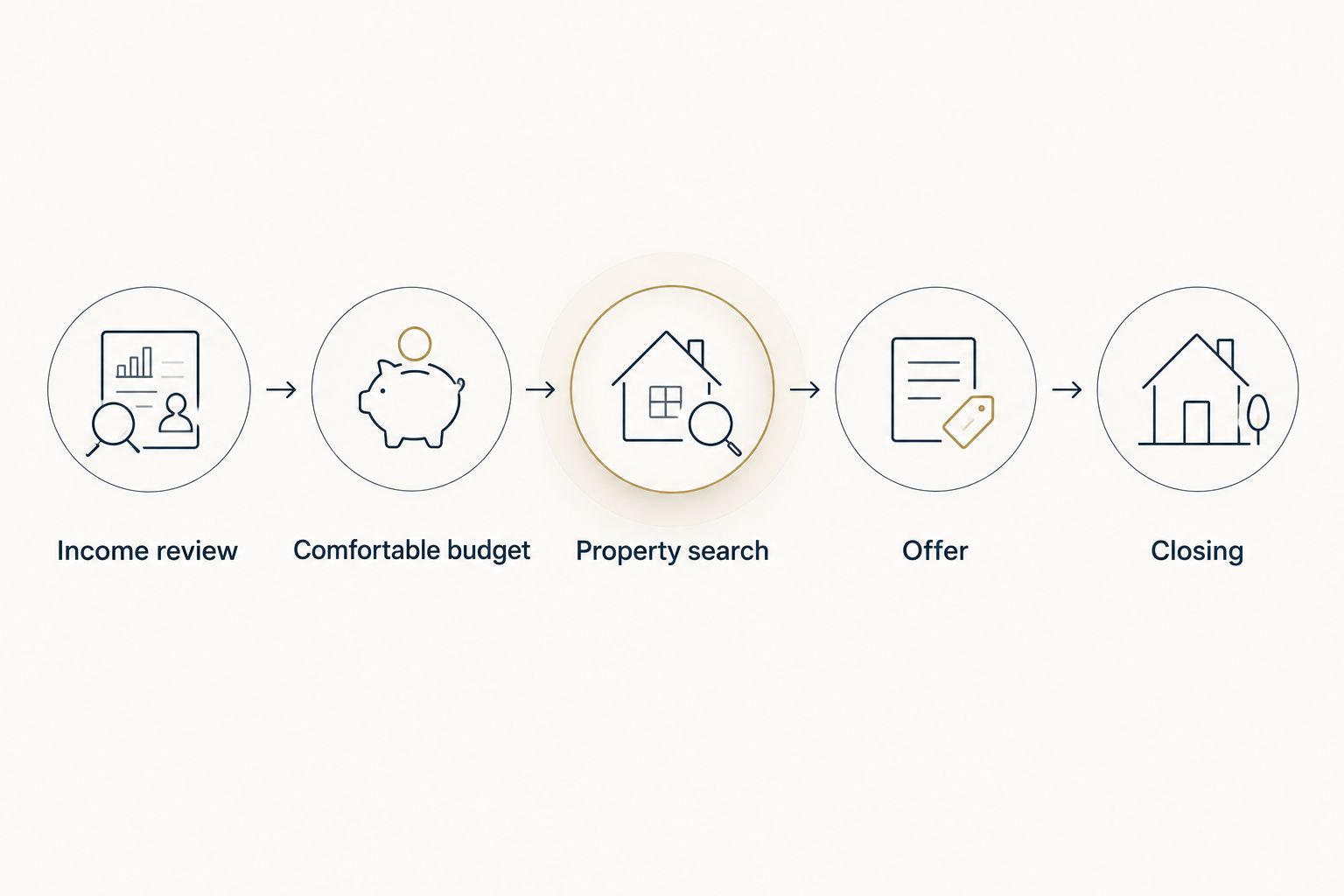
The sequence matters: income review comes before a comfortable budget, and a comfortable budget comes before an offer. Property enthusiasm should not reverse that order.
Compare your purchase options
Best for means best fit for your evidence and cash position, not an automatic recommendation. Ask each lender to explain the applicable requirements in writing; program names alone do not establish whether you qualify.
| Option | Best for | Main benefit | Key limitation |
|---|---|---|---|
| Conventional mortgage | Buyers whose documented income meets conventional underwriting requirements | Uses established conventional underwriting guidelines | Business revenue and taxable income require analysis; eligibility is not automatic |
| Bank-statement mortgage | Buyers whose eligible deposits support a lender’s alternative documentation program | Offers a different way to document income | Lender-specific expense adjustments, terms, and restrictions require close review |
| Cash purchase | Buyers with sufficient verified funds beyond business operating needs | Removes mortgage underwriting from the purchase | Commits substantial liquid funds and does not remove property due diligence |
| Delayed purchase | Buyers who need clearer records or stronger reserves | Creates time to address a specific financing weakness | Postpones the move without guaranteeing future approval or market conditions |
A cash purchase still requires disciplined inspection, title review, and a clear understanding of ownership costs. Delaying is a useful option only when you name the problem you intend to solve, such as incomplete records or insufficient reserves.
Common mistakes self-employed Dallas buyers make
Treating every business deposit as personal income
Account transfers, borrowed money, and receipts needed to cover business expenses do not all represent income available for a mortgage. Ask the lender which deposits count and what supporting records are required before basing your search on account activity.
Changing tax decisions solely to qualify
Tax planning and mortgage qualification serve different purposes. Discuss proposed changes with both your accountant and lender before acting; a mortgage application does not justify inaccurate reporting or a tax decision you do not understand.
Shopping homes before reviewing the income file
An initial payment estimate does not settle self-employed income questions. Obtain a document-based lender review before committing to a property that depends on a particular qualifying-income calculation.
Using working capital as though it were spare savings
A business account balance can include money needed for payroll, taxes, suppliers, or upcoming obligations. Identify those commitments before transferring funds, and ask the lender what documentation is required when business assets support the purchase.
Assuming a home office makes every property suitable
Physical space and permitted use are separate questions. Review property-specific restrictions and local requirements before assuming you can receive clients, store equipment, or operate your business from the home.
FAQ
Can I buy a house in Dallas if I’m self-employed?
Yes, self-employed buyers can qualify for a home purchase in Dallas when they meet the applicable financing requirements. Lenders review documented income, debts, credit, assets, and the property rather than treating self-employment alone as a disqualification.
How long do I need to be self-employed before getting a mortgage?
The required history depends on the loan program and your circumstances. Fannie Mae’s Selling Guide generally calls for a two-year earnings history for self-employed borrowers, with exceptions subject to its requirements and lender review.
Do mortgage lenders use business revenue or take-home income?
Mortgage lenders calculate qualifying income under the applicable program’s rules rather than simply using gross business revenue or the amount you transfer to yourself. Tax returns, business expenses, ownership, and current financial records can affect that calculation.
Is a bank-statement loan better than a conventional mortgage?
A bank-statement loan is not automatically better for a self-employed buyer. Compare eligibility, income calculations, borrowing costs, reserves, and restrictions against a conventional mortgage using the same purchase scenario.
Can I use business funds for my down payment?
Business funds can be acceptable under some loan guidelines when the lender verifies ownership, access, and any required analysis of the withdrawal’s effect on the business. Get the lender’s requirements before transferring money, and consult your accountant about the business implications.
Can I buy a Dallas home with space for my business?
You can search for a home that accommodates your work, but the intended activity must comply with applicable restrictions and local requirements. Verify association rules, deed restrictions, and any relevant municipal requirements before committing.
Who can help me coordinate a self-employed home purchase in Dallas?
The Scott Michaels Group provides real estate advisory support for Dallas and North Dallas buyers. Pair that representation with a lender who reviews self-employed income and an accountant who understands your business records; each professional addresses a different part of the purchase.
One last thing
An approval answers a financing question, not a business-management question. Before you commit to a home in 2026, write down which funds must stay in the business and which funds are genuinely available for the purchase.
Then compare that boundary with your lender’s requirements and your household budget. A property belongs on your shortlist only when the financing, ongoing ownership obligations, and business cash needs work together.