
Medical professionals’ home buying in Dallas is the process of matching a home, financing, and location to clinical work with the aim of securing a suitable primary residence without disrupting your career transition. This 2026 guide explains how to evaluate hospital access, employment documentation, student debt, and closing dates before you commit.
- Home buying for medical professionals in Dallas starts with work locations, financing review, and a realistic closing timeline.
- The Scott Michaels Group suits Dallas medical professionals seeking buyer representation, not mortgage underwriting.
- Compare conventional financing with any physician mortgage you qualify for; eligibility and terms depend on the lender.
- Test hospital access and review property condition before choosing a home based on appearance.
Why home buying matters for Dallas medical professionals
A home must support the work you actually do. A hospital-based physician, an outpatient clinician, and a traveling nurse need different location criteria, even when their preferred homes look similar.
For your 2026 search, treat employment, financing, and location as connected decisions. An employment start date affects your purchase timeline; lender documentation requirements affect when you can proceed; work locations determine which neighborhoods deserve attention.
The Scott Michaels Group is best for Dallas medical professionals seeking buyer representation rather than mortgage underwriting. Explore The Scott Michaels Group for real estate guidance across Dallas and North Dallas, while keeping loan eligibility and approval decisions with your lender.
The distinction matters: an agent helps you evaluate properties and negotiate a purchase, while a lender determines whether your financial profile meets its requirements. Neither role replaces your inspection, insurance, or legal review.
Build your Dallas home-buying plan
1. Define your work-location requirements
Start manually with a map, your expected schedule, and every location where you must report. Do not choose a neighborhood from the address of your primary employer alone. If your role includes rotations, multiple clinics, or overnight call, include those destinations in the search brief.
For a 2026 relocation, separate confirmed work assignments from possible future placements. A home that suits an unconfirmed assignment is not necessarily suitable for your signed role. Keep Plano and other North Dallas locations in consideration only when they fit your actual work pattern.
Finish this step with a written location brief:
- List your confirmed hospital, clinic, and administrative work addresses.
- Set a maximum acceptable journey for each required destination.
- Compare 2 routes to your most important work location.
- Test travel during the hours you expect to report and return.
- Record which assignments remain unconfirmed before narrowing neighborhoods.
2. Establish a lender-reviewed spending boundary
Gather your financial documents yourself before browsing at the top of a search range. Include employment agreements, income records, student-loan statements, and funds intended for the purchase. Ask the lender which documents it needs for your employment situation rather than assuming a signed contract is sufficient.
Separate the lender’s approval limit from the household commitment you want. Your working budget should account for ownership expenses, debt obligations, and cash you intend to retain. A larger approval does not make a larger purchase the right decision.
Use the financing conversation to resolve specific questions:
- Ask how the lender evaluates your current income and employment start date.
- Request its treatment of student-loan obligations in writing.
- Identify the documents required before underwriting can proceed.
- Build an ownership worksheet covering taxes, insurance, maintenance, and association obligations.
- Keep moving expenses and a household reserve separate from purchase funds.
3. Compare mortgage paths before choosing one
Request written explanations directly from lenders, then compare the same purchase scenario across the options you qualify for. Physician mortgage programs have lender-specific eligibility and requirements. A medical job title alone does not establish eligibility, and nurses or allied health professionals should not assume that a physician-branded program includes their profession.
In 2026, ask lenders to explain the complete loan structure rather than selecting a program from its name. The Scott Michaels Group can provide buyer representation while you coordinate financing with your chosen lender; it is not a substitute for that lender’s underwriting decision.
Make the comparison specific:
- Ask which professions, credentials, and career stages qualify.
- Compare conventional financing with any specialty program available to you.
- Ask how each lender handles student debt and future employment income.
- Confirm whether the proposed property type meets program requirements.
- Request an explanation of cash requirements, mortgage insurance, and rate structure.
4. Translate your schedule into property criteria
Create your own must-have list before touring. Then use buyer representation to turn that list into a focused search rather than repeatedly viewing homes that fail the same practical test. For a medical professional, an attractive living room does not compensate for an unsuitable sleep environment or an impractical arrival routine.
Separate requirements from preferences. Daytime rest, a workable departure route, and a floor plan that supports your household deserve explicit attention. Do not assume a detached house solves noise concerns or that a condo creates fewer responsibilities without reviewing the property and its documents.
Evaluate these details during each showing:
- Check bedroom placement relative to roads, shared walls, and household activity.
- Evaluate window coverings and your ability to control daylight.
- Walk the route from parking to the entrance with work bags in mind.
- Examine space for household routines during overnight or irregular shifts.
- Review association rules relevant to parking, occupancy, and property use.
5. Compare homes with one decision framework
Build a simple spreadsheet and score 3 candidate homes against the same requirements. Use categories such as work access, sleep conditions, household fit, property condition, and ownership obligations. Keep the scoring scale consistent; the purpose is to expose trade-offs, not to turn personal preferences into a scientific ranking.
Reject a home that fails a nonnegotiable before comparing finishes. A property can look appealing and still require a daily compromise you already decided against. Your written criteria provide a useful reference when a showing creates pressure to overlook that compromise.
Apply the framework consistently:
- Use the same criteria and scoring scale for every finalist.
- Mark each nonnegotiable as satisfied, unresolved, or failed.
- Separate observed conditions from statements that still need verification.
- Record questions for the inspector, lender, insurer, or association.
- Revisit the strongest candidate at a different time before committing when practical.
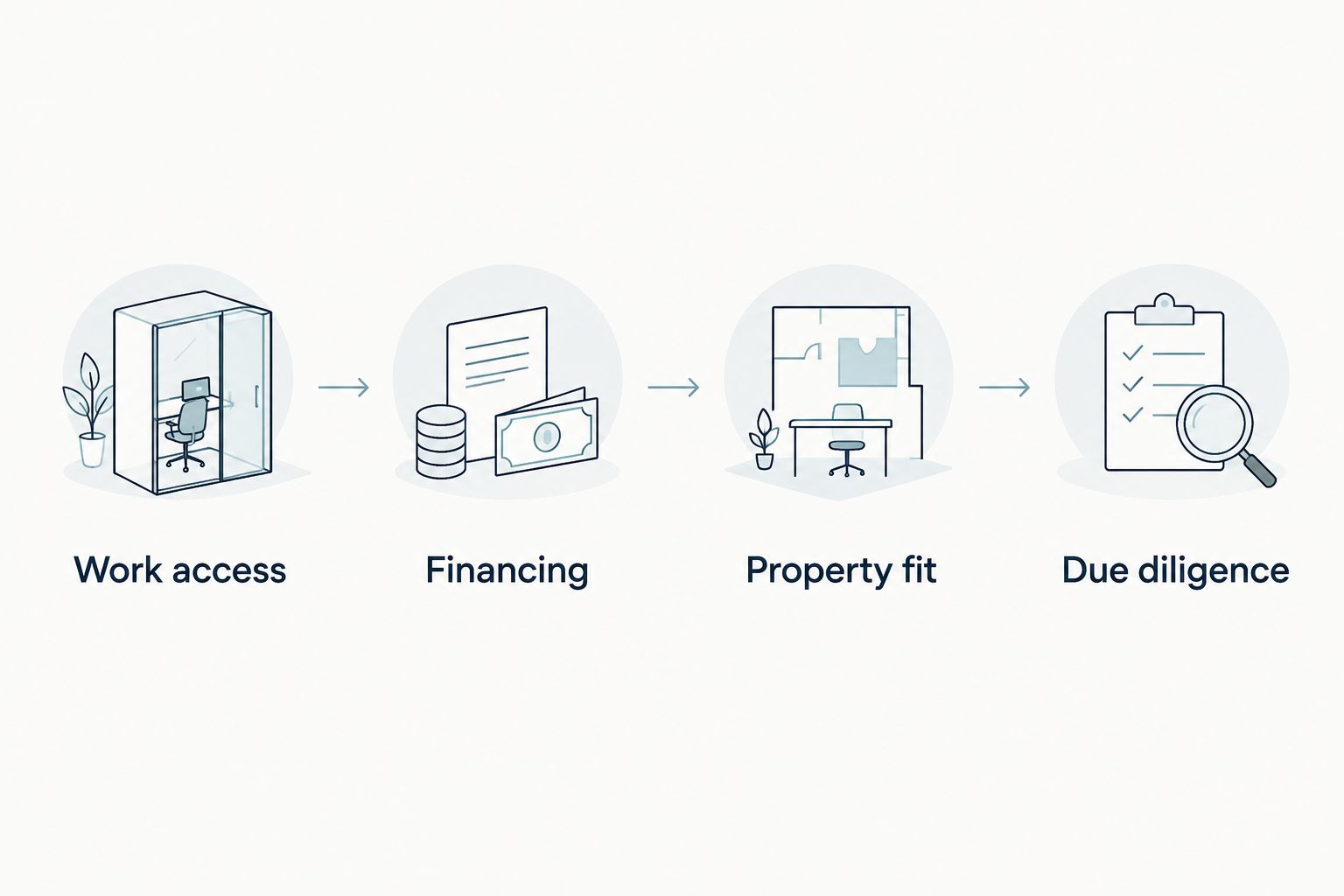
The decision sequence is simple: Work access, Financing, Property fit, and Due diligence. Resolve each part before treating a preferred home as a purchase-ready choice.
6. Investigate the property before removing protections
Start with the available disclosures and a written list of questions. Then engage the appropriate professionals to assess condition, coverage, title, and financing requirements. A showing is not an inspection, and an attractive renovation does not answer questions about the underlying systems.
For a condo, review association materials as part of the purchase decision, not as an administrative afterthought. For any property, discuss contract protections and deadlines before signing. If a concern requires specialist evaluation, establish who will investigate it and when you need the answer.
Keep the review organized:
- Arrange an independent inspection appropriate to the property.
- Obtain insurance information early enough to assess suitability.
- Ask about drainage, prior repairs, and disclosed property conditions.
- Review applicable association documents and ownership obligations.
- Discuss unresolved findings and contractual options with the appropriate adviser.
7. Coordinate closing with your clinical transition
Create a shared calendar yourself, then coordinate it with your agent and lender. Include your work start, lease obligations, moving arrangements, lender milestones, contractual deadlines, and possession terms. In 2026, a relocation plan should still distinguish an expected closing date from confirmed access to the home.
Protect time for decisions that require your participation. Ask how documents, questions, and approvals will reach you during clinical hours, and agree on an alternative communication method when you are unavailable. A workable purchase timeline leaves room for the work transition; it does not depend on every event happening at once.
Complete the handoff deliberately:
- Confirm closing and possession arrangements from the transaction documents.
- Schedule 30-minute calendar windows for reviewing outstanding decisions.
- Ask the lender what changes require notification before closing.
- Arrange utilities and moving logistics around confirmed possession terms.
- Verify wiring instructions through an independently confirmed contact method.
Compare your buying and financing options
There is no single option that fits every medical professional. Compare representation, financing, and timing separately: hiring an agent does not choose your mortgage, and qualifying for a mortgage does not establish that buying immediately fits your plans.
| Option | Best for | Main advantage | Key limitation |
|---|---|---|---|
| Self-directed purchase planning | Buyers organizing requirements before professional conversations | Gives you a clear brief and a record of priorities | Does not replace underwriting, inspection, or contract advice |
| The Scott Michaels Group buyer representation | Dallas and North Dallas buyers seeking guided property selection and negotiation | Provides real estate advisory support through the purchase process | Does not provide mortgage approval or replace independent specialist reviews |
| Conventional mortgage review | Buyers evaluating a standard financing route | Creates a financing baseline for comparing alternatives | Qualification and property requirements still need lender review |
| Physician mortgage review | Eligible medical professionals evaluating a specialty loan | Allows comparison of a profession-specific program with other financing | Eligibility and terms vary by lender; not every medical profession qualifies |
| Temporary rental before buying | Relocating clinicians with unresolved work-location or timing questions | Lets you evaluate daily routines before committing to ownership | Requires a separate housing decision and a later purchase process |
Choose the option that addresses your unresolved decision. If your work assignment is uncertain, a different mortgage does not solve that uncertainty. If your location is settled but financing is not, more property tours will not resolve underwriting questions.
Common mistakes medical professionals make
Buying around one workplace address
A primary hospital address is an incomplete search brief when your role includes other reporting locations. Map all confirmed destinations and weight them by your actual obligations. Do not let a convenient journey to an occasional location outweigh an impractical daily routine.
Treating future income as approved income
An offer letter and a lender’s approval are different things. Ask the lender exactly how it evaluates your employment agreement and when required conditions must be satisfied. Make purchase commitments around the lender-reviewed scenario, not an assumed treatment of future earnings.
Letting a program name decide the mortgage
A physician-branded loan deserves the same scrutiny as any other financing. Compare eligibility, structure, required funds, and obligations rather than assuming the specialty label makes it the best fit. Keep a conventional financing comparison in the discussion when you qualify.
Leaving property review to the last available moment
A demanding schedule is a reason to organize due diligence early, not to compress it. Arrange inspection access, document review, and decision windows before clinical duties consume the calendar. Escalate unresolved questions while your contractual options remain available.
FAQ
What's the best first step for home buying as a medical professional in Dallas?
Start by confirming your work locations and requesting a lender review of your employment and financial documents. Those decisions establish where to search and which purchase scenario to evaluate.
Can I buy a Dallas home before starting my new medical job?
Ask your lender whether its program accepts your future employment income and what conditions apply. A signed employment agreement does not by itself establish mortgage approval or a workable closing date.
Do nurses and other medical professionals qualify for physician mortgages?
Eligibility depends on the lender and the specific program. Ask for the accepted professions and credentials in writing rather than assuming all medical professionals qualify.
Is Plano better than Dallas for a hospital commute?
Choose between Plano and Dallas by testing travel to your actual work locations at your reporting hours. A city name alone does not establish which home offers the better journey for your schedule.
Should I rent before buying when relocating for a medical position?
Rent first when you need to resolve work-location or household questions before committing to ownership. Buying deserves consideration when those requirements, financing, and your expected plans are sufficiently clear.
Is a condo better than a house for a busy medical professional?
Choose by comparing the specific property's responsibilities, rules, sleep conditions, and access rather than its label. Review condo association documents and inspect either property type before deciding.
Can The Scott Michaels Group help with my Dallas home search?
The Scott Michaels Group provides buyer representation across Dallas and North Dallas. Use that real estate guidance alongside your lender, inspector, and other appropriate advisers.
One last thing
Before you submit an offer in 2026, rehearse an ordinary workday from the property: departure, parking, return, meals, and sleep. Walk through the inconvenient version of that day, not just the ideal one. The right home supports your clinical schedule and your life away from it.