
Instead of manually reconciling your builder’s deadlines with your lender’s requests, connect the signed purchase contract, financing terms, construction milestones and closing calendar in one shared checklist. For a 2026 home purchase in Melissa, TX, the essential rule is simple: a builder contract commits you to purchase terms; it does not approve your mortgage.
- Builder contract to mortgage Melissa TX: coordinate contract deadlines and lender approval before committing to closing.
- The Scott Michaels Group fits North Dallas buyers seeking real estate advisory support alongside their mortgage lender.
- Builder approval, mortgage underwriting and property completion are separate checkpoints.
- Confirm financing protections, appraisal terms and rate-lock expiration before signing or changing your purchase agreement.
Why this matters
A new-construction purchase connects two separate processes. Your builder controls the purchase agreement and construction schedule; your lender evaluates whether you and the property meet the loan requirements.
Those processes do not automatically move together. A contract amendment can change the amount your lender must evaluate, while a construction delay can push closing beyond your rate-lock expiration.
The Scott Michaels Group provides real estate advisory support for North Dallas buyers. Your lender handles mortgage approval, and a Texas real estate attorney handles legal interpretation when a contract provision needs review.
The goal is not simply to obtain a preapproval. It is to make the purchase agreement, approved financing and finished property align on closing day.
Before you start
- Collect the complete agreement. Have the proposed or signed builder contract, every addendum, the property identification, selections and any written amendments. Give your lender the complete package, not only the signature page.
- Prepare your financing file. Gather the income, asset and identification documents your lender requests, plus your preapproval and any Loan Estimate already issued. Confirm who will coordinate with the builder and title company.
- Check the non-obvious risk: financing language. Do not assume the builder’s contract lets you cancel and recover your deposit if financing fails. Identify the actual financing conditions, notice requirements and deadlines before you sign; obtain legal advice where needed.
For your 2026 purchase, confirm whether you are buying a completed home from the builder or financing construction itself. The workflow below focuses on a builder sale financed with a purchase mortgage; construction financing requires a different loan structure.
Contract and financing requirements
Start with the contract, because it defines obligations that a lender’s preapproval does not replace. Keep 3 working files: the purchase agreement, the loan documents and a deadline tracker.
Establish the contract handoff
- Identify the transaction. Confirm the buyer names, property address or lot identification, purchase amount, deposit terms and anticipated completion provisions. Resolve discrepancies before those details enter the loan file.
- Locate the financing provisions. Identify any financing condition, loan-application deadline, approval deadline and cancellation procedure. If the agreement does not provide a protection you need, discuss it before signing rather than assuming a standard Texas resale provision applies.
- Send the entire agreement to your loan officer. Include addenda covering options, credits, completion and closing. Ask the loan officer to confirm receipt and identify anything missing.
- Build the deadline tracker. Record the contract requirement, responsible person, due date and proof of completion. Include the required method for delivering notices; an informal conversation is not a substitute for contractual notice.
Expected result: Your lender has the same purchase terms you signed, and you know which deadlines affect your financing and deposit.
Builder agreements differ. If the meaning of a financing provision, default clause or remedy is unclear, have a Texas real estate attorney explain it before you rely on it.
Loan application and lender selection
A builder’s preferred lender and an independent lender are financing options, not substitutes for reviewing the purchase agreement. Compare written terms against the same property, loan type and assumptions.
| Financing option | Best for | Advantage | Limitation |
|---|---|---|---|
| Builder’s preferred lender | Buyers evaluating a builder-connected financing offer | Provides a direct point of coordination with the builder’s transaction process | Connected terms still need independent comparison; do not assume the offer is the best fit |
| Independent lender | Buyers seeking a separate financing comparison | Gives you another written proposal to evaluate | Requires coordination with the builder’s contract and construction deadlines |
Establish the mortgage file
- Confirm the loan structure. Tell the loan officer whether the home is completed, under construction or not yet started. Ask whether the proposed purchase mortgage fits the property’s expected condition at closing.
- Complete the application accurately. Supply the documents the lender requests and disclose other obligations. Make sure the application reflects the contract’s buyer names and property details.
- Review the Loan Estimate. The Consumer Financial Protection Bureau explains that lenders generally must provide a Loan Estimate within 3 business days after receiving a mortgage application. Review the loan amount, loan type, projected payment, closing costs and rate-lock information.
- Compare like with like. Ask competing lenders to use consistent assumptions about the property, down payment and loan structure. Separate a builder-related credit from the other financing terms so you can see the complete proposal.
- Confirm how to proceed. Ask each lender how it accepts your intent to proceed and what happens next. Receiving a Loan Estimate does not mean you have completed underwriting or committed to that lender.
Expected result: You have a documented financing plan tied to the actual builder agreement, with a clear route from application to underwriting.
For a 2026 comparison, distinguish the estimate’s response window from a rate lock. CFPB guidance explains that estimated closing costs generally must be honored for at least 10 business days, subject to applicable rules and changed circumstances; an unlocked interest rate is not guaranteed by that window.
Underwriting and construction milestones
Mortgage approval depends on both the borrower and the property. A conditional approval means outstanding requirements remain; read the conditions rather than treating the word approval as permission to stop tracking the file.
Coordinate the approval checkpoints
- Assign each condition. Ask your loan officer which items belong to you, the builder, the appraiser or the title company. Keep the outstanding-condition list with your deadline tracker.
- Confirm appraisal timing. Let the lender order the appraisal through its process. Ask how the lender will handle an appraisal based on plans or an unfinished property and whether a completion inspection will be required.
- Check the construction schedule. Obtain the builder’s current anticipated completion and closing dates in writing. Share changes with the lender rather than assuming the lender has received them.
- Align the rate lock. Confirm the expiration date, extension terms and responsibility for any extension charges. Do not select a lock period without discussing the construction schedule.
- Report financial changes. Before opening credit, financing furniture, changing employment or moving large sums, ask your lender how the change affects underwriting. Keep documentation for transfers and deposits.
Expected result: Every unresolved loan condition has an owner, and your construction schedule is being checked against appraisal and rate-lock requirements.
The 2026 milestone sequence should remain visible to everyone coordinating the purchase: Contract review, Loan application, Underwriting, Completion, Closing review. These are checkpoints, not a promise that every task happens strictly in order.
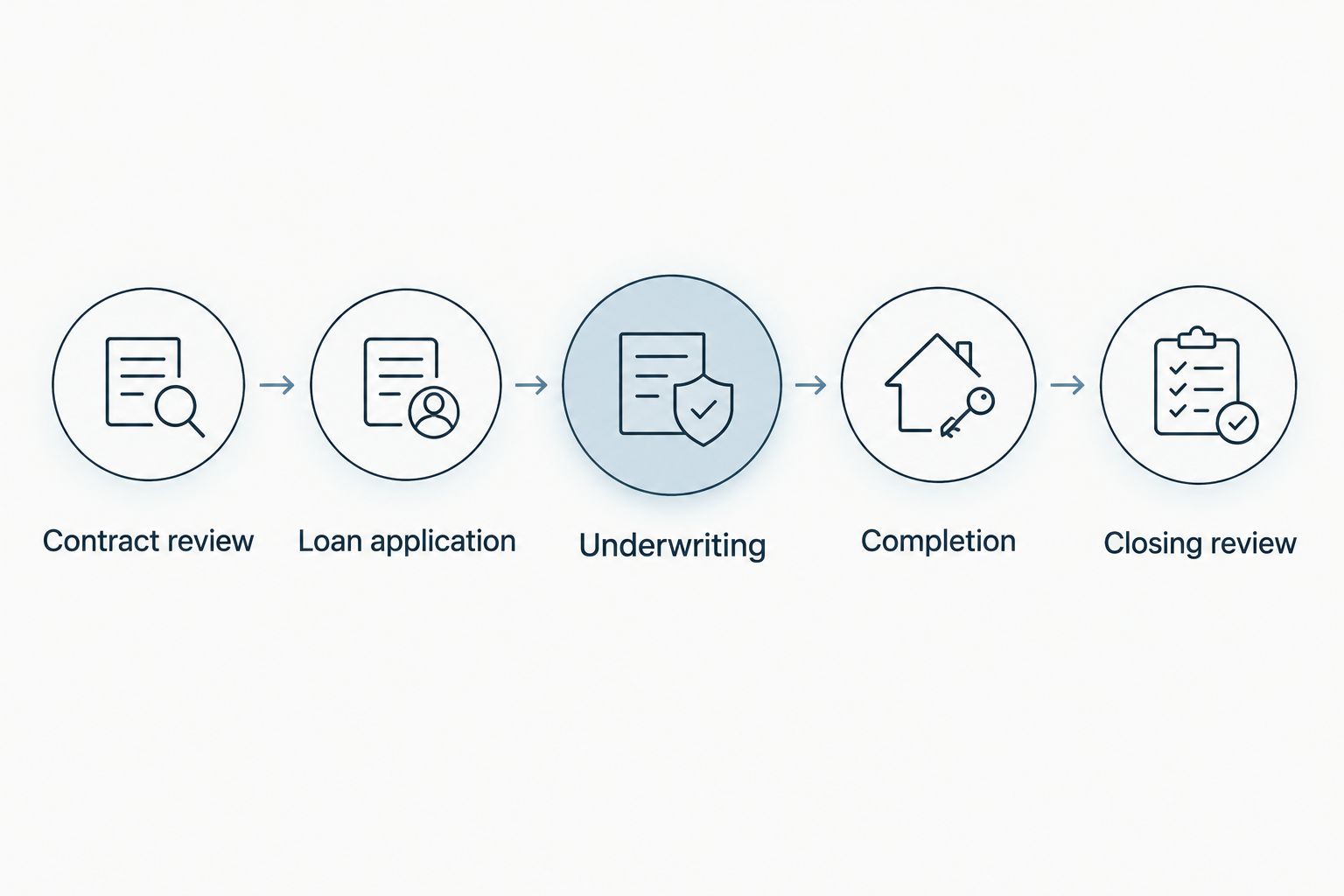
The Scott Michaels Group can support real estate coordination and purchase decisions; mortgage underwriting remains with your lender. Keep representation and lending responsibilities distinct so unanswered questions reach the person who can resolve them.
Closing documents and funding
A projected closing date is not the same as confirmation that all loan and property conditions are satisfied. Ask the lender and title company what remains before scheduling movers or making other difficult-to-reverse commitments.
Reconcile the final file
- Check the final agreement. Confirm that signed amendments, selections and applicable credits appear in the lender’s file. A verbal understanding does not update the documents.
- Review the Closing Disclosure. For mortgages covered by the federal disclosure rules, you must receive the initial Closing Disclosure at least 3 business days before consummation. Ask your lender to confirm the timing for your transaction.
- Compare documents. Review the Closing Disclosure against the latest Loan Estimate and signed purchase terms. Ask about differences in the loan amount, payment, cash needed to close and credits.
- Separate the walkthrough from lender clearance. Document unfinished or defective work through the builder’s process. Ask the lender whether outstanding work affects funding; do not assume a walkthrough list satisfies lender requirements.
- Verify funds and possession. Confirm wiring instructions through an independently verified telephone number. Ask the title company when funding, closing and possession occur under your agreement rather than assuming keys follow immediately after signing.
Expected result: Your final loan documents reflect the purchase agreement, required conditions are addressed, and you understand when funds and possession will change hands.
When the builder contract changes
A signed change order or revised completion date creates a second workflow: update the mortgage file whenever the purchase terms change. Do not wait for final closing documents to reveal the difference.
- Purchase amount changes: Send the signed amendment to the lender and ask whether underwriting or the appraisal needs review.
- Credits change: Have the lender confirm that the revised credit fits the loan program’s requirements and appears correctly in the closing documents.
- Completion moves: Recheck the rate lock, document requests, appraisal requirements and closing schedule.
- Buyer or ownership details change: Obtain lender and title-company guidance before amending names or the intended ownership structure.
Expected result: The loan file follows the agreement you will actually close, not an earlier version. Keep the previous documents, but clearly identify the current signed version.
Troubleshooting
The builder wants financing approval before the lender is finished
Ask the lender to identify exactly what remains and whether the outstanding items concern you or the property. Review the contract deadline immediately; request any necessary extension in writing before the deadline expires, with legal guidance where appropriate.
The appraisal does not support the contract amount
Ask the lender to explain the financing effect and its process for addressing factual appraisal errors. Review the contract’s appraisal and financing provisions before choosing between renegotiation, additional funds or another permitted response; do not assume cancellation is available.
Construction extends beyond the rate lock
Contact the lender before expiration and obtain the extension terms in writing. Ask the builder about responsibility under the agreement, but do not assume a delay automatically obligates the builder to cover the consequences.
A builder credit is missing from the closing documents
Send the signed agreement establishing the credit to the lender and title company. Ask them to reconcile the discrepancy and confirm whether the credit is permitted under the loan program before you approve the final figures.
You receive changed wiring instructions
Stop and verify the instructions by calling a previously verified title-company number. Do not use a telephone number supplied only in the message announcing the change, and do not rely on an email reply as verification.
Customize your workflow
For a 2026 Melissa purchase, add your own dependencies to the deadline tracker: an existing-home sale, lease termination, relocation schedule or required accessibility work. Tell your lender about financial dependencies and ask your advisor how the purchase agreement addresses timing.
Use advisory support for decisions, not just document forwarding. The Scott Michaels Group’s real estate advisory role fits buyers who want help coordinating purchase choices and representation; it does not replace lending approval, an inspection or legal advice.
Before committing to closing, ask for a written status update covering the contract, loan conditions, property completion and possession. Each item should identify what remains and who is responsible.
FAQ
How do I connect a builder contract to a mortgage in Melissa, TX?
Give your lender the complete signed builder agreement and coordinate its financing deadlines with underwriting, appraisal and completion requirements. Track amendments, loan conditions and closing dates in one shared checklist.
Does signing a builder contract mean my mortgage is approved?
No. A builder contract establishes purchase obligations, while your lender separately evaluates your finances and the property before approving the mortgage.
Do I have to use the builder’s preferred lender?
Review the builder agreement and any connected financing terms rather than assuming a requirement. Ask for the terms in writing and compare another lender’s proposal using consistent loan assumptions.
Can I get my deposit back if financing falls through?
Your contract determines whether financing failure permits cancellation and return of the deposit. Have a Texas real estate attorney review the relevant conditions, notice requirements and deadlines before relying on that protection.
What happens if my new home is not finished before my rate lock expires?
Contact your lender before expiration to discuss the extension terms and financing consequences. Review your builder agreement separately to determine whether it addresses responsibility for a construction delay.
Is a construction loan the same as a mortgage for a builder home?
No. A purchase mortgage generally finances your acquisition of the home, while construction financing funds the building process under a different structure. Ask your lender which structure matches your agreement.
When should I receive the Closing Disclosure?
For mortgages covered by the federal disclosure rules, you must receive the initial Closing Disclosure at least 3 business days before consummation. Ask your lender to confirm the applicable calendar and whether a later change affects your closing schedule.
One last thing
The most useful question is not whether your loan is approved, but what remains before it can fund. Ask that question again after a contract amendment, a construction delay and the final walkthrough; each event can expose a different unfinished requirement.