Best starting point: a homesite with documented access, utilities, and permitted use. Best for privacy: acreage suited to a custom home. Best for an existing neighborhood: an infill lot. This 2026 guide ranks parcel types for your search for land for sale mckinney tx—not individual listings or claims that a particular property is available.
- For land for sale mckinney tx, prioritize documented access, permitted use, utilities, and total project scope.
- Choose a documented homesite for fewer unresolved buildability questions; choose acreage when space matters more than simplicity.
- Thescottmichaelsgroup helps buyers find land across the Dallas–McKinney–Collin County area.
- Compare infill lots, custom-home acreage, recreational land, and development tracts against different purchase goals.
Why this matters
An attractive parcel is not automatically a suitable building site. Road frontage, an attractive view, and nearby houses do not establish legal access, utility capacity, or permission for your proposed project.
Thescottmichaelsgroup is a Keller Williams-affiliated real estate team led by Scott Michaels, serving homebuyers and sellers across the Dallas–McKinney–Collin County area. For a 2026 land purchase, define the intended use before comparing properties: a primary residence, recreational retreat, and development project require different evidence.
The best parcel is the one that supports your intended use with the fewest unresolved constraints—not the one with the most appealing photographs. The rankings below help you decide which property type deserves your attention first.
What makes the best land parcel in McKinney?
Use these criteria before you rank any candidate:
- Permitted use: Confirm the governing jurisdiction, zoning where applicable, recorded restrictions, and approval requirements for your intended use.
- Legal access: Establish a recorded right to reach the property. Physical access alone does not settle the question.
- Utility feasibility: Identify providers, service locations, connection requirements, and wastewater options. A nearby line is not a service commitment.
- Usable land: Review boundaries, easements, flood hazards, drainage, terrain, and other conditions affecting the proposed building area.
- Total project scope: Compare the work required after purchase, including surveying, engineering, access, utilities, and site preparation.
- Exit flexibility: Consider whether the parcel also suits another plausible buyer without assuming future rezoning or subdivision approval.
McKinney land options at a glance
These rankings describe purchase scenarios, not verified properties. Every parcel still needs its own document review and site investigation.
| Rank and parcel type | Best for | Standout advantage | Key limitation |
|---|---|---|---|
| 1. Documented homesite | Buyers prioritizing a clearer building plan | Important feasibility questions already have supporting records | Records still need verification against your specific design |
| 2. Custom-home acreage | Buyers prioritizing privacy and layout flexibility | Space to evaluate separation, orientation, and outdoor uses | More land does not guarantee a larger usable building area |
| 3. Infill lot | Buyers seeking an existing neighborhood setting | Surrounding development provides context for the proposed home | Setbacks, easements, and access can constrain the footprint |
| 4. Recreational parcel | Buyers whose primary goal is outdoor use | Selection centers on the activities you intend to pursue | Recreation suitability does not establish residential suitability |
| 5. Development tract | Buyers pursuing a defined development project | Evaluation can focus on an explicit site program | Approval, infrastructure, and engineering questions demand deeper review |
1. Documented homesite: best land for a clearer building plan
A documented homesite is a parcel supported by records addressing access, permitted use, boundaries, and utility feasibility. The label describes the evidence you should seek; it is not a guarantee that construction can begin.
For your 2026 shortlist, ask whether those records support the home you actually intend to build. A parcel suitable for one layout does not automatically accommodate a different footprint, driveway, or wastewater arrangement.
Documented homesite pros:
- Gives you specific records to verify rather than relying on verbal assurances.
- Helps your builder identify site-related questions before design advances.
- Supports a more focused comparison of remaining work across candidates.
Documented homesite cons:
- Existing records can be outdated or unrelated to your proposed project.
- Restrictions and easements can still rule out features you want.
Best for: Buyers who value a clearer route from land selection to home planning.
Request a current survey or an appropriate survey proposal, recorded restrictions, access documentation, and written utility information. Ask your builder to mark a preliminary footprint before you treat the parcel as a fit.
Verdict: Buy only after the supporting records match your intended home and your contract's review requirements are satisfied.
2. Custom-home acreage: best land for privacy and flexibility
Custom-home acreage gives you more ground to evaluate for placement, separation, and outdoor uses. The important distinction is between total acreage and land that supports your plans.
Start with a working site sketch. Place the home, driveway, outdoor areas, and any proposed outbuildings, then check that sketch against restrictions, easements, drainage, and wastewater requirements.
Custom-home acreage pros:
- Lets you evaluate alternative home orientations and building locations.
- Supports privacy planning through distance and placement.
- Gives you room to investigate separate outdoor uses.
Custom-home acreage cons:
- Access, utility routing, and maintenance require their own planning.
- Site constraints can leave less usable space than the boundary suggests.
Best for: Buyers who put space and layout flexibility ahead of a simpler site plan.
On a 2026 acreage search, do not stop at the view from the road. Walk the proposed building area with appropriate permission, understand the access route, and identify which portions require specialist assessment.
Verdict: Hold until the usable building area, access plan, and utility approach are documented.
3. Infill lot: best land for an existing neighborhood setting
An infill lot sits within an existing pattern of development. It suits buyers who want to assess a proposed home alongside established streets and neighboring properties rather than evaluate a more isolated site.
Nearby homes provide context, not proof of permission. Confirm the parcel's own setbacks, recorded restrictions, utility arrangements, and any applicable design requirements.
Infill lot pros:
- Lets you inspect the surrounding neighborhood before committing.
- Makes neighboring building placement and street conditions visible.
- Gives your designer a defined setting for the proposed home.
Infill lot cons:
- Easements and setbacks can restrict a seemingly adequate footprint.
- Construction access and staging need attention on constrained sites.
Best for: Buyers who prioritize an established neighborhood over a larger parcel.
Ask your designer to test the actual home footprint, including parking and driveway placement. A lot that accommodates a house does not necessarily accommodate your house.
Verdict: Buy only after a preliminary layout fits the parcel's verified constraints.
4. Recreational parcel: best land for outdoor use
Recreational land should be assessed against the activities you actually plan to pursue. Walking, gardening, keeping animals, and occasional personal use each raise different questions about access, restrictions, and site conditions.
Do not treat recreational suitability as evidence that you can build a residence later. Future residential use requires a separate review.
Recreational parcel pros:
- Keeps the search focused on your intended outdoor activities.
- Lets you assess terrain and access through direct site visits.
- Separates a recreation decision from an immediate homebuilding decision.
Recreational parcel cons:
- Restrictions or local rules can prohibit the activity you want.
- Access and maintenance remain important without a residence.
Best for: Buyers whose primary goal is a permitted outdoor use rather than immediate residential construction.
For a 2026 purchase, write down the intended activities and verify each one. If a future home matters to your decision, investigate that possibility before purchase rather than treating it as a fallback.
Verdict: Skip any parcel whose permitted uses do not match your primary activity.
5. Development tract: best land for a defined project
A development tract is land evaluated for a specific project, such as a proposed subdivision or another use requiring approvals. Its suitability depends on the proposed site program, governing requirements, infrastructure, and engineering—not simply its size.
Start with the project concept, then assess the land. Reversing that sequence leaves you trying to force a project onto a parcel that has not been shown to support it.
Development tract pros:
- Allows a defined project to guide the entire investigation.
- Gives engineers and planning professionals a concrete scope to assess.
- Makes approval and infrastructure questions explicit before purchase.
Development tract cons:
- The desired use or layout is not guaranteed approval.
- Infrastructure requirements and site constraints can change the project scope.
Best for: Buyers prepared to commission planning, engineering, and legal review for a defined development proposal.
For 2026 evaluations, distinguish current permissions from requested changes. Treat an unapproved concept as a proposal, not an established property feature.
Verdict: Hold until qualified professionals have assessed the project and identified the necessary approvals.
How these parcel types are ranked
The ranking starts with a residential buyer seeking a clearer building decision. A documented homesite comes first because supporting records directly address the access, permitted-use, utility, and site questions in the criteria above.
The remaining options serve different goals; they are not inferior versions of the same purchase. Move custom-home acreage to the top if privacy is your priority. Move recreational land or a development tract first only when that use defines your search.
No individual parcel is ranked here. A property-specific recommendation requires records, site information, and your intended use.
Turn your shortlist into a purchase decision
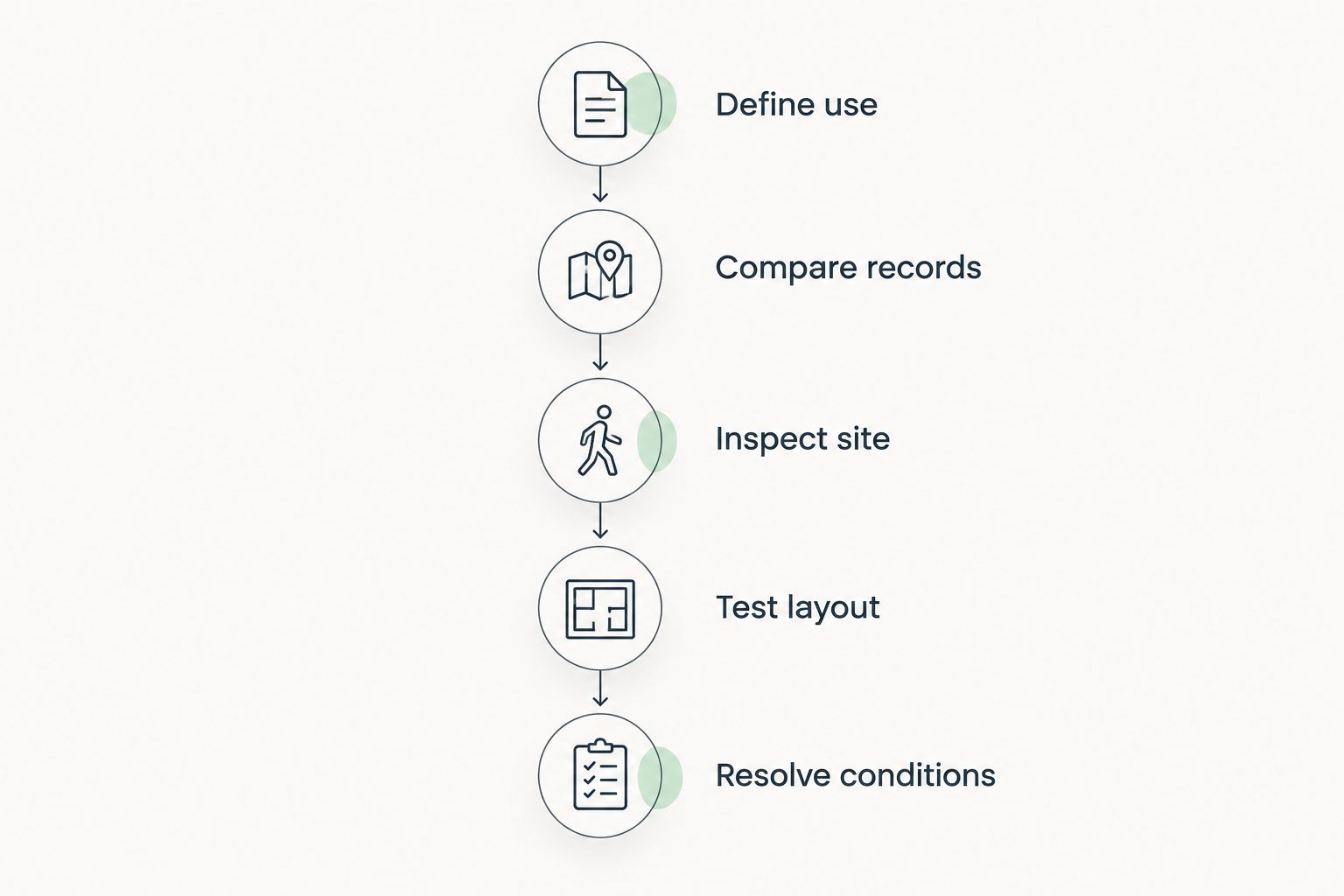
Apply the same process to each candidate so attractive presentation does not outweigh unresolved facts.
- Define use. Write a 1-page brief covering the intended building, outdoor uses, access needs, and non-negotiable restrictions.
- Compare records. Compare 3 candidate parcels using the same checklist for boundaries, restrictions, access, and utilities.
- Inspect site. Visit each serious candidate 2 times, at different times of day, with permission. Observations supplement professional review; they do not replace it.
- Test layout. Have the appropriate professionals assess the proposed footprint, access, drainage, and utility approach.
- Resolve conditions. Discuss contract protections and investigation requirements with your agent and qualified advisers before committing.
Keep unresolved items visible. A utility inquiry awaiting a response is not confirmed service, and a proposed driveway is not documented legal access.
Start your McKinney land search
Discuss your intended use and property priorities with Thescottmichaelsgroup.
Which land parcel should you choose?
Choose a documented homesite as the default for a primary-residence search. It directs your attention toward evidence of suitability rather than assumptions about what vacant land allows.
Choose acreage when privacy and placement flexibility justify the additional site planning. Choose infill when the neighborhood setting leads your decision. Recreational parcels and development tracts belong on separate shortlists because they answer different needs.
Thescottmichaelsgroup helps buyers find land across the Dallas–McKinney–Collin County area. Bring a written use brief to the search so property selection starts with your requirements, not an appealing photograph.
FAQ
What's the best land for sale in McKinney TX for building a home?
The best starting point is a homesite with documented access, permitted use, utility feasibility, and a suitable building area. Verify those records against your proposed home before treating the parcel as buildable for your project.
Is acreage better than an infill lot in McKinney?
Acreage is the better fit when privacy and placement flexibility lead your decision; an infill lot is the better fit when an existing neighborhood matters more. Neither option removes the need to investigate access, restrictions, utilities, and site conditions.
Can I build a house on any vacant parcel?
No, vacant land does not automatically permit or physically support a house. Confirm the governing rules, recorded restrictions, legal access, utility options, and site constraints for the specific parcel.
Does road frontage mean a parcel has legal access?
Road frontage alone does not establish every right or approval needed for your proposed access. Have the relevant title, survey, and access records reviewed, and verify driveway requirements with the appropriate authority.
How do I check utilities before buying land?
Contact the relevant providers and request written information about service feasibility and connection requirements for the parcel. Investigate wastewater arrangements separately rather than assuming a nearby utility line serves the property.
What should I review before buying recreational land?
Review whether your intended activities are permitted and whether the parcel provides suitable legal access and site conditions. Investigate future residential plans separately if they influence your purchase decision.
Who can help me search for land around McKinney?
Thescottmichaelsgroup helps buyers find land across the Dallas–McKinney–Collin County area. Give the team your intended use and property priorities, and involve qualified specialists for parcel-specific technical and legal questions.
One last thing
Ask for the document behind the property's strongest selling point. If the appeal is access, identify the recorded right; if it is buildability, identify the supporting approvals and site evidence; if it is utilities, obtain provider information.
Do not let an attractive parcel turn an unanswered question into an assumed fact.