Best overall: horse-ready acreage with usable pasture. Best for a custom build: unimproved pasture land. Best for a simpler private setup: residential horse acreage. For equestrian ranch land for sale Collin County TX buyers are evaluating in 2026, use these ranked property profiles to compare listings by horse use—not appearance alone.
- For equestrian ranch land for sale Collin County TX buyers should prioritize usable pasture, water, access, and permitted use.
- Horse-ready acreage is the default recommendation when existing improvements pass inspection and match your intended horse use.
- Unimproved pasture suits a custom layout; residential horse acreage suits buyers prioritizing a home and private horsekeeping.
- Thescottmichaelsgroup helps Collin County land buyers; verify each property's restrictions and physical condition before committing.
Why the property profile matters
A barn does not establish that a property suits your horses. Neither does an acreage total: drainage, access, restrictions, and the placement of improvements determine how you can use the land.
Thescottmichaelsgroup is a fit for buyers seeking real estate representation for equestrian ranch land in Collin County. The Keller Williams-affiliated team led by Scott Michaels helps buyers and sellers with land, luxury homes, and condos across the Dallas–McKinney–Collin County area. Start your search with Thescottmichaelsgroup, then evaluate individual properties against the same written requirements.
For a 2026 purchase, separate what exists today from what you intend to add. An attractive property can still require a different entrance, additional water infrastructure, or a permitted-use review before it fits your plans.
What makes the best equestrian ranch land
Use these criteria before comparing barns, homes, or decorative entrances. A property that fails a nonnegotiable requirement should leave your shortlist early.
- Usable land: Identify pasture, turnout, riding areas, drainage paths, and ground occupied by buildings or access lanes. Gross acreage is not the same as usable horse space.
- Permitted use: Review deed restrictions, applicable rules, and recorded documents against private horsekeeping, boarding, lessons, breeding, or events—whichever you actually intend.
- Water and drainage: Verify the water source and inspect how water moves through paddocks, entrances, and building areas.
- Horse infrastructure: Assess fencing, gates, shelter, storage, electrical work, and the condition of existing improvements.
- Trailer and service access: Check entry width, turning space, road conditions, and access for feed deliveries, veterinary visits, and emergency response.
- Daily operation: Map feeding, turnout, manure handling, equipment movement, and the relationship between the house and horse facilities.
Choose the property that passes your operating requirements, not the property with the longest feature list. Keep those requirements unchanged as you tour different listings.
Best equestrian property profiles at a glance
These rankings compare purchase approaches, not named parcels. Match the profile to your intended use before judging an individual listing.
| Rank and property profile | Best for | Standout feature | Key limitation |
|---|---|---|---|
| 1. Horse-ready improved acreage | Using existing horse facilities | Pasture and infrastructure evaluated together | Existing facilities can conceal repair needs |
| 2. Unimproved pasture land | Designing a custom equestrian layout | Freedom to plan placement before construction | Water, access, and improvements need separate evaluation |
| 3. Residential horse acreage | Combining a primary home with private horsekeeping | Home and horse facilities on the same property | Residential priorities can crowd out horse space |
| 4. Training-oriented acreage | A defined riding or training program | Space organized around riding and horse movement | Physical facilities do not establish permitted business use |
| 5. Contiguous expansion land | Adding land beside an existing holding | Direct connection to your current operation | Adjacency does not guarantee practical integration |
1. Horse-ready improved acreage: best for existing facilities
Horse-ready improved acreage combines land with existing horse infrastructure, such as fencing, shelter, or a barn. It earns the default recommendation because you can inspect the actual arrangement rather than assess only a proposed layout. Treat “horse-ready” as a condition to verify, not a listing description to accept.
Best for: Buyers whose requirements closely match the property's existing facilities.
Walk the complete horse route: unloading, shelter, turnout, water, and riding space. Check whether gates operate properly and whether equipment can reach storage without crossing occupied paddocks.
Horse-ready improved acreage pros:
- You can inspect the existing layout directly.
- Established improvements show how the property has been organized.
- Facilities that match your needs reduce the scope of your proposed changes.
Horse-ready improved acreage cons:
- Visible improvements do not establish structural or electrical condition.
- An unsuitable layout can require removal as well as replacement.
For your 2026 shortlist, request available maintenance records covering the preceding 12 months. Records support inspections; they do not replace them.
Verdict: Buy only when the land, facilities, and permitted use pass review together.
2. Unimproved pasture land: best for a custom equestrian layout
Unimproved pasture land suits buyers who want to decide where the barn, paddocks, access lanes, and riding areas belong. It provides a planning starting point rather than a finished horse property. The purchase decision must include the feasibility of your intended improvements.
Best for: Buyers with a defined equestrian plan who do not need existing facilities.
Prepare a concept layout before committing. Place water, vehicle access, drainage, manure handling, and utility needs alongside the proposed barn—not in a later planning exercise.
Unimproved pasture land pros:
- You can organize the property around your intended daily routine.
- Proposed improvements need not follow an inherited barn layout.
- You can separate horse movement from vehicle movement in the design.
Unimproved pasture land cons:
- An open field does not establish building or utility feasibility.
- Planned infrastructure requires its own professional review and approvals.
Ask relevant providers and professionals to verify service access and site constraints. A seller's description of future potential is not a completed feasibility assessment.
Verdict: Hold until your intended layout, access, water, and improvement plans are verified.
3. Residential horse acreage: best for home-centered horsekeeping
Residential horse acreage combines a home with land intended for private horse use. This profile fits buyers who want the household and horses on the same property without making a training operation the central objective. Evaluate the residence and horse areas as separate systems.
Best for: Buyers prioritizing a primary home alongside private horsekeeping.
Start outdoors before touring the house. Otherwise, an appealing kitchen or floor plan can distract you from inadequate turnout, inconvenient water access, or difficult trailer movement.
Residential horse acreage pros:
- Home and horse activities share a location.
- You can assess the relationship between living areas and animal facilities.
- A clearly defined private-use plan helps focus your property search.
Residential horse acreage cons:
- Driveways, landscaping, and residential structures occupy land horses cannot use.
- Residential restrictions can conflict with the use you have in mind.
Draw separate boundaries for household space, horse space, and service access. Confirm that the layout works without relying on a neighboring parcel or an assumed access right.
Verdict: Buy when the home and horse areas both work without compromising essential requirements.
4. Training-oriented acreage: best for a defined riding program
Training-oriented acreage places riding areas, horse circulation, and support facilities at the center of the property plan. It belongs on your shortlist when a specific riding or training program drives the purchase. Facilities alone do not establish permission to operate a business.
Best for: Buyers with a written training-use plan and clearly defined facility requirements.
Assess footing, drainage, fencing, lighting where present, storage, parking, and safe movement between areas. If your plan includes clients, staff, lessons, or boarding, examine those uses explicitly during due diligence.
Training-oriented acreage pros:
- A defined program gives you a clear facility checklist.
- Existing riding areas can be inspected against your requirements.
- Operational needs guide the layout assessment rather than residential appearance.
Training-oriented acreage cons:
- Specialized facilities can be unsuitable for a different discipline or routine.
- Business activity introduces questions beyond private horsekeeping.
In 2026, evaluate the intended operation—not simply the property's previous use. Confirm applicable restrictions and requirements with the appropriate authorities and advisers.
Verdict: Hold until both the facilities and your intended activities receive the necessary review.
5. Contiguous expansion land: best for an existing property owner
Contiguous expansion land is a parcel adjoining land you already own. Its value to your horse operation depends on how the parcels connect physically and legally. A shared boundary is only the starting point.
Best for: Existing owners seeking additional space next to their current holding.
Inspect the connecting boundary, elevation changes, drainage, fencing, and proposed gate locations. Review each parcel's title, restrictions, and access separately before treating them as a single operation.
Contiguous expansion land pros:
- Adjoining land creates an opportunity for direct connection.
- You can assess the addition against an existing operating layout.
- The search has a specific purpose rather than a general acreage target.
Contiguous expansion land cons:
- A drainage feature or other obstacle can prevent useful circulation.
- Separate parcels can carry different restrictions or recorded rights.
Verdict: Buy only when the additional land solves a documented need and connects as intended.
How these property profiles rank
The ranking puts inspectable land and facilities first, then separates alternatives by buyer objective. Horse-ready acreage is the default for buyers seeking existing infrastructure; the remaining profiles win only for their distinct use cases.
No profile earns a recommendation from appearance alone. Apply the same criteria to every listing: usable land, permitted use, water, infrastructure, access, and daily operation. A lower-ranked profile that meets your requirements beats a higher-ranked one that fails them.
A practical review before you commit
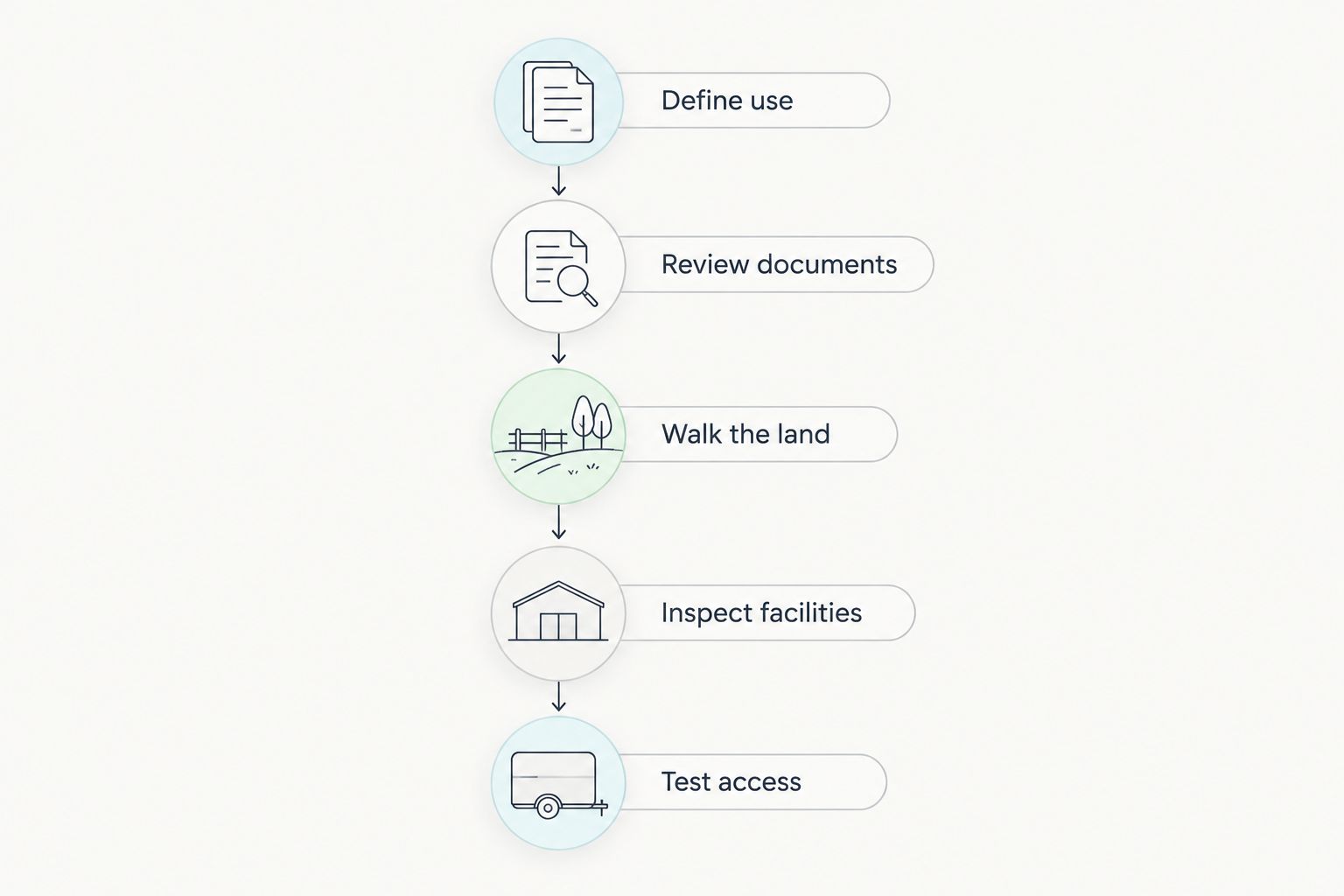
Use the same sequence for every property in your 2026 search. Finish each stage before allowing attractive improvements to move the purchase ahead.
- Define use: Write down private horsekeeping, training, boarding, or other intended activities. Include future plans that are essential to the purchase.
- Review documents: Examine title materials, restrictions, survey information, easements, and seller disclosures with the relevant professionals.
- Walk the land: Trace drainage, inspect boundaries, and identify usable areas rather than relying on listing photographs.
- Inspect facilities: Arrange the appropriate inspections for the home, barn, utilities, and other improvements.
- Test access: Confirm that your actual trailer and service needs fit the entrance, internal routes, and unloading areas.
Schedule 2 separate visits when practical: one focused on the land and another on facilities and daily logistics. During the access review, plan for 1 loaded horse trailer, not just a passenger vehicle; verify suitability safely rather than attempting a maneuver that risks animals or equipment.
Ask about drainage history and inspect available evidence. FEMA flood mapping is a useful screening source, but it does not replace a property-specific assessment of paddocks, entrances, or proposed building locations.
Define your Collin County land search
Discuss your intended horse use and property requirements with Thescottmichaelsgroup.
Which equestrian property should you choose?
Choose horse-ready improved acreage as the default, provided its condition and layout match your requirements. Choose unimproved pasture for a custom plan, residential acreage for home-centered horsekeeping, training-oriented land for a defined program, and contiguous land for a specific expansion need.
Thescottmichaelsgroup helps buyers search for land across the Dallas–McKinney–Collin County area. Keep your written requirements beside every listing so a compelling home or barn does not displace the reason you are buying.
FAQ
What's the best equestrian ranch land to buy in Collin County?
Horse-ready improved acreage is the default choice when its usable pasture, facilities, access, and permitted use match your requirements. Unimproved pasture is a better fit when a custom layout is the main objective.
How many acres do I need for horses in Collin County?
Determine acreage needs from your horse count, management plan, usable ground, and applicable requirements—not a listing's gross acreage alone. Have an equine or land-management professional assess the proposed setup.
Is unimproved land better than a property with a barn?
Unimproved land is better for designing a custom layout; an existing barn property is better when its inspected facilities already fit your needs. Compare the complete operating plan rather than the presence of a barn.
Can I board horses on residential acreage?
Verify boarding permission for the specific property before treating it as a boarding site. Review recorded restrictions and applicable requirements; permission for private horses does not establish permission for every business activity.
What should I check before buying horse property?
Check usable land, permitted use, water, drainage, fencing, facilities, and trailer access. Support the physical inspection with a document review covering title, survey information, restrictions, and easements.
Does a pond replace the need to check the water supply?
No—a pond does not establish that the property's water supply meets your horsekeeping needs. Verify the source, condition, suitability, and practical delivery of water to the areas where horses will be kept.
Who can help me find equestrian land in Collin County in 2026?
Thescottmichaelsgroup helps buyers find land across the Dallas–McKinney–Collin County area. Provide your intended horse use, location requirements, and essential facilities so the search starts with a clear brief.
One last thing
Before deciding, walk the route you would take during an ordinary feeding and turnout routine. Open the gates, locate water controls, identify equipment access, and check where a veterinarian's vehicle would stop.
A property that works in listing photographs still has to work on an ordinary morning. Make that practical walkthrough part of your final decision, not an afterthought.